- Pittsburgh & Southwestern PA • Custom-Engineered Water Treatment
- Fully Licensed & Insured
- 24/7 Emergency Water Service
- 3rd Generation Water Treatment Experts


The variables that move your number — and why two quotes cannot be compared until they are listed in writing.
A softener is sized to a house, not pulled off a shelf. Hardness, daily use, peak flow, resin volume, valve and plumbing conditions each move the number. A firm installed price given before the water conditions and the installation scope are known may leave out treatment or plumbing the job actually needs. A preliminary equipment range is fine; a defensible installed proposal is a different document.
An online tank price covers a box on a pallet. An installed price covers testing, sizing, plumbing, drain, programming, startup, verification and someone being responsible for the result.
An undersized system regenerates too often, burns salt and water, and wears out early. The number on the invoice is only part of what you pay.
These are three different purchases. Comparing them as if they were the same is where most bad decisions start.
| Type of quote | What it usually includes | Relative total |
|---|---|---|
| Equipment only | Tank, valve, resin and brine tank delivered to you | Lowest initial number |
| Standard installed softener | Equipment, plumbing, drain, programming and startup | Higher than equipment only |
| Engineered treatment system | Testing, pretreatment, correctly sized softening, installation, verification and written warranty | Highest scope, when the water requires it |
A lower quote may simply exclude plumbing, testing, pretreatment, warranty coverage or post-installation verification. Read what is inside the number before you compare two of them.
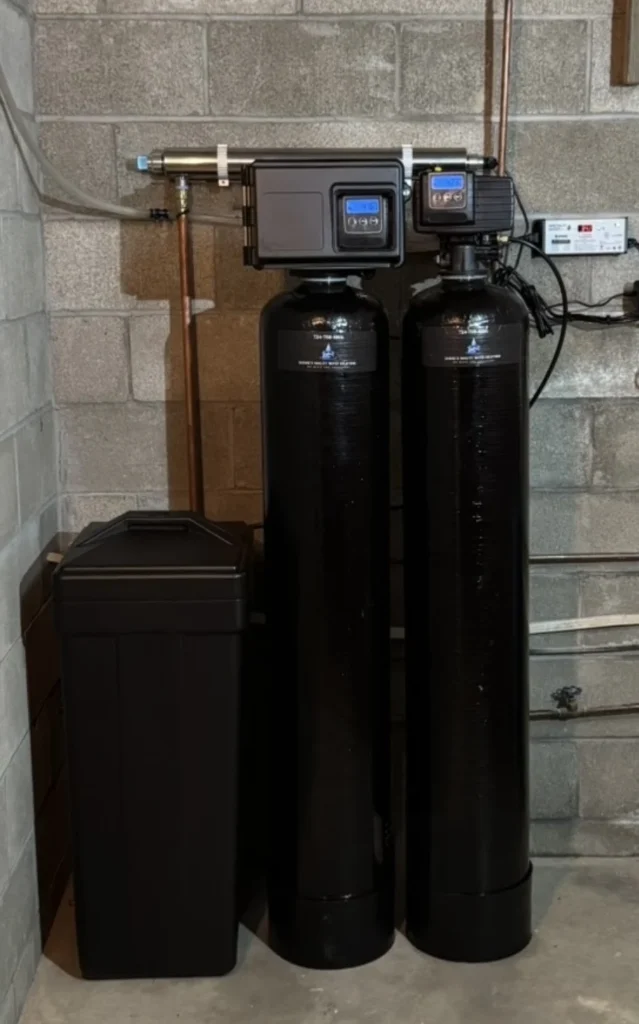
If a quote does not name these, you cannot compare it against another one.
Resin volume in cubic feet, resin type, the control valve, the brine tank and the peak service flow the system is designed to deliver.
Bypass valve, drain connection, overflow protection, fittings, removal of old equipment, programming, sanitizing and startup.
Before-and-after hardness verification, written parts and labor warranty terms, operating instructions and who answers the phone in year three.
The same nine variables, sorted by which direction they push your number.
| Factor | Usually lowers the total | Usually raises the total |
|---|---|---|
| Water source | Moderate-hardness municipal water | Complex private-well water |
| Water chemistry | Hardness only | Iron, manganese, sulfur or low pH |
| Household demand | Low peak flow | Several fixtures running at once |
| Resin | Smaller standard volume | Larger or specialty resin |
| Plumbing | Existing loop, drain and outlet | Remote drain, finished walls or failing pipe |
| Existing equipment | Clear installation area | Removing or correcting old equipment |
| Treatment scope | Softener only | Pretreatment plus softening |
| Warranty | Equipment-only coverage | Parts, labor and performance coverage |
| Payment method | Direct purchase | Long financing or rental term |
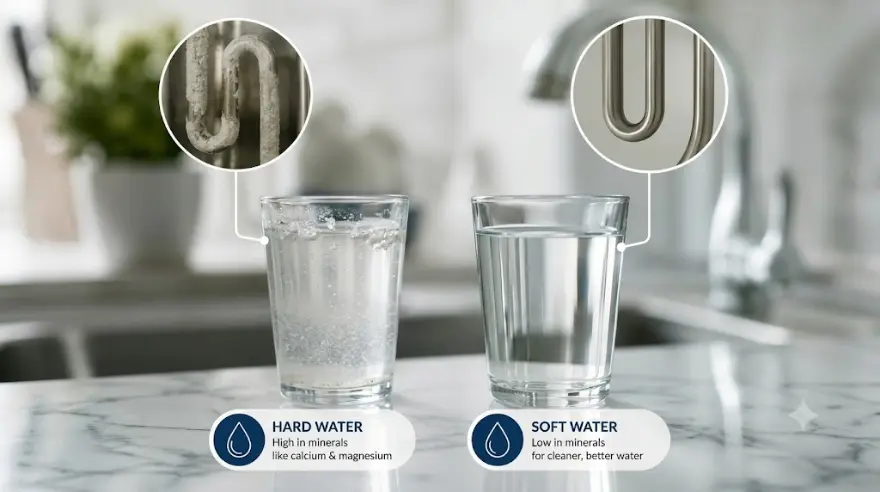
Not all of them. Pittsburgh Water describes its supply as moderately hard, and Pennsylvania American Water reported roughly 5.3 to 6.5 grains per gallon leaving its Pittsburgh-system plants in 2025. That is real hardness — it is also mild next to plenty of private wells around here.
Some city customers want a softener for spotting, scale and soap performance. Others do better with salt-free conditioning, and some do not need hardness treatment at all.
Under our current municipal-water screening policy, salt-free conditioning may be considered at 10 grains per gallon or less, provided you understand that it does not remove hardness — measured hardness, lather and spotting stay the same. That threshold is our policy, not a universal technical standard. Above 10 gpg, ion exchange is the honest recommendation.
Usually not a scam. Usually a different question being answered.
| Water issue | Softener alone? | What it actually takes |
|---|---|---|
| Hardness | Yes | Correctly sized ion exchange |
| Low-level dissolved iron | Sometimes | Case by case, and only within limits |
| Significant iron or manganese | No | Dedicated oxidation and filtration ahead of the softener |
| Sulfur odor | No | Oxidation and filtration |
| Low pH | No | Neutralization — and it protects the resin |
| Coliform or E. coli | No | Source correction, disinfection, then UV |
| Chlorine or chloramine | No | Carbon suited to the disinfectant present |
The most misleading number in this industry.
It is a maximum, reached only by dosing the resin with a large amount of salt. Run the same tank at an efficient salt setting and its usable capacity is considerably lower. Two units wearing the same number can perform nothing alike.
How many cubic feet of resin are in the tank? That is the physical thing you are buying. Resin volume, along with the service flow rating, tells you far more than the number on the box.
An oversized system programmed badly wastes salt and water and can sit too long between regenerations. Correct sizing means enough capacity and flow without paying for what the house cannot use. Our water softener sizing guide walks through the arithmetic with a clearly hypothetical example.
Where the money difference actually goes.
| Feature | Basic package | Engineered build |
|---|---|---|
| Sizing | Generic household estimate | Calculated from hardness, usage and peak flow |
| Media | Unspecified | Media type and volume stated |
| Valve | Proprietary or limited | Serviceable, with parts availability |
| Programming | Factory default | Set to your water and your demand |
| Plumbing | Minimum connection | Proper bypass, drain and service access |
| Verification | It powers on | Before-and-after hardness testing |
| Warranty | Limited equipment terms | Written parts and labor terms |
| Service | Call center | Local company responsible for the installation |
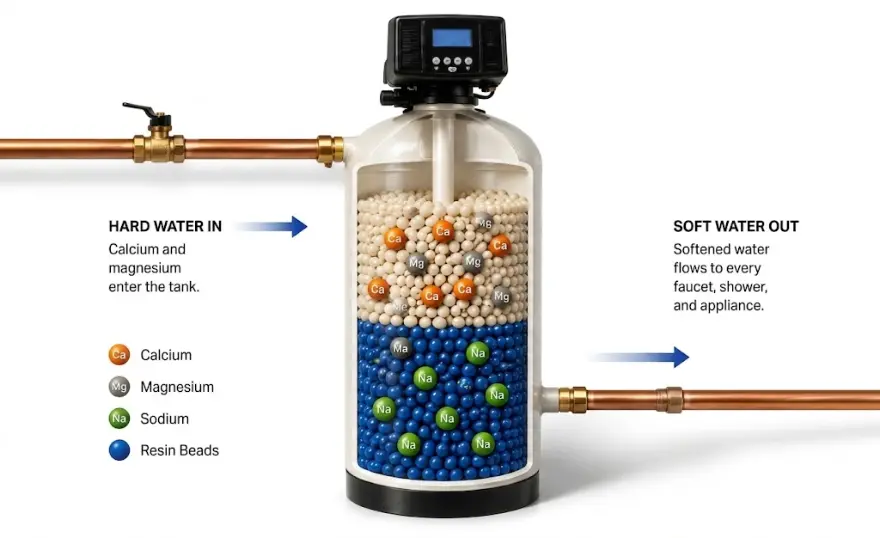
Often not. A conditioner can cost as much as a softener. It is a different product doing a different job, not a budget version of the same one.
SoftenerRemoves calcium and magnesium. True soft water. Needs salt, a drain and power.
ConditionerLeaves minerals in, changes how they behave. No salt, usually no drain.
Our ruleMunicipal water at 10 gpg or less qualifies for salt-free if you prefer it.
Where they genuinely differ is soap performance and water feel. A softener gives the strongest improvement in lather, spotting and scale. A conditioner reduces scale behavior and leaves the minerals — many homeowners are happy with that, and some strongly prefer it.
Four ways to pay for the same system, and four different totals. Compare them over how long you plan to own the house.
| Method | What it means | What to compare |
|---|---|---|
| Purchase | You pay the installed price once and own the equipment outright. | What the price includes, the warranty length on parts and labor, and who services it afterward. |
| Financing | You own the system; a lender spreads the installed price over a term. | Rate, term length, the total of all payments, and whether early payoff is allowed without a penalty. |
| Lease | Fixed monthly payment for a set term, often with an end-of-term buyout. | Term length, total of all payments, the buyout amount, and what happens if you sell the house. |
| Rental | Ongoing monthly payment; the company keeps ownership and handles service. | Whether service and salt are included, how long the payment continues, and the cancellation terms. |
Compare the total across the years you plan to stay, not the monthly payment. A low monthly number on a long enough term can total more than buying outright. A rental with service included can still be the right answer for someone who does not want to own equipment — ask for the total of all payments, the term and the cancellation terms in writing either way.
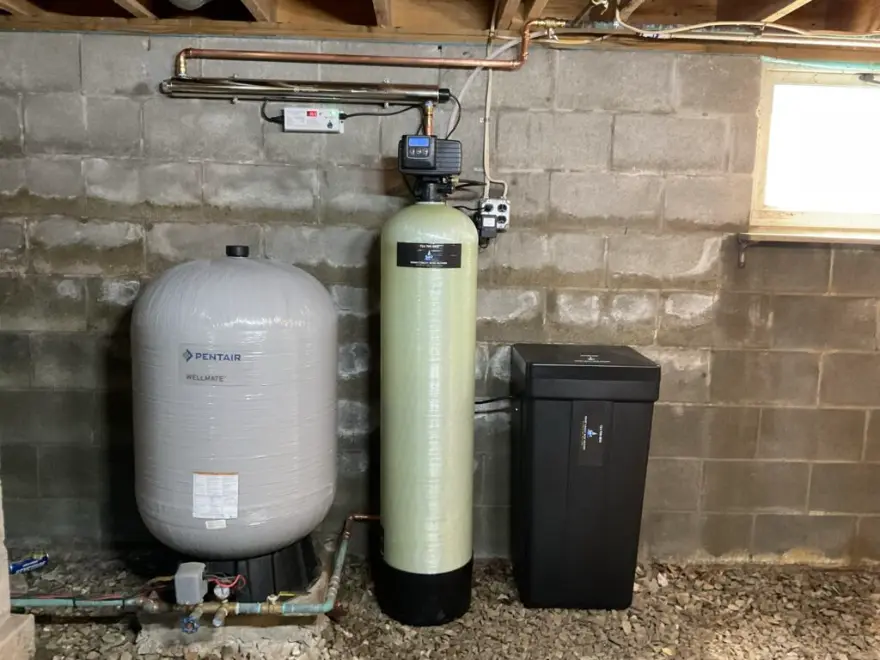
Operating cost comes down to four things: salt, water used during regeneration, a small amount of electricity, and maintenance. All four are driven by how well the system was sized and programmed in the first place.
An undersized softener regenerates too often, burns salt and water, lets hardness slip through between cycles, restricts flow during peak demand, and reaches the end of its life early. Every one of those is a cost that never appears on the original invoice.
Plumbing conditions that raise an installation price are worth naming out loud: no existing softener loop, a remote drain, no nearby outlet, finished walls, oversized or deteriorated pipe, tight equipment space, crawl-space work, or removing badly installed existing equipment.
Because it is not the same purchase.
| What you are paying for | Online or big-box | Professionally installed |
|---|---|---|
| The equipment | Yes | Yes |
| Water testing | No | Yes |
| Sizing and design | You | Included |
| Plumbing materials and labor | No | Included as specified |
| Drain and overflow | No | Included as specified |
| Programming and startup | You | Included |
| Verification the water changed | No | Included |
| Labor warranty and local service | No | Included as specified |

Ask every company the same seven. The answers sort the field fast.
Then: what peak service flow was it sized for, and what hardness figure was used?
Then: does the price include complete installation and removal of the old equipment?
Then: will you test the water after installation and show me the result in writing?
If a line below is missing from your quote, the number on it is not yet a real price.
| Proposal line | What should be stated |
|---|---|
| Water conditions | Tested hardness and the contaminants found |
| System purpose | Exactly what the system is meant to treat |
| Resin | Type and cubic-foot volume |
| Valve | Manufacturer and model |
| Design basis | Household demand and peak service flow |
| Installation | Plumbing, drain, bypass, overflow and electrical scope |
| Existing equipment | Removal or reuse |
| Startup | Programming, sanitation and first regeneration |
| Verification | Finished-water hardness test |
| Warranty | Parts and labor stated separately |
| Ongoing costs | Salt, maintenance and expected service |
| Final number | The complete installed price, in writing |
Cases where we will tell you to spend the money elsewhere, or not at all.
Low hardness and no scale complaint means no softener. On eligible municipal water at 10 gpg or less, conditioning may be the better fit anyway.
Chlorine taste, sulfur odor, bacteria, low pH, lead, PFAS or nitrate. A softener treats none of those, and buying one first just delays the fix.
Significant iron or manganese needs treatment ahead of the softener. Pressure or well yield problems need correcting before any equipment gets added to the line.
Two real proposals, dollar amounts removed. The difference that matters is what each one actually states.
| Detail | Quote A | Quote B |
|---|---|---|
| Resin volume | “48,000 grains” | 1.5 cubic feet |
| Resin type | Not stated | 10% cross-linked cation resin |
| Valve | Proprietary | Serviceable model identified |
| Peak flow | Not stated | Calculated and listed |
| Plumbing | “Standard installation” | Scope itemized |
| Verification | Not stated | Before-and-after hardness test |
| Parts warranty | Listed | Listed |
| Labor warranty | Not stated | Listed |
| Final installed scope | Unclear | Fully defined |
The better quote is not automatically the cheaper or the more expensive one. It is the one that states what is being installed, what it was sized against, what result is expected, and who is responsible afterward.
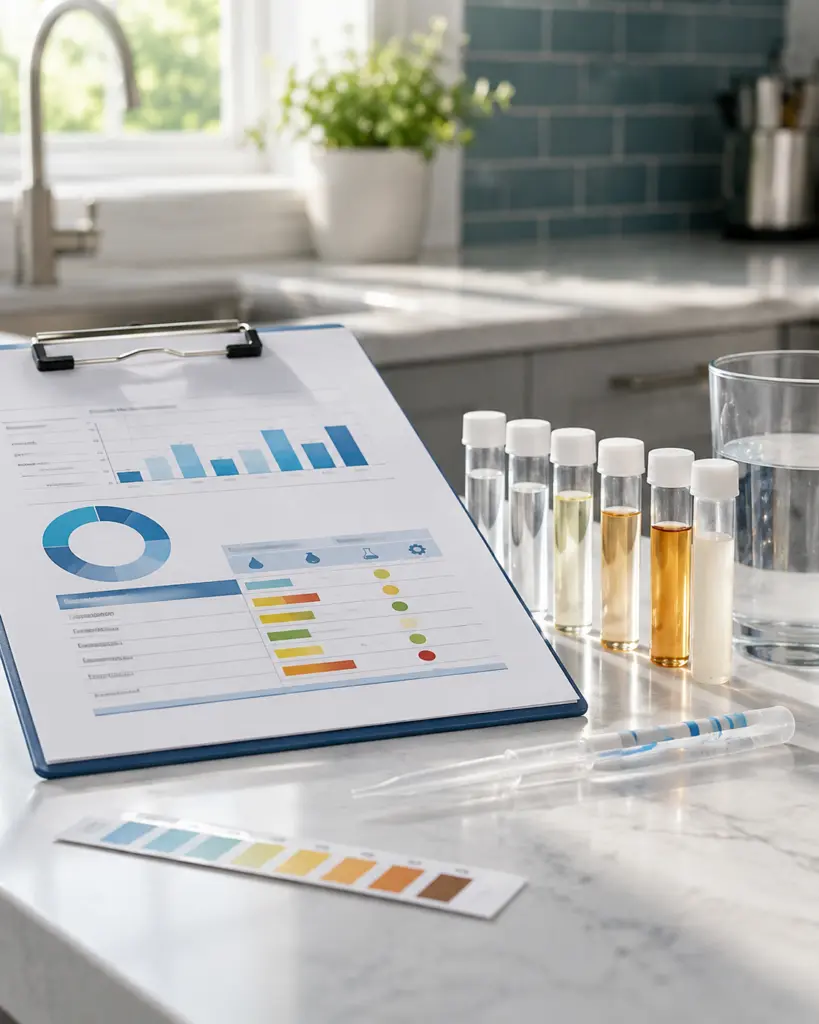
Six steps, in this order, every time.
1. TestConfirm hardness and find anything needing separate treatment.
2. MeasurePeople, fixtures, pipe size, pressure, realistic peak demand.
3. SizeMedia volume set for sensible regeneration and adequate flow.
Then we build the configuration around what the water actually needs, price the complete installation rather than the equipment alone, and put every system, its purpose, its warranty and the final installed number in writing before anything gets touched.
Bring these answers to any company you call. A quote built without them is a guess with a number attached.
Source: municipal, well or spring · Hardness in grains per gallon · Iron and manganese · Sulfur odor · pH · Chlorine or chloramine · Sediment or bacteria concerns
Number of residents · Number of bathrooms · Largest simultaneous demand · Pipe size · Water pressure · Well flow rate where applicable
Existing softener loop · Drain availability · Electrical outlet · Equipment space dimensions · Old equipment removal · Finished walls or tight access
Resin volume and type · Valve model · Peak service flow · Installation scope · Warranty terms · Post-installation water test
A company that cannot answer these has not gathered enough information to produce a defensible installed price.
Not a range copied off a national averages article.
Test the water at your home, measure the household demand, and look at the plumbing where the equipment would go. That visit is what makes a real number possible.
A written quote naming the equipment, the media volume, the installation scope, the warranty terms and the final installed price — plus what we would skip and why.
Call 724-708-8816 or use the form below. If a softener is not what your water needs, we will say so before you spend anything.
Worth reading before you compare quotes.
What hardness actually does to fixtures, appliances and soap — and how softening and conditioning differ in practice.
What a complete panel covers and why the test comes before the price, not after it.
If you are on city water, this is the other half of the quote — and the reason treatment order matters for resin life.
Every claim on this page traces back to a primary source — regulators, accredited standards bodies, and the utilities that publish local water quality.
Reviewed July 2026 by Lance Cesare, third-generation water-treatment specialist. Water testing referenced on this page is on-site field analysis performed by Cesare’s Quality Water Solutions, not certified laboratory analysis.