- Pittsburgh & Southwestern PA • Custom-Engineered Water Treatment
- Fully Licensed & Insured
- 24/7 Emergency Water Service
- 3rd Generation Water Treatment Experts


Two different metals, one shared cause: the plumbing between the main and your glass.
Not the source water and not the treatment plant. Lead comes from service lines, solder, galvanized pipe and brass fixtures. Copper comes from the copper pipe itself when the water is aggressive enough to attack it.
A Consumer Confidence Report describes a public system of mains and sample sites. It cannot describe your service line, your solder joints or your kitchen faucet.
Find out what your plumbing is made of, then test the actual tap through an accredited laboratory. Lead is invisible, tasteless and odorless — there is no shortcut around a lab result.
Both are picked up on the way to the tap, which is why two houses on the same street can test very differently.
The pipe connecting the main to the building. Ownership is split — the utility owns main to curb, the property owner owns curb to house — so a “replaced” line is not always replaced end to end.
Lead solder in copper joints, galvanized pipe that once fed off a lead line, and faucets or valves installed before the stricter lead-free definition took effect in January 2014.
Acidity, low alkalinity, temperature, pipe condition and how long water sits all decide how much metal transfers. Street work, meter work or a line replacement can also shake loose particles that had settled in the plumbing.
Calm, specific steps — in this order.
Use appropriately flushed cold water, or a filter carrying a verified lead-reduction claim, for drinking, cooking and infant formula. Lead dissolves more easily in hot water, so never use the hot tap for consumption.
Boiling does not remove lead. As water evaporates it can leave more behind. Clean your faucet aerators too, since particles collect there.
Contact your water supplier and follow the laboratory’s instructions. If a child or pregnant person may have been exposed, ask a physician about blood-lead testing — a water test measures the water, not the person.
The most misunderstood numbers in drinking water.
A system-level trigger for utility response, calculated from a set of sampled taps — not a per-faucet safety promise.
EPA’s Lead and Copper Rule Improvements lower the action level and require systems to identify and replace lead pipes within ten years.
EPA’s non-enforceable goal for lead is zero, and public health bodies hold that there is no safe level of lead exposure.
Pittsburgh Water states there is no detectable lead in its water when it leaves the treatment plant and travels through the mains. Lead enters through service lines and household plumbing, which is exactly why the utility added orthophosphate corrosion control in spring 2019 and started replacing lines.
By May 2026 it had passed 15,000 public-side and 11,500 private-side lead service line replacements, with roughly 83% of residential customers determined to be lead-free and a goal of finishing residential work by the end of 2027. A July 2026 funding announcement put them within about 7,000 lines of that finish.
That is real progress and it deserves to be said plainly. It also does not describe your house. Service line material, interior solder, fixtures and how long water sits differ building to building.
Recent published tap sampling from Southwestern Pennsylvania suppliers.
| System | 90th percentile lead | 90th percentile copper | What it shows |
|---|---|---|---|
| PA American Water — Pittsburgh | 4 ppb | 0.185 ppm | Compliant overall, and one of the 50 sampled sites was above the lead action level |
| MAWC — Indian Creek | Below 2.5 ppb | 0.069 ppm | 2025 triennial tap sampling; one Scottdale tap measured 7.8 ppb |
| MAWC — G.R. Sweeney | 3.5 ppb | 0.166 ppm | Compliant — while one Apollo tap measured 74 ppb, roughly five times the action level |
| MAWC — McKeesport | Below 2.5 ppb | 0.121 ppm | One tap measured 7.3 ppb |
| MAWC — Furnace Run (Ligonier) | Below 2.5 ppb | 0.17 ppm | Below action levels across the sample set |
Free, and worth doing before you spend a dollar on equipment.
Every public water system is required to maintain a service line inventory covering lead, galvanized-requiring-replacement and unknown lines. Pittsburgh Water publishes an address-level lead map; PA American Water and MAWC maintain their own inventories.
A lead line is dull gray and soft. Scratch it gently with a key — not a knife, which can puncture it — and lead turns bright silver. Look for a solder “bulb” where the line meets the plumbing.
An inventory tells you about one pipe. It says nothing about solder, brass fixtures or a faucet installed in 2009, and it is not a water result.
They travel together and they behave nothing alike.
| Factor | Lead | Copper |
|---|---|---|
| Can you see it? | No | Sometimes — blue-green staining |
| Can you taste it? | No reliable taste | Metallic at higher concentrations |
| Main sources | Service lines, solder, brass, fixtures | Copper pipe and brass components |
| Main concern | Toxic exposure, greatest risk to children and pregnancy | Gastrointestinal effects at high intake; plumbing damage |
| Regulatory number | 15 ppb action level, health goal of zero | 1.3 ppm action level |
| Point-of-use treatment | Verified lead-reduction filter or RO | RO carrying a copper-reduction claim |
| Whole-house fix | Source replacement plus corrosion control | Correct the corrosive water chemistry |
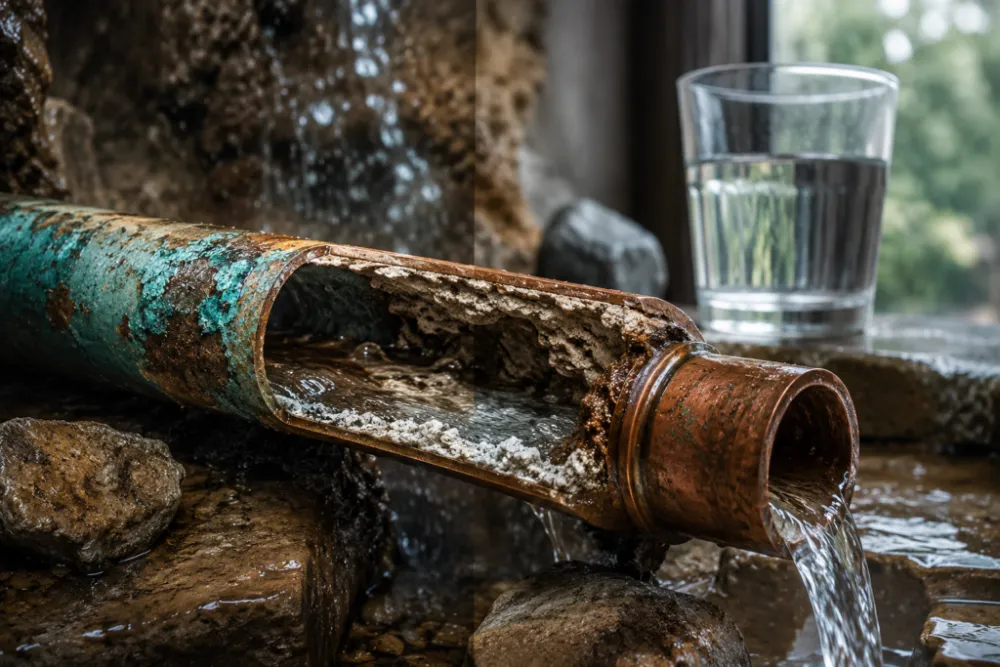
Blue or green staining means water is dissolving copper out of your pipes and carrying it to the fixture. Low pH, low alkalinity, hot water, long stagnation and new copper plumbing all push it along.
The other warning signs travel with it: a metallic taste, green crust around fittings and soldered joints, and pinhole leaks in supply lines. Pinholes deserve a plumbing evaluation, not a filter — corrosion that aggressive is a structural problem.
On a private well this usually traces straight back to chemistry. NSF puts it plainly: when pH falls below 7.0, water turns acidic and leaches lead and copper from pipes and fixtures, and an acid-neutralizing system is generally how that gets corrected.
Four conditions decide how much transfers from the pipe to the glass.
Low pH is aggressive toward metal. Low alkalinity means there is little buffering, so the water stays aggressive even when a single pH reading looks only mildly low.
The longer water sits against plumbing, the more it picks up — and hot water pulls more than cold. It is why first-draw morning water is the worst case and why formula gets made with cold.
Protective scale inside old pipe holds metal in place. Street work, meter work or a partial line replacement can fracture it and release particles for a while afterward.
The sample plan depends on the question you are asking.
The testing sequence
Utility inventory, service line material on both sides of the curb, interior pipe, solder, fixture age and any recent work.
First-draw after stagnation, a flushed sample, and sequential bottles when a service line needs profiling.
Pennsylvania requires accreditation for drinking water analysis. Lead and copper are lab work — no strip, meter or handheld device substitutes.
pH, alkalinity, hardness, TDS and iron alongside the metals, so the result can be explained rather than just reported.
What the numbers mean, what is likely contributing, and what should happen next — on paper.
Retest treated water, and retest again after plumbing work or a service line replacement.
First draw versus flushed
A first-draw sample captures water that sat against your faucet and interior plumbing. A flushed sample shows what arrives after the water has moved through some or all of it. Comparing them is diagnostic. High first draw with a low flushed result points toward the faucet or nearby plumbing. Both high points further upstream, toward the service line or broader corrosion. Wide swings between samples suggest particulate release rather than steady dissolution. None of these patterns prove a source on their own — they tell us where to look next.
No, and it was never designed to. A Consumer Confidence Report describes the public system: the source, the treatment, the corrosion control and regulatory monitoring at a set of selected sample sites.
Lead and copper compliance is calculated from a 90th percentile across those sites. Your building has its own service line, its own solder, its own fixtures and its own usage pattern — none of which are in that calculation.
Look again at the Sweeney number above. A 3.5 ppb 90th percentile and a 74 ppb tap in the same system, in the same year. The report was accurate. So was the tap.
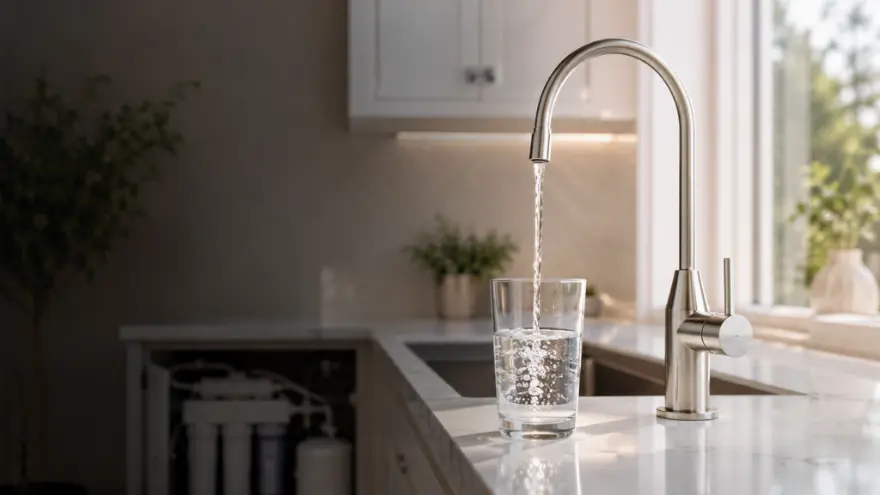
In this order — because a filter on top of an uncorrected source is a rental agreement, not a fix.
Replace the lead service line, lead-containing plumbing or the offending fixture where it is feasible. Utility replacement and reimbursement programs exist — use them.
If low pH is dissolving your plumbing, neutralization addresses the cause throughout the house instead of guarding one faucet.
A plumbed-in filter or reverse osmosis system carrying a verified lead-reduction claim — NSF/ANSI 53 for filters, NSF/ANSI 58 for RO — then retest to confirm.
The claims that get people into trouble.
| Equipment | Treats lead or copper? | What it was built for |
|---|---|---|
| Whole-house carbon | Do not assume it | Chlorine, chloramine, taste and odor |
| Water softener | No | Calcium and magnesium hardness |
| Sediment filter | Particles only, unreliably | Visible particulate |
| TDS meter | Cannot even detect it | General dissolved mineral content |
| RO certified for TDS only | Not without the specific claim | Dissolved solids reduction |
| Boiling | No — can concentrate lead | Microbial concerns during an advisory |
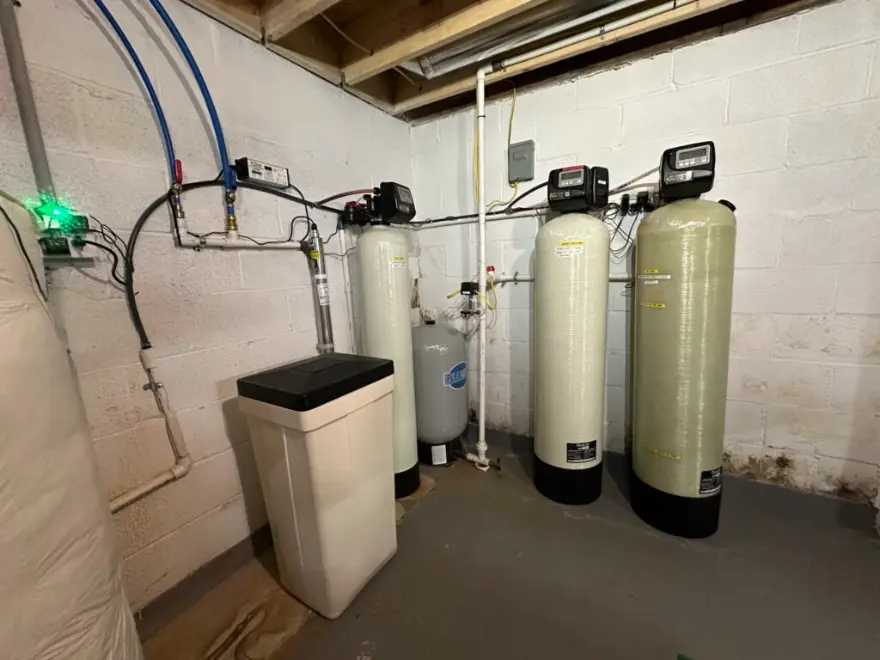
Five ways this goes, depending entirely on what the laboratory finds.
Lab evaluationPlumbing review, sample planning, accredited analysis, written interpretation.
Drinking water packagePoint-of-use treatment carrying a verified lead-reduction claim, then verification.
pH correctionFor wells where acidic water is dissolving the plumbing house-wide.
Plus reverse osmosis where the model carries the applicable claim, and a source-correction plan when the honest answer is that a pipe or fixture needs to go rather than be filtered around.
Where a water test does real work.
Standalone laboratory testing for buyers, sellers and agents — no equipment purchase involved. Worth doing on older homes, unknown service line material, recently renovated plumbing, rentals, and any house where formula will be made.
Identifying the visible pipe material is not a concentration. A home inspector reading “copper” off a basement wall has told you nothing about the solder joining it.
Every fountain, kitchen tap and bottle filler has its own materials and stagnation pattern. PA DEP encourages fixture-level testing for exactly that reason — one lobby result is not a building result.
What keeps a certified system performing, and what actually drives the price.
| Item | Why it matters |
|---|---|
| Cartridge and membrane replacement | A filter past its rated capacity should not be assumed to still meet its certified performance |
| Post-installation lab testing | The only proof the treated water is where you want it |
| Service after plumbing work | Line replacement and street work can release particles for a period afterward |
| Number and type of samples | First-draw, flushed and sequential bottles each add analysis and turnaround |
| Which correction is needed | A certified filter, RO, pH correction and plumbing replacement are very different scopes |
| Service line ownership | Utility programs and reimbursement may cover part of a replacement |
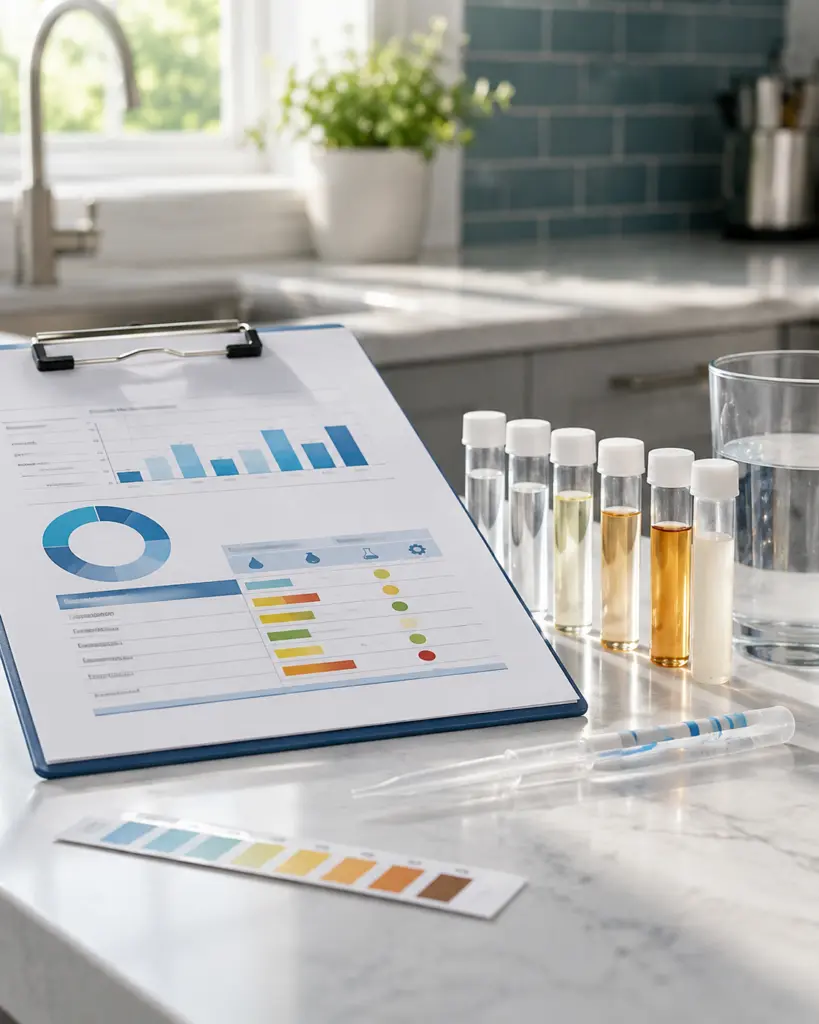
A compliant utility does not tell you what is coming out of your tap. A 90th-percentile number describes a sample of homes, not your service line, your solder or your fixtures. This home wanted its own answer, so we tested at the tap — and sent the lead question to an accredited laboratory rather than reading it off a field kit.
Cranberry Township Municipal Authority · Reports CWS-PA-070626-931 and CWS-PA-072826-931 · Published with the customer’s permission.
The three that connect most directly to lead and copper.
The most common root cause of copper corrosion and metal leaching on a private well. Start here if you are seeing blue-green stains.
Point-of-use treatment, what claims to verify before buying, and why pretreatment comes first.
What a complete panel covers, how to read results, and why property-level testing is the step that decides everything else.
Every claim on this page traces back to a primary source — regulators, accredited standards bodies and the utilities that publish local water quality.
Reviewed July 2026 by Lance Cesare, third-generation water-treatment specialist. Water testing referenced on this page is on-site field analysis performed by Cesare’s Quality Water Solutions. Lead, PFAS, nitrate, disinfection by-product and bacteria results require an accredited laboratory and are not published from field methods.