
Iron & Manganese Removal for Well Water in Southwestern Pennsylvania
Orange rings in the toilet, black streaks in the sink, a metallic taste you can’t unnotice — that’s iron and manganese, and scrubbing will never fix it. Treating the water will.
Most companies install equipment. Cesare’s engineers water.

Do You Have Iron or Manganese in Your Water?
If you’re scrubbing any of these away every week, the minerals are in the water itself — and a free water test tells you exactly how much.
Orange Rings in Toilets & Tubs
Rust-colored stains that come back days after you scrub them away.
Black Stains or Specks
Dark streaks around drains and dark particles in the water — the signature of manganese.
Metallic-Tasting Water
Iron you can taste in every glass, and in coffee and cooking too.
Brown Water After Rain
Discolored water when the well works hardest — metals and sediment stirred into the supply by storms or heavy use.
Stained Laundry
Whites that come out dingy, orange-tinged or gray no matter the detergent.
Slime in the Toilet Tank
Reddish-brown slime in the tank is usually iron bacteria — a different fix than dissolved iron.
Iron or Manganese? What the Stains Are Telling You
Both are dissolved metals common in Southwestern PA well water, and they behave differently. Iron shows up orange and metallic; manganese shows up black and stubborn — and even small amounts of either can stain. Because they’re dissolved, no amount of scrubbing or filter-pitcher use touches them: the fix is whole-house treatment sized to what a test actually measures.
| The Culprit | What You See | How Cesare’s Treats It |
|---|---|---|
| Iron | Orange and rust-colored stains in toilets, tubs and sinks; metallic taste; orange-tinged laundry | Cesare’s iron-removal treatment strips dissolved iron before it ever reaches your fixtures |
| Manganese | Black or dark-brown stains around drains, dark specks in water, gray-dingy laundry | Treated in the same custom-engineered system — sized from your measured levels, not a guess |
| Iron bacteria | Reddish-brown slime in toilet tanks; recurring odor and staining | A different fix than dissolved iron — testing tells us which one your well actually has |
Not sure which one you’ve got? The stains overlap more than people expect — and on tough wells a lab test settles the question. It starts with Cesare’s free in-home water test.
How Do You Remove Iron & Manganese From Well Water?
Iron and manganese are usually removed by oxidizing the dissolved metals and then filtering the oxidized particles out of the water — whole-house, at the point of entry. The right treatment depends on how much iron and manganese you have, whether the iron is dissolved or already oxidized, your pH, sulfur, hardness, whether iron bacteria is involved, and the flow your well can deliver. Low levels of dissolved iron can sometimes be handled by softening; moderate or high levels need dedicated oxidation and filtration. Testing determines the treatment — never the other way around.
The iron number alone isn’t enough — here’s what we measure:
| We Measure | Why It Matters |
|---|---|
| Iron concentration | Determines the iron load the system has to handle |
| Iron type | Dissolved iron and already-oxidized iron behave differently in treatment |
| Manganese | Often the more demanding condition — it dictates parts of the design |
| pH | Low pH keeps metals dissolved and undermines ordinary filters |
| Hydrogen sulfide | Sulfur odor is often treated in the same build |
| Hardness | Decides whether softening belongs in the treatment train |
| Iron bacteria | A different problem than dissolved iron, needing a different fix |
| Well flow rate | Sizes the equipment to what your well can actually deliver |
For reference, iron stains at just 0.3 mg/L and manganese at 0.05 mg/L — the EPA’s secondary standards. But those aren’t sizing numbers: two homes with the same iron level can need different systems if their manganese, pH, sulfur, iron type or well flow differ. That’s why Cesare’s builds from the full analysis.
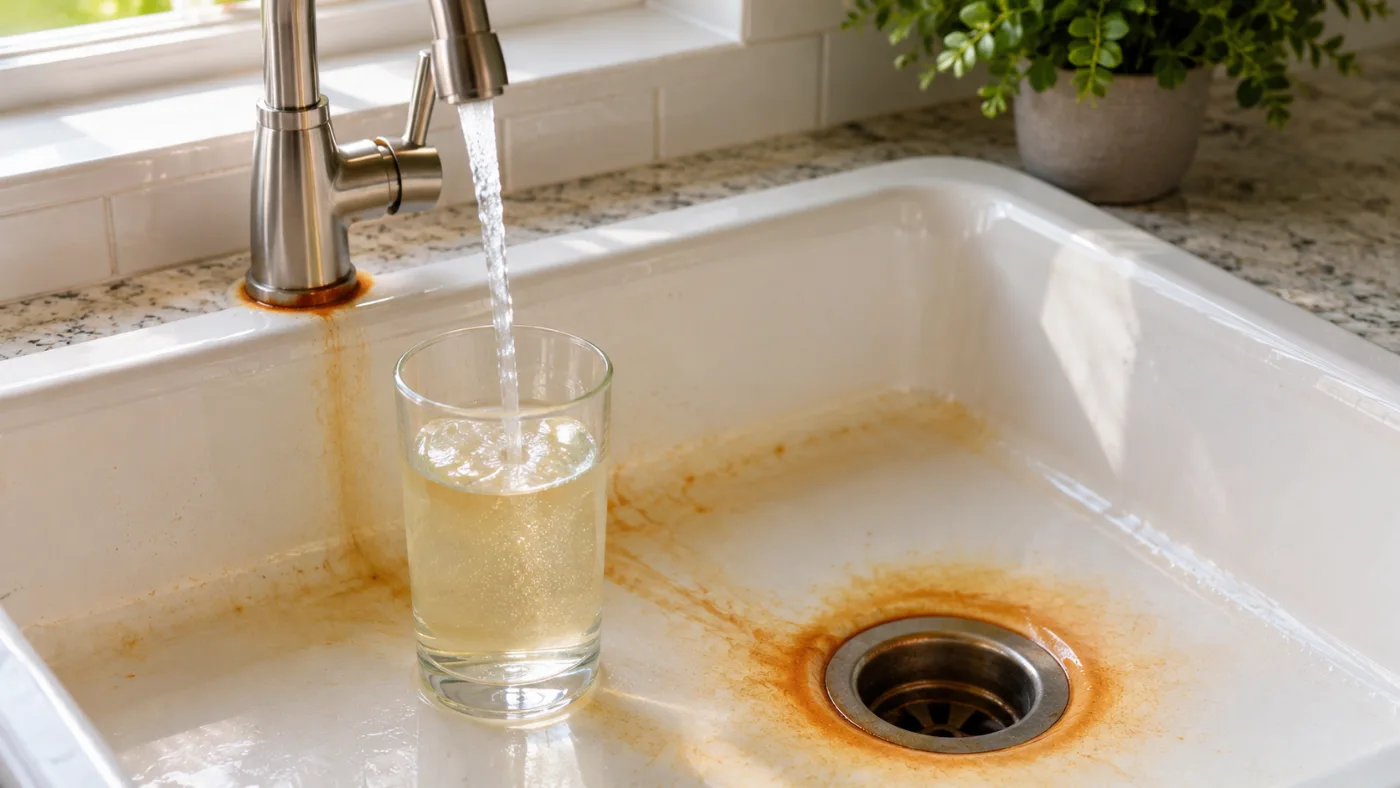
Iron: The Orange Stains
- Dissolved iron rides in clear, then oxidizes into orange stains on everything water touches.
- Cesare’s iron-removal treatment strips it out at the point of entry — whole-house, before the fixtures.
- Sized from your measured iron level, pH and flow — not a one-size cartridge off a shelf.
- Ends the orange rings, the metallic taste and the stained laundry in one build.
Manganese: The Black Stains
- Shows up as black or dark-brown staining around drains and fixtures — even at levels you can’t taste.
- Harder to remove than iron — getting it right depends on measured levels and water chemistry.
- Cesare’s treats iron and manganese together in one custom-engineered whole-house system.
- After install we re-test, so you see the levels drop — not just cleaner-looking sinks.
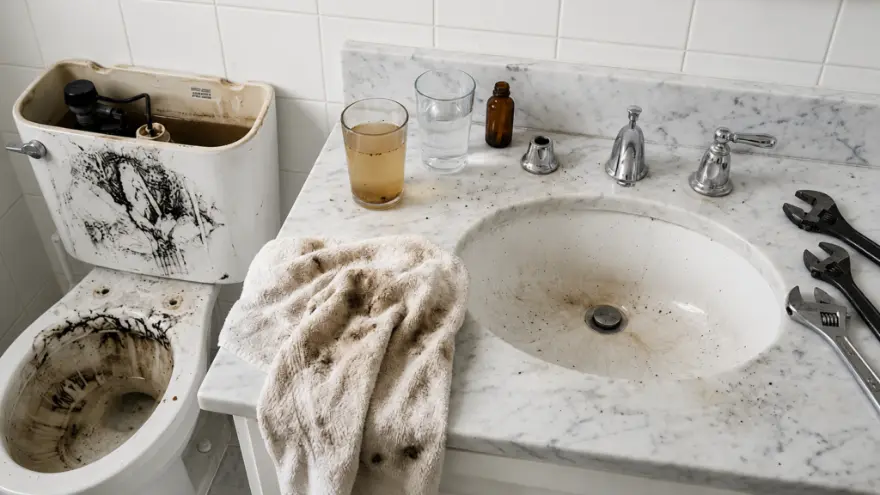
Iron and manganese rarely travel alone — sulfur odor, low pH and hardness often ride along in the same well. Cesare’s tests for all of it and builds one system that handles what’s actually there.
How Cesare’s Ends the Staining for Good
1. Free In-Home Water Test
We measure iron, manganese, pH, hardness and more at your tap — the stains tell part of the story, the numbers tell the rest.
2. Custom System Design
A whole-house treatment build with Custom-Designed media, sized from your measured levels, well flow and plumbing — not a package chart.
3. Professional Installation
Plumbed, programmed and started up by the people who designed it. Most single-system installs are done in a day.
4. Verify & Support
We re-test the finished water so you see the before-and-after numbers — and we stay local for service afterward.

Staining is usually only part of the picture. Wells with iron often carry sulfur odor, hardness or low pH too. If testing finds them, we’ll show you — and one custom build can treat all of it, from softening to whole-house filtration. The test tells us what your well actually needs.
A Pittsburgh Well Owner on Ending Orange Stains
A Pittsburgh family on a private well kept finding orange stains in their sinks that came back no matter how often they cleaned. Here is what they wrote after Cesare’s tested their water and installed a treatment system.
“We’re in Pittsburgh and had orange stains in our sinks that kept coming back no matter how much we cleaned them. Cesare’s Quality Water Solutions tested our well water and explained what was going on. They answered our questions and showed us how to take care of the equipment after installing it. It’s been about two months now and no new stains.”
Josh, Pittsburgh, PA · Read our Google reviews
What We Check When Iron Is Staining Your Fixtures
Educational overview · Not a single customer result
Orange stains and black specks can come from more than one cause, so the fix starts with a test at your tap, not a guess. This is what the visit covers.
Your in-home water analysis is free. If your water needs certified laboratory testing, such as a bacteria panel, that lab work is separate and paid, and we tell you before any sample is sent. The full write-up lives in our iron guide.
What Does Iron & Manganese Removal Cost in Southwestern PA?
Every quote starts with a free water test — so you pay for the system your well actually needs, not a one-size package price.
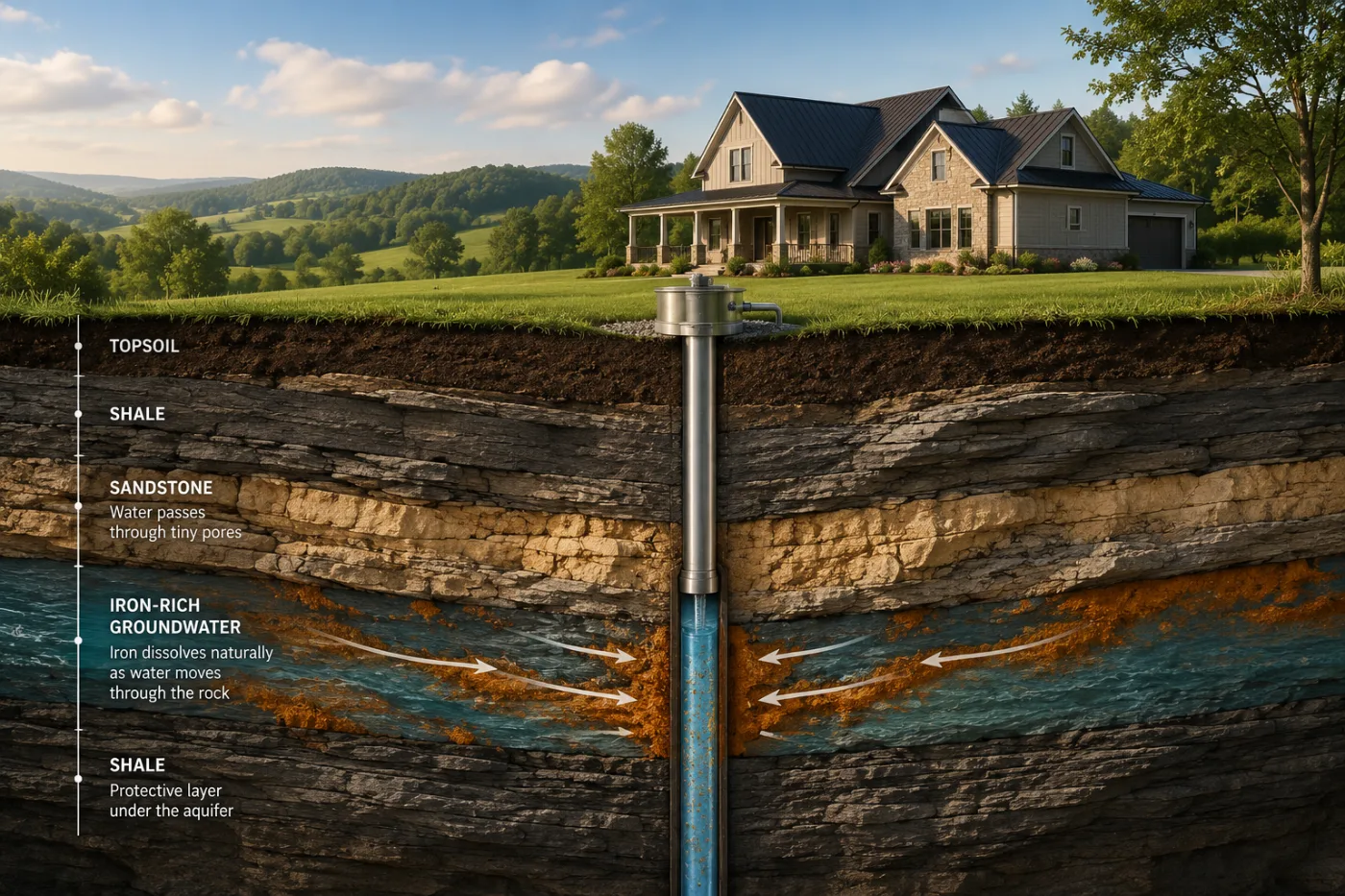
Installed cost comes down to three things:
That’s why Cesare’s tests first — so the quote reflects the system your well actually needs. Straightforward pricing comes after testing, before any work begins.
Where We Fix Iron & Manganese Problems
Cesare’s installs and services whole-house iron and manganese treatment across Pittsburgh and all thirteen Southwestern Pennsylvania counties.
Allegheny / Pittsburgh Westmoreland County Butler County Somerset County Washington County Beaver County Mercer County Lawrence County Indiana County Armstrong County Fayette County Cambria County Greene County
Westmoreland County — our home base: Murrysville, Export, Greensburg and Latrobe. On well water across Washington, Greene, Fayette and Somerset counties, orange and black staining is one of the most common calls we get — and Butler and Beaver county wells see plenty of it too. Wherever the well is, the fix starts with testing it.
The regional data backs it up: in our 2026 Southwestern PA Water Quality Report, manganese exceeded the 0.05 mg/L secondary standard in 50% of tested samples in Indiana and Somerset counties, 41.2% in Lawrence, 37.5% in Armstrong and 29.8% in Beaver. Those are voluntary lab submissions — not a census of every well — but they show why staining is one of the region’s most common water calls. What’s in your well takes a test.
Why Homeowners Call Us After Other Systems Fail.
Google Rating
5.0
We originally went with Specialty Water because Google showed them at the top. Within three years we had to replace the entire system. We've now been with Cesare's for three years and our water still tastes better than bottled water. Cesare's actually tested our water and built a system specifically for it instead of a one-size-fits-all setup. We wish we'd started with Cesare's.
— Jesse Steel
Fayette County
I started losing hope after three different water treatment companies couldn't fix my water. Lance and Monica came out that night, tested my water, and took a sample for a third-party lab. He made sure I was getting the right system for my water. Install went great and now my water is better than bottled. Trust Lance — he won't let you down.
— moonlight Paige
Greensburg, PA • Boswell, PA
Other systems would only soften the water — to remove chlorine they required an additional unit. Cesare's custom build filtered out the chlorine from my township supply with the same unit that softens the water. Very pleased to have soft water and no chlorine. After installation they confirmed it by testing the water.
— Tony Martincic
Westmoreland County, PA
We originally went with Specialty Water because Google showed them at the top. Within three years we had to replace the entire system. We've now been with Cesare's for three years and our water still tastes better than bottled water. Cesare's actually tested our water and built a system specifically for it instead of a one-size-fits-all setup. We wish we'd started with Cesare's.
— Jesse Steel
Fayette County
I started losing hope after three different water treatment companies couldn't fix my water. Lance and Monica came out that night, tested my water, and took a sample for a third-party lab. He made sure I was getting the right system for my water. Install went great and now my water is better than bottled. Trust Lance — he won't let you down.
— moonlight Paige
Greensburg, PA • Boswell, PA
Other systems would only soften the water — to remove chlorine they required an additional unit. Cesare's custom build filtered out the chlorine from my township supply with the same unit that softens the water. Very pleased to have soft water and no chlorine. After installation they confirmed it by testing the water.
— Tony Martincic
Westmoreland County, PA
We originally went with Specialty Water because Google showed them at the top. Within three years we had to replace the entire system. We've now been with Cesare's for three years and our water still tastes better than bottled water. Cesare's actually tested our water and built a system specifically for it instead of a one-size-fits-all setup. We wish we'd started with Cesare's.
— Jesse Steel
Fayette County
I started losing hope after three different water treatment companies couldn't fix my water. Lance and Monica came out that night, tested my water, and took a sample for a third-party lab. He made sure I was getting the right system for my water. Install went great and now my water is better than bottled. Trust Lance — he won't let you down.
— moonlight Paige
Greensburg, PA • Boswell, PA
Other systems would only soften the water — to remove chlorine they required an additional unit. Cesare's custom build filtered out the chlorine from my township supply with the same unit that softens the water. Very pleased to have soft water and no chlorine. After installation they confirmed it by testing the water.
— Tony Martincic
Westmoreland County, PA
Already own an iron filter? Cesare’s services iron and manganese systems we didn’t install — including systems from companies that are no longer around. If the stains are creeping back, we’ll test the water your system is actually producing and tell you honestly whether it needs service, resizing or replacement.
Iron & Manganese FAQs
Straight answers to the questions Southwestern PA well owners actually ask about staining. More answers in our Iron & Manganese Knowledge Center.
Why does my well water leave orange stains in the toilet?
Orange and rust-colored stains are dissolved iron oxidizing once it hits air. The water can even look clear coming out of the tap and still stain everything it touches. Scrubbing removes the stain, not the iron — whole-house treatment does. Our iron guide in The Well walks through it in detail.
Why does my well water leave black stains in the sink?
Black or dark-brown staining is the signature of manganese. It stains at surprisingly low levels and is tougher to remove than iron, which is why treatment gets sized from measured levels rather than guesswork. Our manganese guide in The Well covers it in depth.
Will a water softener remove iron?
A softener can catch small amounts of dissolved iron, but it is not an iron filter — moderate or high iron will overwhelm it and shorten its life. Wells with real iron levels need dedicated iron treatment, sometimes alongside softening. Testing tells us which your water needs.
How much does an iron removal system cost installed?
It depends on how much iron and manganese you have, whether iron bacteria is involved, your well flow rate, and whether sulfur, pH or hardness get handled in the same build. Cesare’s tests first, so you get straightforward pricing after the free water test — before any work begins.
How much iron or manganese is too much?
Iron starts staining at just 0.3 mg/L and manganese at 0.05 mg/L — the EPA’s secondary standards for aesthetic problems. But those are staining thresholds, not sizing numbers: two homes with the same iron level can need different systems if their manganese, pH, sulfur, iron type or well flow differ. The free in-home test measures where your water actually stands.
What is iron bacteria — and is it different from iron?
Iron bacteria are organisms that feed on iron and leave reddish-brown slime, often visible inside the toilet tank. It is a different problem than dissolved iron and needs a different fix — treating one as the other is why some systems never solve the staining.
Can I just use a filter pitcher or under-sink filter?
No — staining is a whole-house problem. Iron and manganese hit the water heater, the laundry, the tubs and every fixture, so the treatment has to sit at the point of entry, ahead of all of it. An under-sink RO can polish drinking water afterward, but it will not stop staining.
Do I need a lab test, or is the free test enough?
The free in-home test measures iron, manganese, pH, hardness and more — enough to design most systems. On tough or unusual wells a certified lab test settles the question; we’ll tell you plainly if yours is one of them.
Why did my iron filter stop working?
Usually one of three reasons: the system was sized to a guess instead of measured levels, the water chemistry — pH, manganese or sulfur — was never accounted for, or iron bacteria was treated like dissolved iron. Cesare’s services iron systems we didn’t install: we test what the system is actually producing and tell you honestly whether it needs service, resizing or a different approach.
Will the stains already in my tubs and toilets go away?
Existing stains still need one last cleaning — but once the iron and manganese are out of the water, new stains stop forming. That is the difference you notice within the first few weeks.

Ready to Stop Scrubbing Stains?
Start with the free water test — we’ll measure the iron and manganese at your tap, walk you through the numbers, and design the whole-house system your well actually needs. Straightforward pricing after testing — no pressure.
What You’ll Get
- In-home water evaluation — free
- Clear explanation of your results
- An iron & manganese treatment plan sized to your well’s measured levels
- Straightforward pricing (after testing)
- Professional installation & local support