- Pittsburgh & Southwestern PA • Custom-Engineered Water Treatment
- Fully Licensed & Insured
- 24/7 Emergency Water Service
- 3rd Generation Water Treatment Experts

Cambria County water is unusually soft and unusually aggressive. Johnstown’s supply is piped in from reservoirs in the next county, Ebensburg treats its own on the plateau, the southeast buys from Highland, and thousands of homes are on private wells. Cesare’s identifies which one is yours, tests the water at your tap, and engineers treatment around what it finds.

About 129,000 people live in Cambria County, spread across 63 municipalities — 32 boroughs, 30 townships and the city of Johnstown. Greater Johnstown Water Authority alone serves more than 21,000 customers across 17 of them. Ebensburg treats its own reservoir water, Highland Sewer and Water Authority supplies the southeast, and past the mains the county runs on private wells. What nearly every Cambria supply has in common is soft water — and here, soft water tends to be aggressive water.
Reservoir water piped in from the next county, a borough plant on the plateau, a regional authority in the southeast, and thousands of private wells in between — Cambria County runs on all of them at once, and the treatment that fits one does not fit the next.
Greater Johnstown Water Authority treats surface water from North Fork and Dalton reservoirs — both in northern Somerset County, not Cambria. Distribution is chlorinated, running 0.84 to 1.13 ppm.
Ebensburg Borough draws from two reservoirs and treats them at its own plant, rated at 1.2 million gallons a day, serving about 2,200 customers in the borough and much of Cambria Township.
Southwestern Cambria buys finished water from Highland Sewer and Water Authority, whose Beaverdam plant draws on reservoirs in Summerhill and Adams townships. Past the mains it is well country.
Penn State’s Agricultural Analytical Services Laboratory has summarized 110 Cambria County drinking-water samples collected between October 2007 and May 2025. These laboratory results describe the samples submitted to Penn State and are not a representative survey of all homes, wells or public water supplies in the county.
Aesthetic and treatment conditions
Health-related indicators
About the data: Individual parameters were tested on different numbers of samples. These results describe the samples submitted — they cannot determine what is present at an individual property. Test the water at the property before treatment is selected.
Source: Penn State Agricultural Analytical Services Laboratory — Cambria County Drinking Water Test Summary.
Corrosion is the defining Cambria County finding, and it comes from the same place the soft water does. These are the conditions Cesare’s is called out for most often here.
Corrosivity fell outside Penn State’s criterion in 30 of 35 tested samples — 85.7%, the highest corrosion finding of any county Cesare’s serves.
Manganese was above the 0.05 mg/L secondary standard in 11 of 42 tested samples, 26.2% — the usual cause of dark grit on fixtures and in laundry.
Iron was above the 0.3 mg/L secondary standard in 9 of 41 tested samples, 22.0%, and one submission came back at 61.3 mg/L.
Soft water and corrosive water usually travel together in Cambria County. With a tested median near 2.5 grains per gallon there is very little mineral buffer, so mildly acidic water goes to work on copper and brass instead of being held in check by hardness. It is also why putting a softener on a Cambria well without checking pH first can make the plumbing problem worse rather than better.
Pennsylvania does not regulate privately owned household wells — testing and treatment are the owner’s responsibility. The Department of Environmental Protection recommends testing every year for total coliform bacteria, nitrates, total dissolved solids and pH, always through a state-certified drinking-water laboratory, plus anything else you have reason to suspect.
Cambria’s submitted samples show why the bacteria line matters: total coliform turned up in 58 of 105 tested samples (55.2%) and E. coli in 20 of 105 (19.0%). Neither number describes any individual well — it describes what came through the lab door. The only way to know which group yours is in is to test it. Cesare’s publishes the same tested county data for neighboring Somerset, Indiana and Westmoreland counties.
Cambria’s signature finding — 85.7% of tested samples outside the corrosivity criterion. Neutralizing treatment sized to measured pH.
Manganese above standard in 26.2% of tested county samples and iron in 22.0% — oxidation and filtration sized to both.
Point-of-use treatment for taste, dissolved minerals and laboratory-confirmed drinking-water concerns.
Cesare’s whole-home carbon filtration for the chlorinated Johnstown, Ebensburg and Highland supplies.
Rotten-egg odor traced to its source — water supply, plumbing or water heater — before treatment is chosen.
Inspection, repair and service for existing equipment — including systems Cesare’s didn’t install.
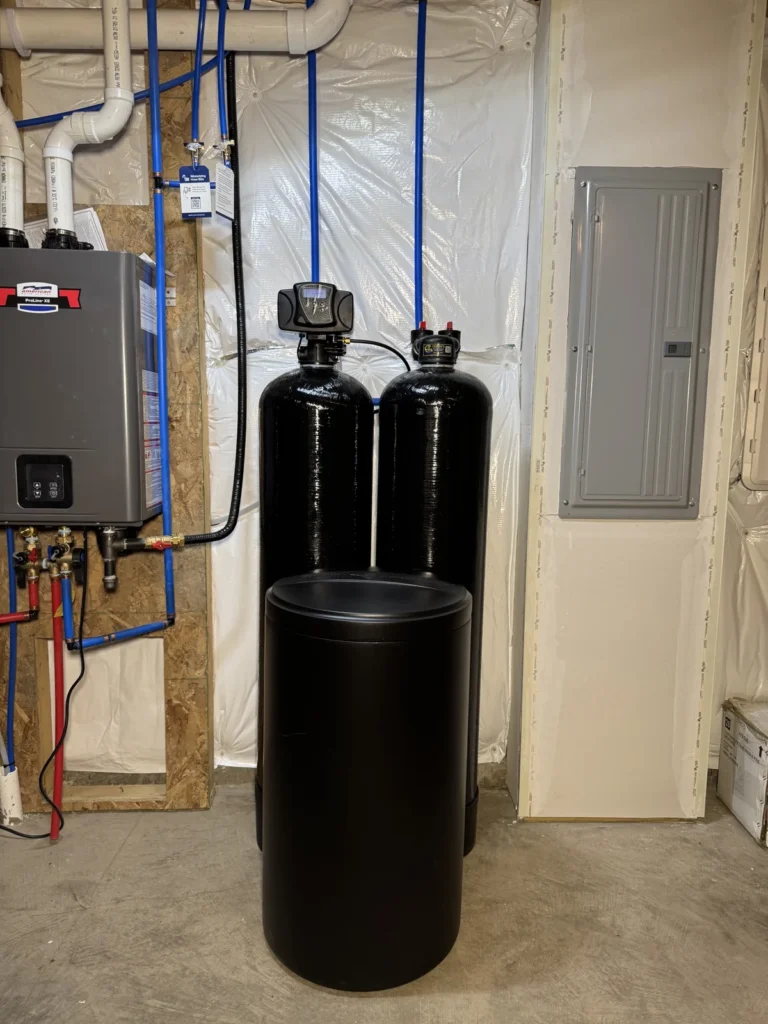
JOHNSTOWN, PA • MUNICIPAL WATER
CAMBRIA COUNTY CASE STUDY
On-Site Water Conditions
Free chlorine: 1.1 mg/L
Hardness: 5.4 gpg
TDS at the kitchen tap: 194 ppm
Concern: chlorine taste, odor and spotting
Cesare’s Treatment Design
Our whole-house activated-carbon filtration for chlorine reduction, an ion-exchange softener for hardness, and reverse osmosis at the kitchen sink.
Follow-Up Results
Free chlorine: below 0.10 mg/L
Hardness: 0.6 gpg
TDS at the RO tap: 11 ppm
Reduction: 94.3%
Measured before and after treatment
Chlorine taste and hardness on the Johnstown municipal system
A Johnstown homeowner wanted less chlorine taste and odor, less mineral buildup on fixtures, and better drinking water at the kitchen. Testing measured a 1.1 mg/L disinfectant residual, 5.4 grains per gallon of hardness and 194 ppm TDS at the tap. Because the Greater Johnstown supply is chlorinated rather than chloraminated, the build used a Cesare’s activated-carbon bed, an ion-exchange softener, and a reverse osmosis system at the sink. Afterward free chlorine measured below 0.10 mg/L, hardness 0.6 gpg, and the RO tap 11 ppm — a 94.3% reduction.
PORTAGE, PA • PRIVATE WELL
ACIDIC WATER, IRON + MANGANESE CASE STUDY
On-Site Water Conditions
pH: 5.7
Iron: 4.6 mg/L
Manganese: 0.29 mg/L
Hardness: 8.8 gpg
Total coliform: present
Cesare’s Treatment Design
pH correction for the acidic water, oxidation-based iron and manganese filtration, ion-exchange softening, and UV disinfection as a final microbial barrier.
Follow-Up Results
pH: 7.3
Iron: below 0.05 mg/L
Manganese: below 0.01 mg/L
Hardness: 0.7 gpg
Total coliform: absent
Measured before and after treatment
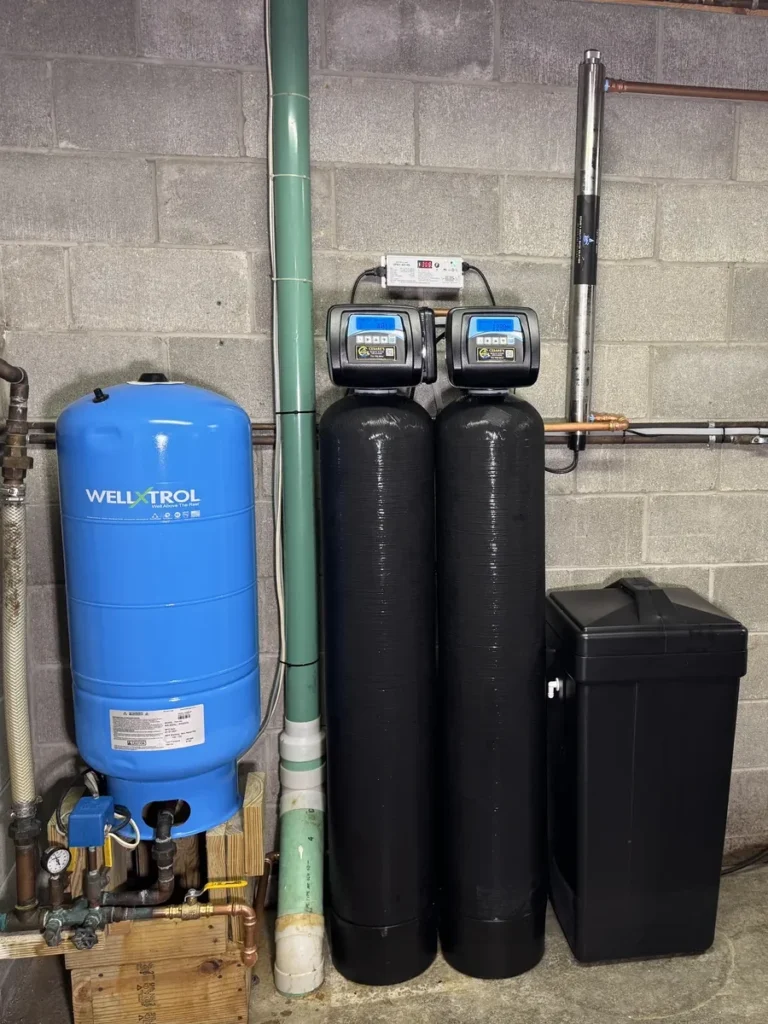
Acidic water, staining and a coliform hit on a Portage well
A homeowner near Portage called Cesare’s about orange staining, dark deposits around fixtures, a metallic taste and blue-green discoloration on the plumbing. Testing found four mineral conditions and one more besides: pH at 5.7, iron at 4.6 mg/L, manganese at 0.29 mg/L, 8.8 grains per gallon of hardness — and a positive total-coliform result that had to be treated on its own terms. At 8.8 grains the well also ran far harder than the county median, a reminder that a Cambria average tells you nothing about your own water. Cesare’s built it in order: pH correction first, then oxidation-based iron and manganese filtration, then softening, then UV as a final microbial barrier. Afterward pH read 7.3, iron below 0.05 mg/L, manganese below 0.01 mg/L, hardness 0.7 gpg and coliform absent.
The Conemaugh valley runs on Greater Johnstown Water Authority — chlorinated reservoir water piped in from Somerset County — and on Highland’s system through the southeast. Both are treated supplies, and both raise their own carbon and hardness questions at the tap.
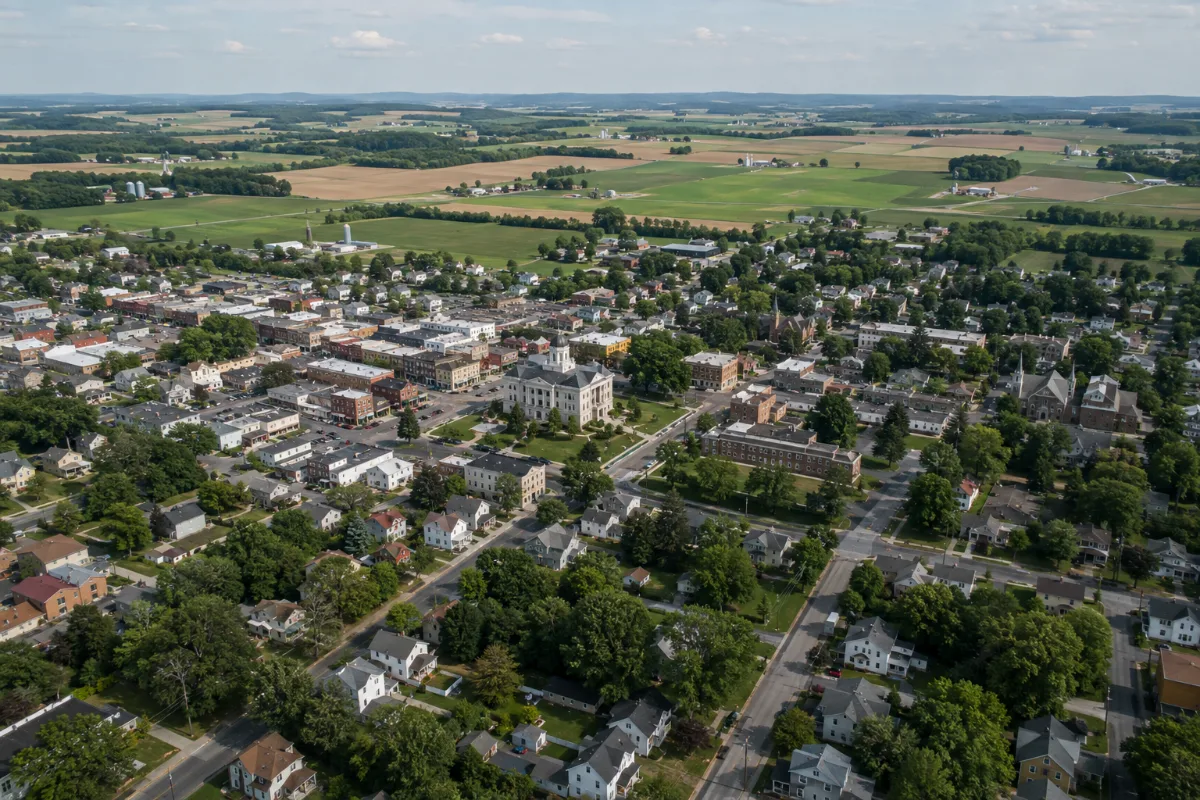
Johnstown Westmont Southmont Ferndale Dale East Conemaugh Lower Yoder Township Upper Yoder Township
Geistown Richland Township Stonycreek Township Adams Township Sidman South Fork Summerhill Franklin
North and east of Johnstown the county climbs onto the Allegheny Plateau: Ebensburg’s own reservoirs, small boroughs strung along the ridge, and farm country where the mains give out and the wells begin.

Ebensburg Cambria Township Jackson Township Nanty Glo Colver Vintondale Mundys Corner Blacklick Township
Northern Cambria Patton Carrolltown Hastings Loretto Cresson Gallitzin Portage
Cesare’s Quality Water Solutions designs, installs and services water treatment across Cambria County, for homes on municipal water and homes on private wells. That includes water testing, pH correction, whole-house filtration, iron and manganese removal, water softening, UV disinfection and reverse osmosis. We identify the water source and test at the tap first — on Cambria water especially, the order treatment goes in matters as much as the equipment.
All of it. Johnstown, Westmont, Southmont, Ferndale, Richland Township, Geistown, Ebensburg, Nanty Glo, Portage, Cresson, Gallitzin, Patton, Carrolltown, Northern Cambria, Hastings and the rural areas between them. The county runs on several separate municipal systems plus a lot of private wells, so treatment needs vary substantially by address.
Penn State’s water lab summarizes 110 drinking-water samples submitted from Cambria County between October 2007 and May 2025. The standout finding is corrosion: 30 of 35 corrosivity-index samples — 85.7% — fell outside the acceptable range, the highest failure rate of any measure in the county summary. Total coliform bacteria turned up in 58 of 105 samples and E. coli in 20 of 105. Manganese was over the limit in 11 of 42 and iron in 9 of 41. These are homeowner-submitted samples, not a survey of every property, which is why we start with water testing at your tap.
There is no single countywide system. Greater Johnstown Water Authority serves the Johnstown area. Ebensburg Municipal Authority runs its own reservoirs and treatment plant. Southwestern Cambria County Water Authority does not treat water at all — it buys finished water from Highland Sewer and Water Authority. Other areas have their own systems or rely on private wells. Which one serves your address changes the answer to almost every other question here.
From the next county over. Greater Johnstown Water Authority’s Riverside system uses surface water from the North Fork and Dalton reservoirs, both located in Conemaugh Township in northern Somerset County. Quemahoning Reservoir is available as an additional source, but the authority’s 2025 report states it was not used during that year. The system serves more than 21,000 customers across 17 municipalities.
Chlorine. Greater Johnstown Water Authority’s current report lists chlorine as the distribution-system disinfectant, with a range of 0.84 to 1.13 mg/L. Worth knowing before you buy carbon filtration, since chlorine and chloramine are removed differently and a filter matched to the wrong one will underperform.
Greater Johnstown Water Authority’s current report shows its regulated monitoring results and reports no lead action-level violation, with a 90th-percentile lead result of 5 ppb — below the 15 ppb federal action level. A utility report describes the system as a whole, though. It cannot tell you what is at one particular faucet, because the service line and the plumbing inside a home affect what actually comes out of the tap. If you have a specific concern, a test at your own tap is what answers it.
It is worth considering when a home has an older or unknown service line, older fixtures or lead-containing plumbing. Greater Johnstown’s current report lists a 5 ppb 90th-percentile result with 2 of 30 sampled sites above 15 ppb, while still reporting no action-level violation at the 90th percentile. Penn State’s Cambria submissions included 3 of 14 first-draw samples above 0.015 mg/L, though that is a small sample to draw from. Either way, lead usually enters from the home’s own line and plumbing, so a first-draw test at your faucet is the only thing that settles it for your house.
Its own reservoirs. Ebensburg Municipal Authority’s current report identifies Old Reservoir #1 and New Reservoir #2, located on Tanner Street near the treatment plant in the Borough and Cambria Township, with the water combined before treatment. The authority can also purchase already-treated water from Greater Johnstown Water Authority’s Saltlick Reservoir plant when it needs to, so Ebensburg water is not always from a single source.
Yes. Ebensburg Municipal Authority’s current report identifies chlorine as the distribution disinfectant, listing a distribution result of 1.90 mg/L with a range of 0.21 to 1.90. Its lead result came in at 1.11 ppb with none of 20 sampled sites over the action level. As always, whole-house filtration should be designed around what is measured at the property rather than a system average.
Purchased, not treated locally. Southwestern Cambria County Water Authority is a consecutive system — its own report describes it as a distribution system that purchases water from Highland Sewer and Water Authority. That water is treated at Highland’s Beaverdam plant, drawing on Beaverdam Reservoir in Summerhill Township as the primary source and Lloydell Reservoir in Adams Township as the secondary, and it is disinfected with chlorine.
Corrosion is Cambria County’s defining water issue. In Penn State’s submissions, 30 of 35 corrosivity-index samples — 85.7% — fell outside the acceptable range, with a median index of −1.8 and a low of −4.3. Blue-green staining around drains and fixtures is the visible version of that: copper being released from your own plumbing. Corrosivity depends on more than pH alone, so it should be diagnosed from the full water chemistry rather than a single pH reading — and corrected before it turns into pinhole leaks.
Often not, and a softener may not be the right first step here. Penn State’s Cambria median is just 43.4 mg/L, about 2.5 grains per gallon, which is genuinely soft — though individual wells ran as high as 372.1 mg/L, so some properties are much harder. The catch is that ion-exchange softening removes the calcium and magnesium that buffer the water, and on an already-soft, corrosive supply that can leave it more aggressive toward copper, not less. The right sequence is to test hardness, pH and corrosivity together and address the corrosion first if it is there.
Orange or rust-colored staining points to iron, black or dark staining to manganese. Penn State found iron over the limit in 9 of 41 Cambria County samples tested and manganese over the limit in 11 of 42 — and the extremes here are severe, with one iron result at 61.3 mg/L and one manganese result at 12.84 mg/L. The fix is iron and manganese filtration matched to the form and concentration in your water, which testing establishes.
That smell usually points to hydrogen sulfide, and where it shows up narrows down the cause. If the odor is in both hot and cold water, the well or supply is likely involved; if it only appears on the hot side, the water heater may be contributing. Sulfur frequently travels with iron and manganese here, so we test for the whole picture before choosing an approach.
Pennsylvania DEP recommends testing private well water every year for total coliform bacteria, nitrates, total dissolved solids and pH, through a state-certified lab, plus anything else you have reason to suspect. In Cambria County it is worth adding iron, manganese and corrosion-related chemistry whenever there is staining or plumbing trouble. Nitrate is not purely theoretical here either — one of the 36 Penn State samples tested came back over the standard. And local source-water assessments list past mining practices among the potential susceptibilities in this area, which is a reason to test rather than a reason to assume.
Treat it as a safety issue. DEP’s guidance is not to consume the water unless it has been brought to a rolling boil for one minute, or to use bottled water for drinking and food preparation while the problem is addressed. Then the well gets investigated for how contamination is entering, corrected or disinfected, and properly retested. A correctly designed UV disinfection system disinfects water passing through the reactor, but it does not repair the well or prevent contamination from entering the source. Locally this comes up often: 58 of 105 submitted samples tested positive for total coliform and 20 of 105 for E. coli.
It depends on the water and what the tests find. A Johnstown municipal home wanting chlorine filtration is a very different project from a Portage-area well needing pH correction, iron and manganese removal and UV together. Flow rate, plumbing and the number of stages all factor in — and on corrosive Cambria water, the sequence matters as much as the equipment. Cesare’s prices a system after testing the water and identifying what the property actually requires.
Straight answers to the water questions we hear most in Cambria County.
See how Cambria County compares with 12 other Southwestern Pennsylvania counties for hardness, iron, manganese, bacteria and corrosivity in the 2026 Southwestern PA Water Quality Report.
2026 Southwestern PA Water Quality Report →
Get a professional water analysis and a custom treatment plan—clear answers, no pressure.