- Pittsburgh & Southwestern PA • Custom-Engineered Water Treatment
- Fully Licensed & Insured
- 24/7 Emergency Water Service
- 3rd Generation Water Treatment Experts


The most important answers up front — then the full guide below.
Yes. Pennsylvania does not regulate private wells — you are responsible for your water quality, and testing is the only way to know what is in it.
The PA DEP and EPA recommend testing at least once a year — and immediately after any change in taste, odor, or color.
On-site testing takes about an hour. Lab results for bacteria and metals typically follow within days.
Southwestern PA wells most often show iron, manganese, hardness, sulfur odor, low pH, and bacteria — driven by our region’s geology and mining history.
You get your numbers explained in plain English. If treatment is needed, the system is engineered from your results — then retested to verify it works.
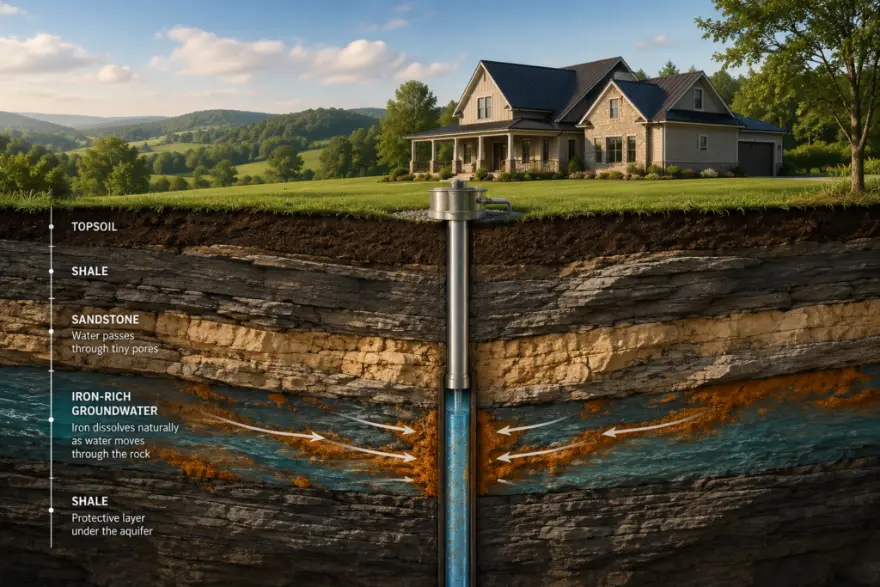
Private wells are not regulated like municipal water systems — in Pennsylvania, the homeowner alone is responsible for monitoring and maintaining water quality. No agency tests your well for you.
Water quality also changes over time. Geology, weather, flooding, nearby land use, aging well components, and shifting groundwater conditions can all alter what comes out of your tap from one year to the next. Regular testing is the only reliable way to know what is actually in your water — guidance echoed by the EPA and the Pennsylvania DEP.

Our region sits on a specific geological profile: iron-bearing shale and sandstone, limestone, legacy coal mining, and active gas extraction. As groundwater moves through these formations, it picks up iron, manganese, hardness minerals, and sulfur — and acidic conditions pull even more metal into solution.
That is why the same handful of problems show up in wells across Westmoreland, Allegheny, Washington, Butler, Beaver, Armstrong, Indiana, and Fayette counties — and why Penn State Extension studies have found that a large share of Pennsylvania private wells fail at least one drinking-water standard.
A real water test measures the chemistry, the biology, and the physical condition of your water — because each one points to a different fix.
| Test | What It Tells You | Why It Matters |
|---|---|---|
| Total Coliform & E. coli | Surface or septic intrusion | Health — the first test every well needs |
| Iron | Orange stains, metallic taste | Staining, plumbing buildup — iron guide |
| Manganese | Black and brown staining | Stains at just 0.05 mg/L — manganese guide |
| Hardness | Calcium & magnesium load | Scale, soap scum, appliance life — hard water guide |
| pH | How corrosive the water is | Low pH eats copper plumbing and keeps metals dissolved |
| TDS & Turbidity | Total mineral load and clarity | Baseline chemistry for any treatment design |
| Nitrates & Sulfates | Runoff and mining byproducts | Health at high levels; common near farms and old mines |
| Lead, Copper, Arsenic, PFAS | Metals and emerging contaminants | Lab-tested when plumbing age or location raises risk |
Testing almost always finds one of these. Each links to its full guide, so you can go deep on whatever your water shows.
Rotten-egg smell from hydrogen sulfide — strongest at hot taps.
Acidic water that corrodes copper plumbing and leaves blue-green stains.
Coliform and E. coli indicate surface intrusion or septic influence.
Cloudy water, grit in aerators, clogged fixtures and appliances.
Lead, copper, arsenic, nitrate, and PFAS — tested when risk factors call for it.
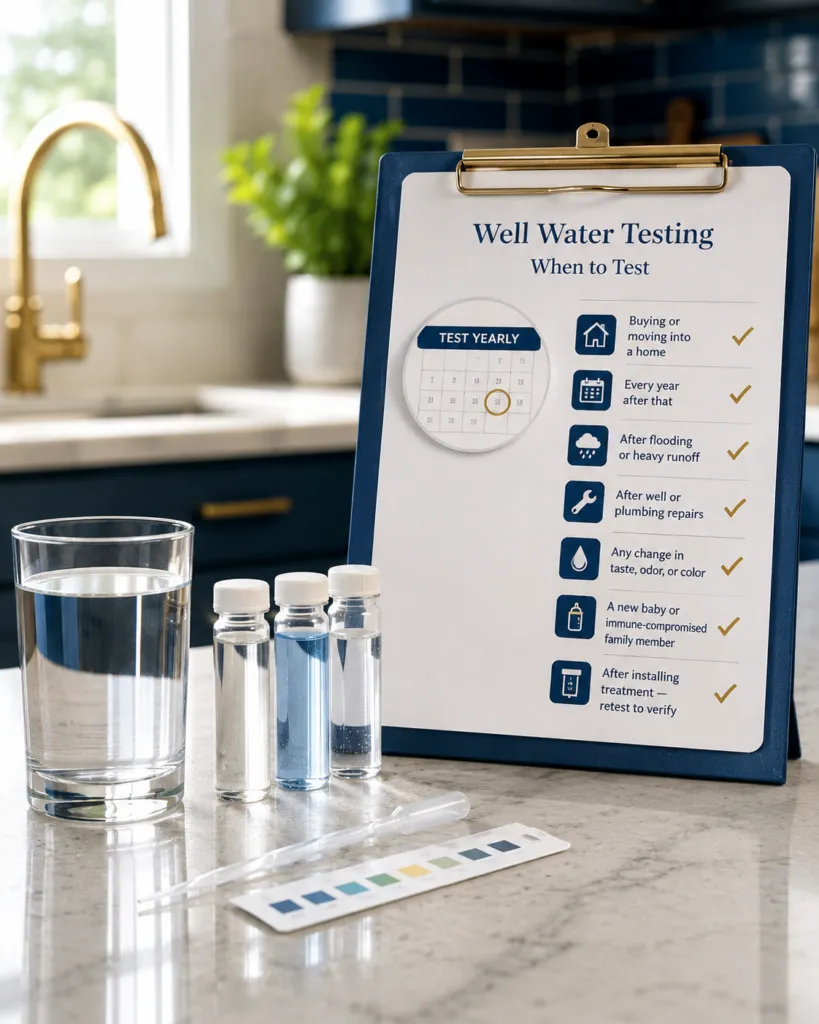
The short answer: at least once a year — for coliform bacteria, nitrates, TDS, and pH — and immediately any time the water changes. That is the standing guidance from the EPA and Pennsylvania DEP.
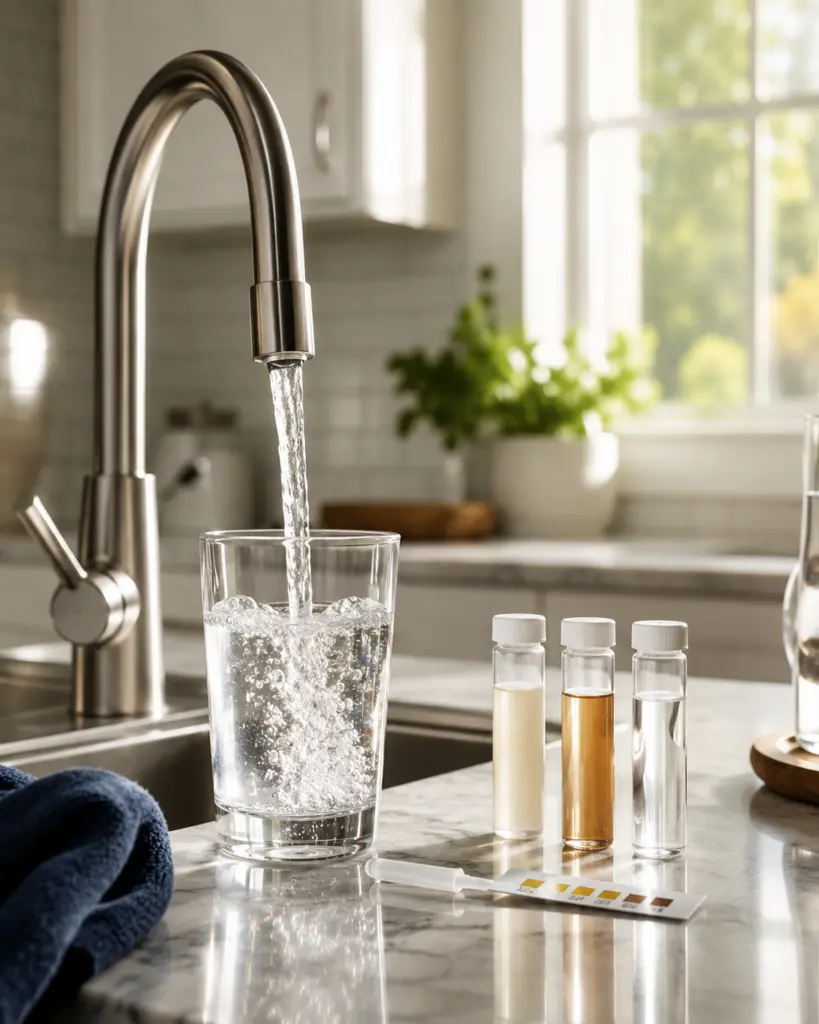
Any of these means the water has changed — and the only way to know why is to test:
Home strips have a place — but they cannot make health decisions for you. Here is the honest comparison:
| Home Test Strips | Professional Testing | |
|---|---|---|
| Accuracy | Rough color-match ranges | Calibrated, precise readings |
| Bacteria | Unreliable | Accredited lab analysis |
| Metals & PFAS | Not detectable | Laboratory-verified |
| Interpretation | You are on your own | Every number explained against EPA limits |
| Best use | Quick screening between annual tests | Health decisions and treatment design |
Penn State Extension recommends accredited laboratories for definitive analysis — exactly how we handle bacteria and metals.
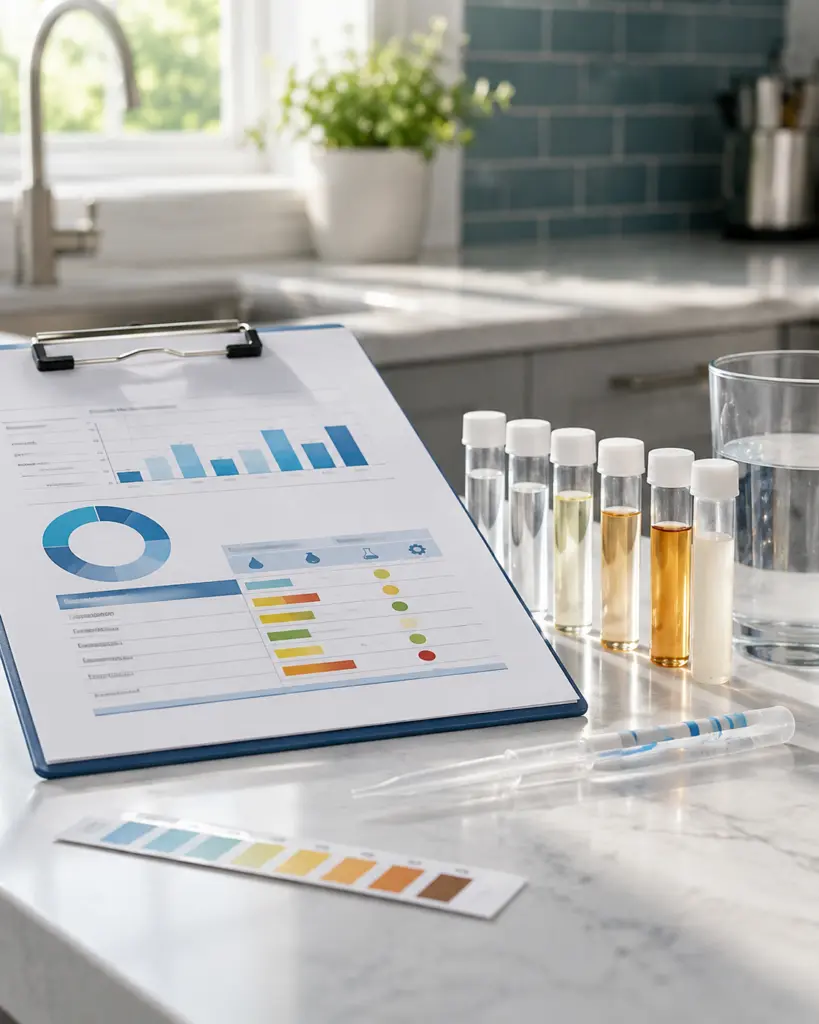
A lab report is not just pass/fail — and we never hand you one without a translation. ppm (parts per million) and mg/L are the same unit: how much of a substance your water carries. gpg (grains per gallon) is the hardness unit, where 1 gpg = 17.1 mg/L.
The EPA sets two kinds of limits. MCLs (Maximum Contaminant Levels) are enforceable health limits — bacteria, nitrate, lead, arsenic. Secondary standards cover aesthetic problems: iron stains above 0.3 mg/L, manganese above 0.05 mg/L, and the taste and scale that come with high TDS and hardness. Knowing which side of that line each number falls on is the difference between a health issue and a housekeeping issue — and it decides what kind of treatment, if any, your water actually needs.
From sample to verified results — the same engineering path every time.
The 6-step testing process
Pulled at the source with clean chain-of-custody handling.
On-site chemistry plus accredited lab work for bacteria and metals.
Every number explained in plain English — not just pass/fail.
Which contaminants matter, and which are just cosmetic.
Treatment designed from your chemistry — only if you need it.
The finished water is tested again to prove it performs.
Testing designs the treatment
Your results decide everything. Iron level and type determine the oxidation method. Hardness sizes the softener. pH decides whether correction comes first. Bacteria call for disinfection. Without the numbers, equipment is a guess — with them, it is engineering. That is why every Cesare’s system starts with a test and ends with a retest.
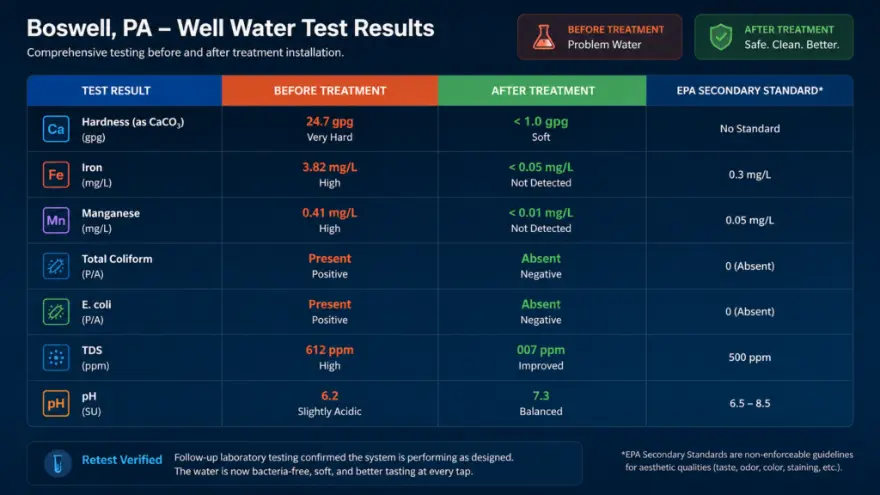
This Boswell well-water case study shows why comprehensive testing matters: water that appeared clear and tasted normal was found to contain coliform and E. coli bacteria, very hard water, elevated iron and manganese, and high total dissolved solids.
ProblemThe homeowner believed the well was safe — no obvious warning signs. On-site testing and third-party laboratory analysis identified bacterial contamination along with hardness, iron, manganese, and elevated TDS.
TreatmentA custom whole-home system designed from the complete analysis: oxidation and filtration for iron and manganese, water softening for hardness, and ultraviolet disinfection for microbiological protection.
Verified ResultFollow-up testing found no detectable coliform or E. coli in the sampled water. The homeowner also reported softer water, improved taste, and no recurring iron or manganese staining.
A private well can look, smell, and taste normal while still containing contaminants that cannot be detected without testing — treatment should be designed from verified water chemistry, not symptoms alone.
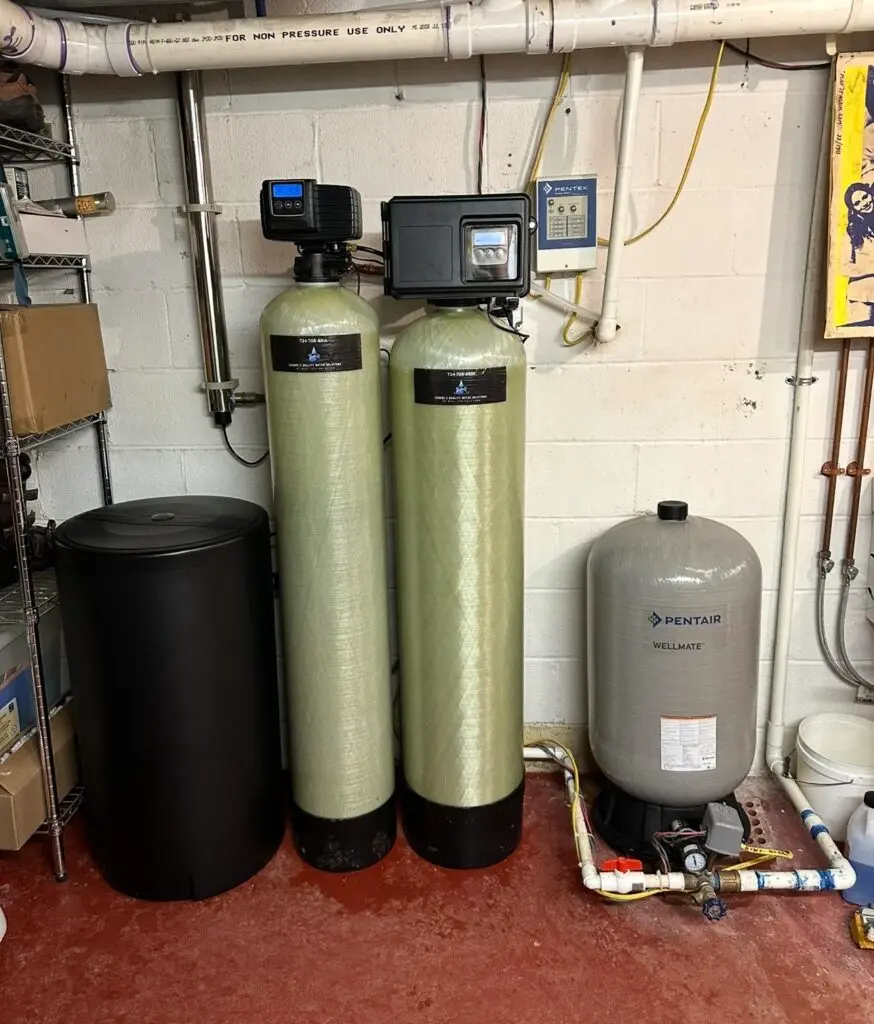
“Lance and Monica came out that night, tested my water, and took a sample for a third-party lab. This guy really knows his stuff — now my water is better than bottled.”
Paige — Boswell, PA · Google review| Measurement | Raw water before all treatment | Whole-home treated water after filtration, softening and UV | Applicable reference |
|---|---|---|---|
| Hardness (as CaCO₃) | 24.7 gpg | Below 1 gpg | No federal drinking-water limit |
| Iron | 3.82 mg/L | Below the field method’s 0.05 mg/L reporting limit | EPA secondary guideline, 0.3 mg/L — aesthetic, not health-based |
| Manganese | 0.41 mg/L | Below the field method’s 0.01 mg/L reporting limit | EPA secondary guideline, 0.05 mg/L |
| Total dissolved solids | 612 mg/L | Reduced — verified at retest. The dedicated RO faucet is a separate sample point and reads far lower than the whole-home tap | EPA secondary guideline, 500 mg/L |
| pH | 6.2 | 7.3 | EPA secondary range, 6.5–8.5 |
| Coliform and E. coli | Not published here — bacteria results require an accredited laboratory, which we arrange for the homeowner | Zero detection is the goal for public systems | |
EPA secondary guidelines are non-enforceable aesthetic references covering taste, odor, color and staining. Coliform and E. coli are health-based, and any presence is a failure — which is why those results come from an accredited laboratory rather than a field kit.
More answers in our Water Testing & Analysis Knowledge Center.
Every claim on this page traces back to a primary source — regulators, accredited standards bodies and the utilities that publish local water quality.
Reviewed July 2026 by Lance Cesare, third-generation water-treatment specialist. Water testing referenced on this page is on-site field analysis performed by Cesare’s Quality Water Solutions, not certified laboratory analysis. Bacteria, lead, nitrate, PFAS and disinfection by-product results require an accredited laboratory and are not published from field methods.
The guidance on this page follows Pennsylvania and federal drinking-water authorities — the same standards we test your water against.