

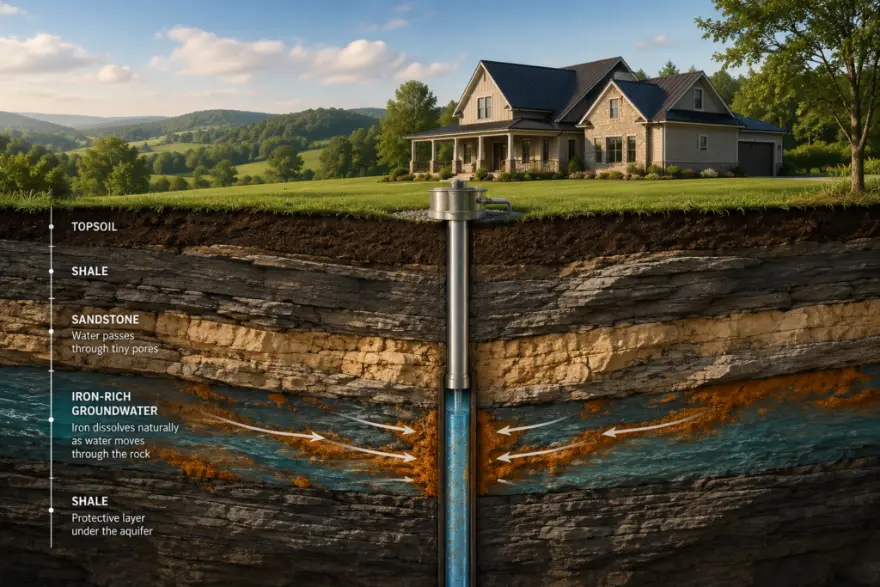
What Is Iron in Well Water?
Iron is a naturally occurring metal that dissolves into groundwater as it moves through the shale, sandstone, and coal-seam geology under Southwestern Pennsylvania. Straight from the well it is often ferrous iron — fully dissolved and invisible, so the water can look perfectly clear at the tap.
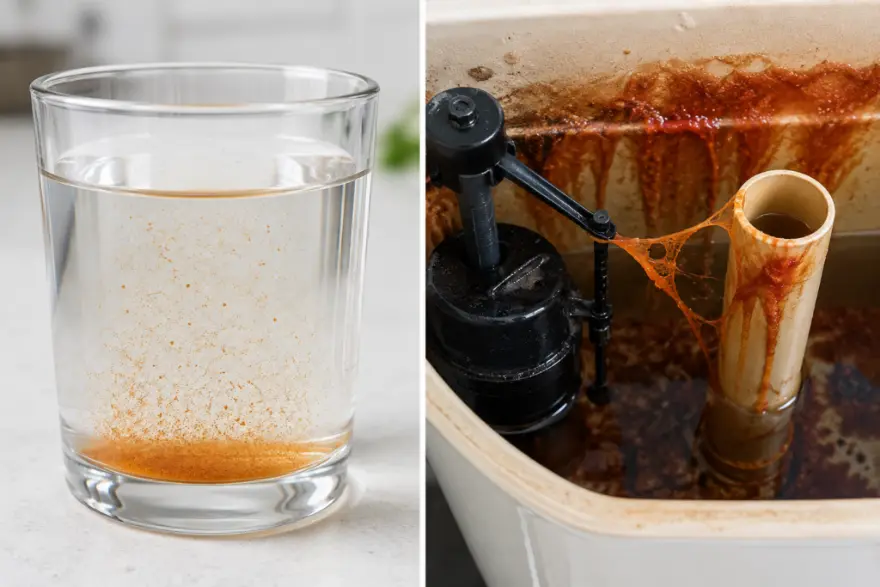
The moment that water meets air, the iron oxidizes and turns into ferric iron — the reddish-orange rust particles that stain sinks, toilets, tubs, and laundry. That is why a glass that looks clean can leave an orange ring an hour later. Cesare's, a third-generation Murrysville company, engineers whole-house iron removal for well and city water across all 13 Southwestern Pennsylvania counties.
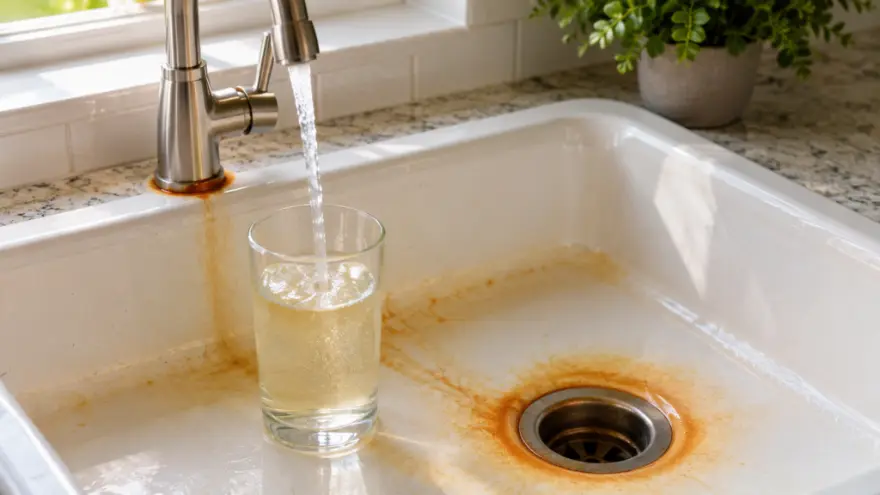
Signs You Have Iron in Your Well Water
Iron rarely shows up as one obvious problem — it shows up everywhere water sits or dries. If several of these sound familiar, iron is the likely cause:
- Orange, rust, red, or brown water
- Orange rings in the toilet, tub, and sinks
- Rust or orange stains on white laundry
- A metallic taste or metallic smell
- Clear water that turns orange after it sits
- Clogged plumbing and reduced water pressure
- Sediment and rust building up in the water heater
- Slimy orange buildup in tanks and toilet flappers (iron slime)
The 4 Types of Iron Found in Well Water
Most iron problems we diagnose across Southwestern Pennsylvania fall into one of these four categories, and identifying the correct type is the first step toward designing the right treatment system.
Ferrous Iron
“Clear-water iron.” Fully dissolved and invisible in the glass, it oxidizes into orange rust only after it hits air — the classic clear-then-orange well water.
Ferric Iron
Already oxidized before it reaches you. You can see the rust-colored particles floating in the water, and they settle out as orange sediment.
Organic Iron
Iron bonded to natural tannins from decaying vegetation. It often gives water a yellow or tea-colored appearance and usually requires specialized treatment beyond a standard iron filter.
Iron Bacteria
Iron bacteria feed on iron and produce a reddish-orange slime inside toilet tanks, plumbing, pressure tanks, and fixtures. Because they are living microorganisms, they require disinfection in addition to filtration.
How Iron Is Removed From Well Water
Every iron problem is different, but the engineering follows the same path — tested, corrected, oxidized, filtered, and verified.
The 5-stage treatment process
Test the Water
Iron type & level, pH, hardness, manganese, bacteria.
Correct Low pH
Acidic SW PA water keeps iron dissolved — fix pH first.
Oxidize the Iron
Air injection, ozone, chlorine, or oxidizing media.
Filter the Iron
Media sized to your iron load and household flow rate.
Retest & Verify
Confirmed clear, stain-free water at every tap.
Engineered to your water
Dissolved ferrous iron passes through most filters untouched. The system first corrects low pH, then converts the iron into filterable ferric particles using air injection, ozone, chlorine, or oxidizing media — and traps it in filtration media sized to your iron load and flow rate, backwashing it away on a set cycle. A final retest proves the water runs clear.
- Orange stains eliminated
- Clear water at every tap
- Plumbing & heater protected
- Sized to your flow rate
- Verified by retest
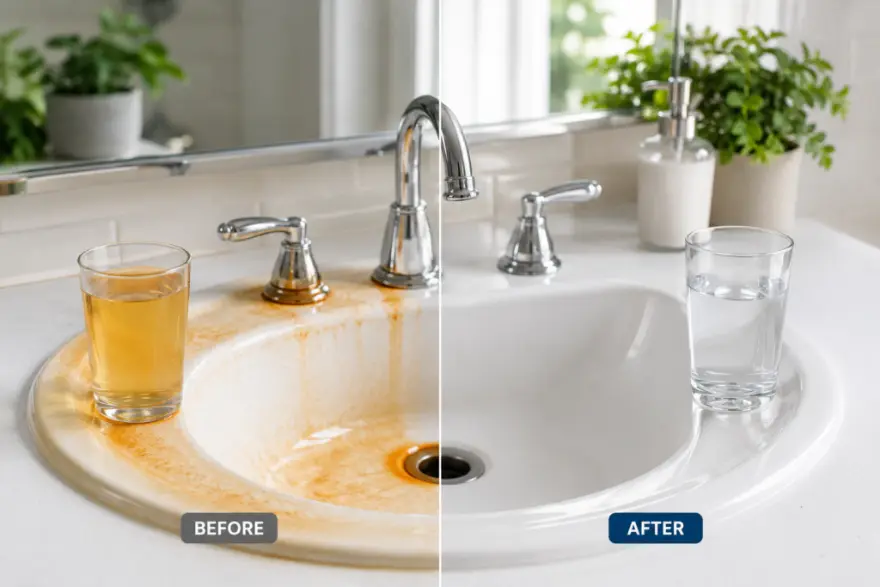
Why the Orange Stains Keep Coming Back
You scrub the sink, the toilet, the tub — and days later the orange is back. Cleaning only removes the iron that has already oxidized on the surface. It does nothing to the dissolved iron still dissolved in the water.
Every new gallon that comes out of the well carries fresh dissolved iron, and every gallon oxidizes into a new stain. The stains never stop until the iron is removed from the water itself — before it reaches your fixtures. That is exactly what a properly engineered whole-house iron removal system does.

Why Iron Is Common in Southwestern Pennsylvania
The ground under Western Pennsylvania is rich in iron. Groundwater filters through iron-bearing shale, sandstone, and the region's coal seams, and the historical coal-mining activity across the area only adds to how much iron ends up in private wells.
Two other local factors make it worse: our groundwater is often low in oxygen, which keeps iron dissolved and invisible, and it tends to run acidic, which pulls even more iron into solution. Penn State Extension has reported that excessive iron affects a large share of Pennsylvania private water supplies. We see it constantly across Allegheny, Westmoreland, Washington, Butler, Indiana, Armstrong, Fayette, Beaver, and the surrounding counties.
How Much Iron Is Too Much?
The EPA sets a Secondary Maximum Contaminant Level for iron — a guideline based on staining and taste rather than health. Here is where the numbers land:
| Iron Level (mg/L) | What It Means |
|---|---|
| Below 0.3 mg/L | EPA secondary standard. Staining is usually minimal. |
| 0.3 mg/L and up | Orange and rust staining begins on fixtures and laundry. |
| 1.0 mg/L and up | Obvious staining, metallic taste, and buildup in plumbing and the water heater. |
| 3.0 mg/L and up | Heavy staining and pressure loss — whole-house treatment strongly recommended. |
Staining starts right around 0.3 mg/L, and many Southwestern Pennsylvania wells run well above it. A water test tells you exactly where yours stands.
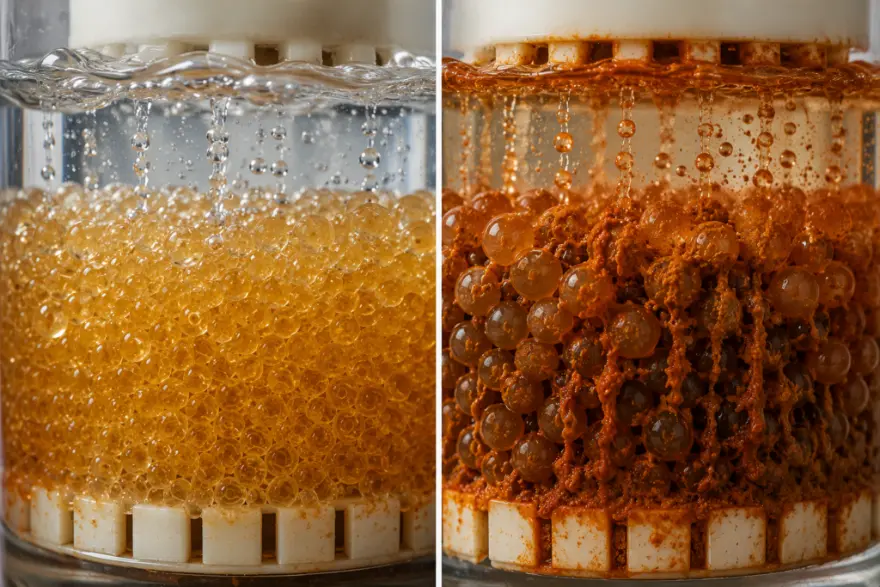
Can a Water Softener Remove Iron?
Sometimes — but not always, and not on its own. A water softener can pull out small amounts of dissolved (ferrous) iron along with hardness. Push it past its limit and the iron fouls the softener resin, so it stops softening and stops catching iron.
Whether a softener alone can handle your water depends on the iron level, the type of iron, and how much manganese, hardness, and bacteria are in the mix. Higher iron, ferric or organic iron, or any iron bacteria all call for dedicated iron removal ahead of — or instead of — the softener. The honest answer only comes from a test.
Iron vs. Manganese
Iron and manganese are close cousins in Western PA well water, and many homes have both. The difference is in the color they leave behind:
| Iron | Manganese | |
|---|---|---|
| Stain color | Orange, red, rust, brown | Black, dark brown, purple |
| Taste | Metallic | Bitter, metallic |
| Stains at | 0.3 mg/L | 0.05 mg/L |
| Where it shows | Sinks, tubs, laundry | Dishwasher, fixtures, laundry |
Seeing black stains instead of orange? Learn more about manganese removal — and if you have both, one custom system can be engineered to handle them together.
Iron vs. Iron Bacteria
These get confused constantly, but they are not the same thing. Iron is a dissolved mineral — a chemistry problem you oxidize and filter out. Iron bacteria are living organisms that feed on iron and leave a slimy, reddish-orange, sometimes rainbow-sheened buildup in toilet tanks, well casings, and fixtures.
A filter alone will not fix iron bacteria — they keep growing and re-clogging the system. Iron bacteria need disinfection and a shock-and-control approach, often paired with iron removal for the mineral itself. Getting the diagnosis right is the difference between a system that works and one that keeps clogging.
Iron Removal Case Study in Southwestern Pennsylvania
A Westmoreland County home had iron showing up everywhere: orange staining in the toilets, metallic-tasting water, and sediment building up in the plumbing fixtures. Testing found elevated iron, moderate hardness, and slightly acidic water.
Problem
On-site field analysis measured 4.6 ppm iron with 0.18 ppm manganese, 14.8 gpg hardness, a pH of 6.5 at the low end of the recommended aesthetic range, and turbidity of 5.2 NTU — enough iron to stain everywhere the water sat or dried.
Treatment
A custom whole-home system built from the full analysis: pH correction, air-injection oxidation, dedicated iron and manganese filtration, and ion-exchange softening.
Verified Result
Follow-up field testing found iron below the method’s 0.05 mg/L reporting limit, manganese below 0.01 mg/L, hardness under 1 gpg, pH at 7.1 and turbidity under 0.5 NTU — no more orange staining or metallic taste.
Iron at 4.6 ppm stains fixtures, laundry, and every surface the water touches. Treatment matched to the water chemistry took this well from heavy staining to iron not detected.
The Test Results: Before and After
| Measurement | Before treatment | After treatment | Applicable reference |
|---|---|---|---|
| Total iron | 4.6 mg/L | Below the field method’s 0.05 mg/L reporting limit | EPA secondary guideline, 0.3 mg/L — aesthetic, not health-based |
| Manganese | 0.18 mg/L | Below the field method’s 0.01 mg/L reporting limit | EPA secondary guideline, 0.05 mg/L |
| Hardness (as CaCO₃) | 14.8 gpg — very hard | Below 1 gpg | No federal drinking-water limit |
| pH | 6.5 — the lower end of the recommended aesthetic range | 7.1 | EPA secondary range, 6.5–8.5. Corrosion potential depends on alkalinity and the full water chemistry, not pH alone |
| Turbidity | 5.2 NTU | Below 0.5 NTU | Treatment objective: visibly clear finished water. Federal turbidity limits apply to public systems, not private wells |
Sources & References
Every claim on this page traces back to a primary source — regulators, accredited standards bodies and the utilities that publish local water quality.
Iron in Well Water
- Iron and manganese in Pennsylvania drinking water
- Iron bacteria: identification and treatment
Federal Standards
- Secondary guideline for iron, 0.3 mg/L — aesthetic, not health-based
- Secondary guideline for manganese, 0.05 mg/L
State Program
- Safe Drinking Water Program requirements for public water systems
- Private wells are not regulated at the state level in Pennsylvania
Treatment Certification
- NSF/ANSI 42 and 44 standards for filtration and ion exchange
- Oxidizing filter media performance references
Regional Geology
- Iron and manganese in Appalachian Plateau groundwater
- Coal-region influence on Southwestern PA well chemistry
Treatment Technology
- Oxidation, filtration and greensand media selection
- Why softeners have limits on dissolved iron
Reviewed July 2026 by Lance Cesare, third-generation water-treatment specialist. Water testing referenced on this page is on-site field analysis performed by Cesare’s Quality Water Solutions, not certified laboratory analysis. Bacteria, lead, nitrate, PFAS and disinfection by-product results require an accredited laboratory and are not published from field methods.
Iron in Well Water FAQs
What causes orange stains in my sinks, tubs, and toilets?
Why is my water clear at first, then turns orange?
Why is my toilet bowl orange?
Why is my well water rusty or brown?
What is the difference between iron and manganese?
What is iron bacteria?
Is iron in drinking water dangerous?
How much iron is too much?
Can boiling remove iron from water?
How much does an iron removal system cost?
Will a water softener remove iron?
What type of iron filter do I need?
Why is iron so common in Southwestern Pennsylvania well water?
Can iron damage my plumbing and appliances?
Can iron and manganese be removed together?
How do I know which iron removal system is right for my home?
More answers in our Iron & Manganese Knowledge Center.