- Pittsburgh & Southwestern PA • Custom-Engineered Water Treatment
- Fully Licensed & Insured
- 24/7 Emergency Water Service
- 3rd Generation Water Treatment Experts

Fayette County water changes with your address. Uniontown blends Youghiogheny and Monongahela river water, Connellsville mixes bulk river supply with springs and a well, Brownsville draws from the Monongahela, and much of the county runs on private wells. Cesare’s identifies which one is yours, tests the water at your tap, and engineers treatment around what it finds.

About 123,000 people live in Fayette County, and there is no single Fayette County water. Pennsylvania American Water runs three separate systems here — Uniontown, Connellsville and Brownsville — each on a different raw supply. The North Fayette County Municipal Authority treats Youghiogheny River water for roughly 35,000 residents across 23 municipalities. Beyond the mains, in a county of two cities, sixteen boroughs and twenty-four townships, homes run on private wells that nobody tests but the owner.
Youghiogheny water bought in bulk, Monongahela water treated at Brownsville, springs and a reservoir up the Indian Creek valley, and thousands of private wells — Fayette County runs on all of them at once, and the treatment that fits one does not fit the next.
Pennsylvania American Water’s Uniontown system takes surface water from the Youghiogheny and the Monongahela — Youghiogheny water bought from MAWC, Monongahela water treated at the Brownsville plant.
Most Connellsville water is bought from MAWC off the Youghiogheny. A smaller part comes from Indian Creek Valley Water Authority — Pritts Spring, Grimm Spring, Neals Run Well and Mill Run Reservoir.
Brownsville draws from the Monongahela. North Fayette County Municipal Authority treats Youghiogheny water for about 35,000 residents. Past the mains, the county is private-well country.
Penn State’s Agricultural Analytical Services Laboratory has summarized 150 Fayette County drinking-water samples collected between December 2007 and May 2025. These laboratory results describe the samples submitted to Penn State and are not a representative survey of all homes, wells or public water supplies in the county.
Aesthetic and treatment conditions
Health-related indicators
About the data: Individual parameters were tested on different numbers of samples. These results describe the samples submitted — they cannot determine what is present at an individual property. Test the water at the property before treatment is selected.
Source: Penn State Agricultural Analytical Services Laboratory — Fayette County Drinking Water Test Summary.
Corrosion leads every finding in Fayette County, and all three Pennsylvania American systems arrive chloraminated rather than chlorinated. These are the conditions Cesare’s is called out for most often here.
Corrosivity fell outside Penn State’s criterion in 51 of 72 tested samples — 70.8%, second only to Cambria among the 13 counties Cesare’s serves.
Manganese was above the 0.05 mg/L secondary standard in 15 of 55 tested samples, 27.3% — the usual cause of dark grit on fixtures and in laundry.
Iron was above the 0.3 mg/L secondary standard in 12 of 50 tested samples, 24.0%, and one submission came back at 74 mg/L.
Corrosive water is the quiet one. It leaves no stain until it has been working on the copper for years, and by then the evidence is a pinhole leak in a finished ceiling. A corrosivity index is not the same thing as low pH — pH is one input among several — so the cause has to be measured before anything is installed to correct it.
Pennsylvania does not regulate privately owned household wells — testing and treatment are the owner’s responsibility. The Department of Environmental Protection recommends testing every year for total coliform bacteria, nitrates, total dissolved solids and pH, always through a state-certified drinking-water laboratory, plus anything else you have reason to suspect.
Fayette’s submitted samples show why the bacteria line matters: total coliform turned up in 84 of 141 tested samples (59.6%) and E. coli in 36 of 141 (25.5%). Neither number describes any individual well — it describes what came through the lab door. The only way to know which group yours is in is to test it. Cesare’s publishes the same tested county data for neighboring Westmoreland, Greene and Somerset counties.
Whole-home filtration matched to your system — Cesare’s chloramine-capable carbon on PA American supplies, metals and hardness elsewhere.
Sized to measured hardness — 4.70 gpg average in Uniontown, 5.96 in Brownsville, 3.09 in Connellsville.
Point-of-use treatment for taste, dissolved minerals and laboratory-confirmed drinking-water concerns.
Manganese was above standard in 27.3% of tested county samples and iron in 24.0% — oxidation and filtration sized to both.
Rotten-egg odor traced to its source — water supply, plumbing or water heater — before treatment is chosen.
Inspection, repair and service for existing equipment — including systems Cesare’s didn’t install.
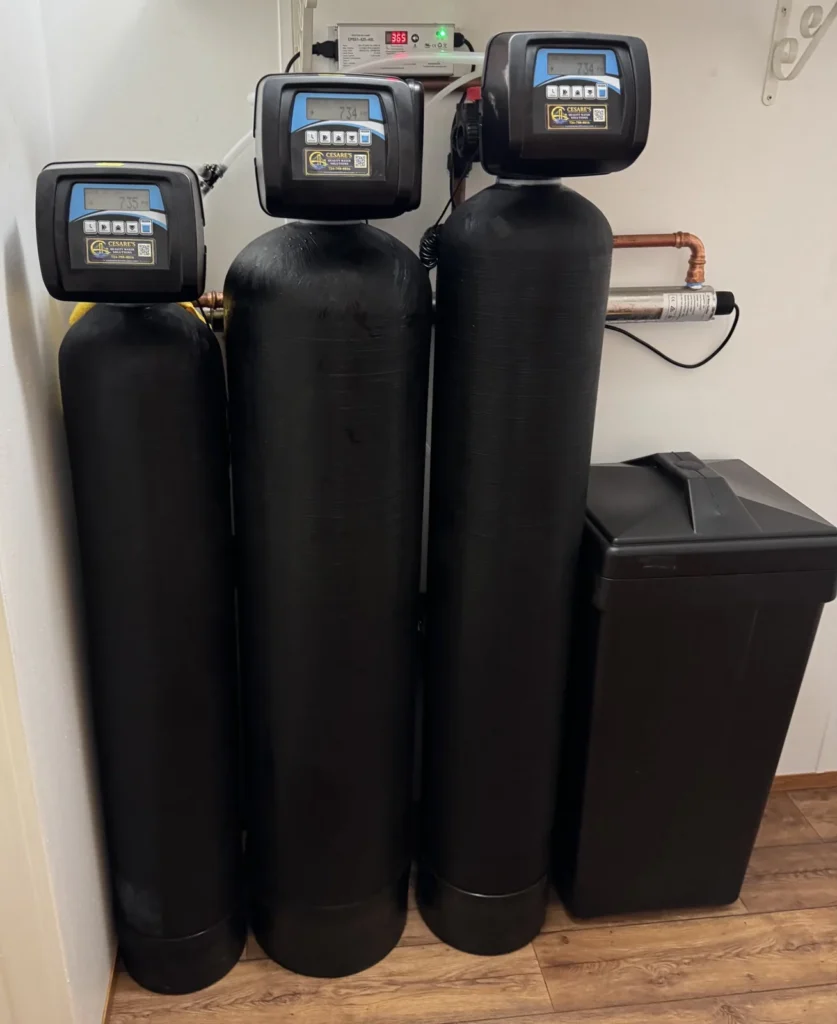
UNIONTOWN, PA • MUNICIPAL WATER
FAYETTE COUNTY CASE STUDY
On-Site Water Conditions
Disinfectant residual: 1.9 mg/L
Hardness: 5.2 gpg
TDS at the kitchen tap: 236 ppm
Concern: disinfectant taste and scale
Cesare’s Treatment Design
Our whole-house chloramine-capable carbon filtration, an ion-exchange softener for hardness, and reverse osmosis at the kitchen sink.
Follow-Up Results
Disinfectant residual: below 0.10 mg/L
Hardness: 0.6 gpg
TDS at the RO tap: 14 ppm
Reduction: 94.1%
Measured before and after treatment
Disinfectant taste and hardness on the Uniontown municipal system
A Uniontown homeowner wanted less disinfectant taste, less mineral buildup on fixtures, and better drinking water at the kitchen. Testing measured a 1.9 mg/L disinfectant residual, 5.2 grains per gallon of hardness and 236 ppm TDS at the tap. Because the Uniontown supply is chloraminated rather than chlorinated, the build used a Cesare’s chloramine-capable carbon bed, an ion-exchange softener, and a reverse osmosis system at the sink. Afterward the residual measured below 0.10 mg/L, hardness 0.6 gpg, and the RO tap 14 ppm — a 94.1% reduction.
FARMINGTON, PA • PRIVATE WELL
ACIDIC WATER, IRON + MANGANESE CASE STUDY
On-Site Water Conditions
pH: 5.8
Iron: 3.8 mg/L
Manganese: 0.24 mg/L
Hardness: 6.4 gpg
Total coliform: present
Cesare’s Treatment Design
pH correction for the acidic water, oxidation-based iron and manganese filtration, ion-exchange softening, and UV disinfection as a final microbial barrier.
Follow-Up Results
pH: 7.3
Iron: below 0.05 mg/L
Manganese: below 0.01 mg/L
Hardness: 0.7 gpg
Total coliform: absent
Measured before and after treatment
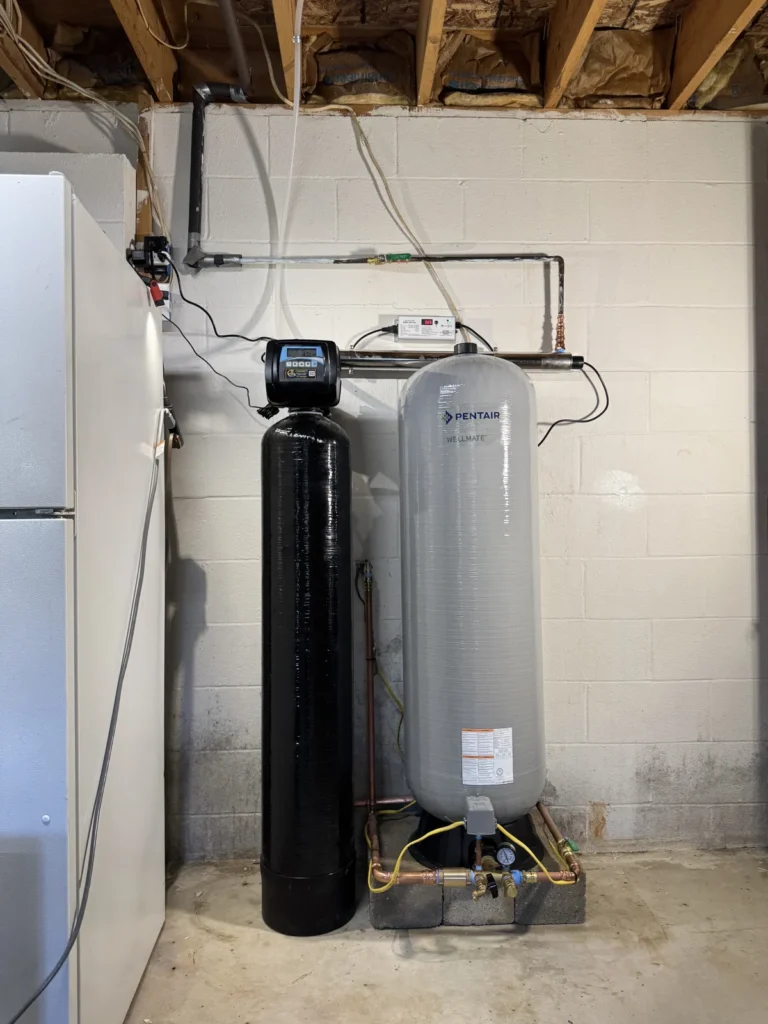
Acidic water, staining and a coliform hit on a Farmington well
A homeowner near Farmington called Cesare’s about orange staining, dark deposits around fixtures, a metallic taste and blue-green discoloration on the plumbing. Testing found four mineral conditions and one more besides: pH at 5.8, iron at 3.8 mg/L, manganese at 0.24 mg/L, 6.4 grains per gallon of hardness — and a positive total-coliform result that had to be treated on its own terms. Cesare’s built it in order: pH correction first, then oxidation-based iron and manganese filtration, then softening, then UV as a final microbial barrier. Afterward pH read 7.3, iron below 0.05 mg/L, manganese below 0.01 mg/L, hardness 0.7 gpg and coliform absent.
The county seat and the river towns all run on Pennsylvania American Water, and every one of those surface supplies is treated with chloramines rather than free chlorine — a different carbon problem than plain chlorine, and one worth getting right.
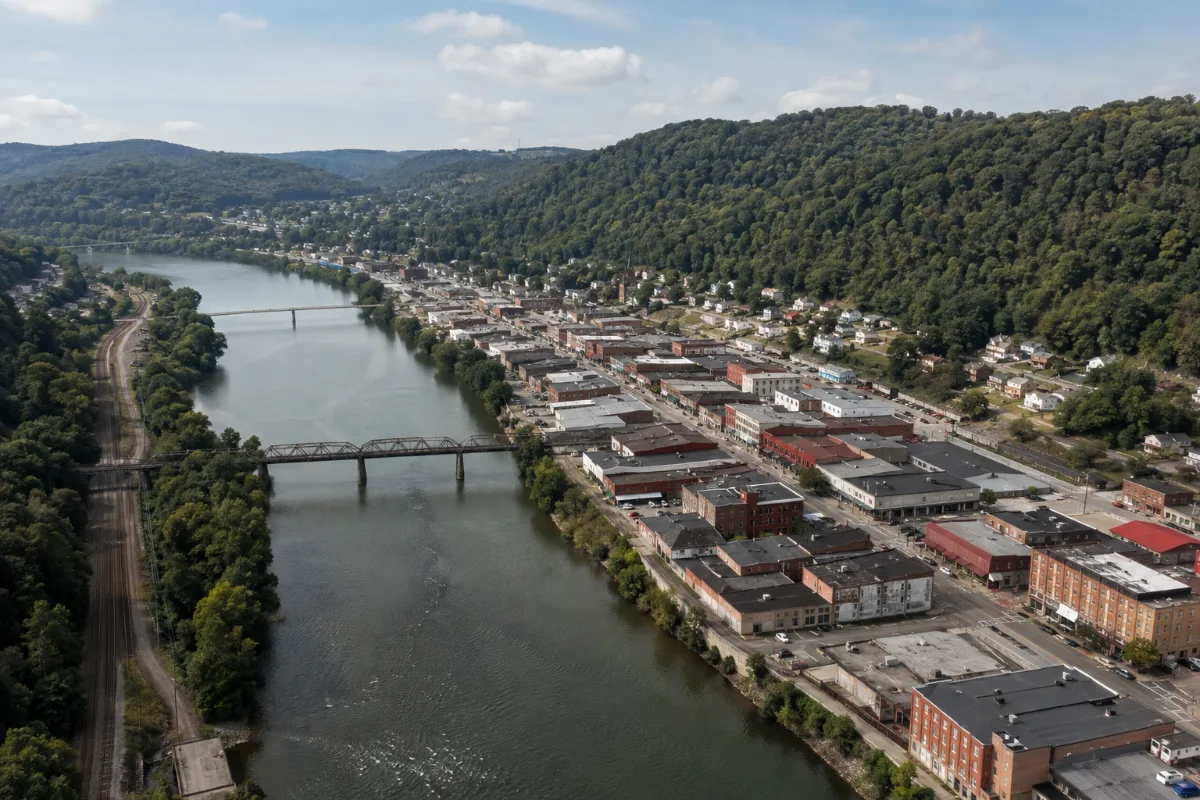
Uniontown North Union Township South Union Township Hopwood Menallen Township Fairchance Lemont Furnace Oliver
Connellsville South Connellsville Connellsville Township Bullskin Township Dunbar Dunbar Township Brownsville Masontown
South and east of Uniontown the county turns to mountain, gorge and farm, and the public mains thin out fast. This is private-well country, and it is where corrosive, low-pH water shows up most.
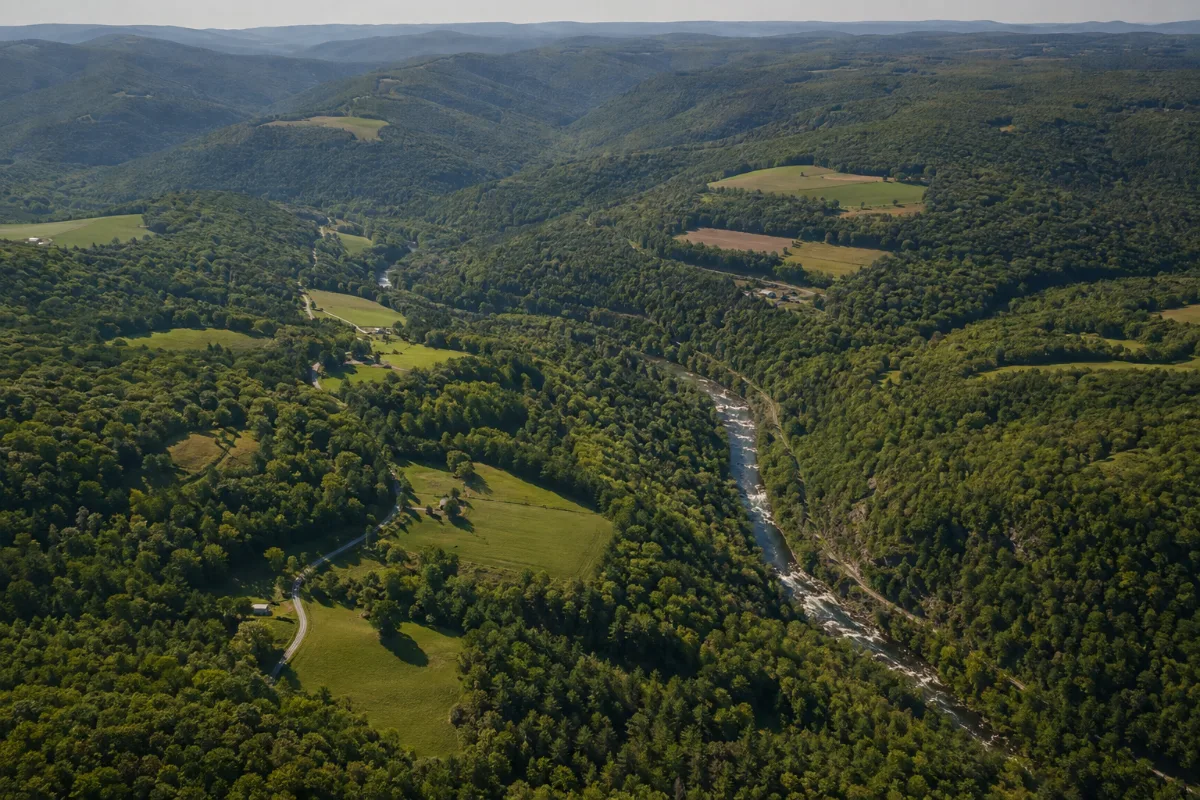
Farmington Ohiopyle Chalk Hill Markleysburg Wharton Township Henry Clay Township Mill Run Normalville
Smithfield Point Marion Springhill Township German Township Redstone Township Perryopolis Fayette City Newell
Cesare’s Quality Water Solutions designs, installs and services water treatment across Fayette County, for homes on municipal water and homes on private wells. That includes water testing, whole-house filtration, water softening, iron and manganese removal, pH correction, sulfur treatment, UV disinfection and reverse osmosis. We identify the water source and test at the tap first, because Fayette runs on three separate Pennsylvania American systems plus a lot of rural wells.
All of it. Uniontown, Connellsville, Brownsville, Masontown, Fairchance, Hopwood, Perryopolis, Dunbar, Smithfield, Farmington, Ohiopyle, Point Marion and the rural townships between them. Source water and treatment needs change substantially by address here, since the county mixes purchased river water, spring and reservoir supplies, and private wells.
Penn State’s water lab summarizes 150 drinking-water samples submitted from Fayette County between December 2007 and May 2025. Among the samples tested, total coliform bacteria turned up in 84 of 141 and E. coli in 36 of 141 — both among the higher rates in the region. Manganese was over the 0.05 mg/L limit in 15 of 55, iron over 0.3 mg/L in 12 of 50, and median hardness ran 54.8 mg/L, about 3.2 grains per gallon. These are homeowner-submitted samples, not a survey of every property, which is why we start with water testing at your tap.
No. Pennsylvania American Water runs three separate systems here — Uniontown, Connellsville and Brownsville — and they do not share one source or one disinfectant profile. Uniontown blends purchased Youghiogheny water with Monongahela water treated at Brownsville. Connellsville is mostly purchased Youghiogheny water with a smaller spring-and-reservoir contribution. Brownsville is Monongahela. Beyond those, rural Fayette runs on private wells.
Two rivers. Pennsylvania American Water’s Uniontown system uses treated Youghiogheny River water purchased through the Municipal Authority of Westmoreland County, plus Monongahela River water that Pennsylvania American treats at its Brownsville facility. Hardness averages 80.4 mg/L, about 4.70 grains per gallon, ranging 26 to 178, with average pH around 7.96. The system serves Uniontown along with South Union, North Union, Menallen and Dunbar townships.
Chloramine. Pennsylvania American Water treats its surface-water supplies with chloramines for bacteriological protection through the distribution system, and the Uniontown report records chloramine residuals from 1.16 to 2.09 parts per million. Chloramine takes different Cesare’s carbon filtration than free chlorine, so it is worth confirming what is at your address before buying a whole-house filter.
In June 2026 Pennsylvania American Water announced it had begun replacing approximately 400 lead service lines in the City of Uniontown and North Union and South Union townships, work that started with neighborhood inspections in August 2025. This is a materials-replacement program, not a response to a failed test: the same utility’s most recent compliance sampling reported a 90th-percentile lead result of 1 ppb with zero of 32 sampled sites above the 15 ppb action level. Lead at an individual tap depends on the service line and the household plumbing, which is exactly what the program addresses.
Mostly purchased water. Pennsylvania American Water’s Connellsville system buys most of its supply from the Municipal Authority of Westmoreland County, whose raw source is the Youghiogheny River. A smaller share comes from the Indian Creek Valley Water Authority, which draws on Pritts Spring, Grimm Spring, the Neals Run Well and Mill Run Reservoir. Connellsville is the softest of the three Fayette systems at 53 mg/L, about 3.09 grains per gallon.
Both, depending on the source. Pennsylvania American disinfects its groundwater supplies with chlorine and treats surface-water supplies with chloramines, and Connellsville receives water from more than one kind of source. The current report records chloramine in distribution from 0.95 to 2.04 parts per million alongside chlorine measurements. That mix is a good reason to confirm what is actually at your tap rather than assuming one or the other.
The Monongahela River. Pennsylvania American Water treats Brownsville’s surface supply with chloramines, and that same Brownsville facility supplies part of the Uniontown system. It is the hardest of the three Fayette systems, averaging 102 mg/L, about 5.96 grains per gallon, with a range of 39 to 217 mg/L.
Fayette is on the softer side for the region, but it varies by source. Penn State’s countywide median is 54.8 mg/L, about 3.2 grains per gallon, while the three municipal systems run 3.09 grains in Connellsville, 4.70 in Uniontown and 5.96 in Brownsville. Individual wells are the wild card — submitted results ranged from under 1 up to 525.9 mg/L. A softener is worth it when the hardness measured at your home justifies it, which is a test question, not a county question.
Blue-green staining around drains and fixtures is corrosive water dissolving copper out of your own plumbing, and it is Fayette County’s single most common test failure. In Penn State’s submissions, 51 of 72 corrosivity-index samples — 70.8% — fell outside the acceptable range, with pH readings running from 4.8 to 9.1. Left alone, corrosive water eventually produces pinhole leaks. A neutralizer installed ahead of the plumbing raises the pH and stops the damage at the source.
Orange or rust-colored staining points to iron, black or dark staining to manganese. Penn State found iron over the limit in 12 of 50 Fayette County samples tested and manganese over the limit in 15 of 55 — and one iron result came back at 74 mg/L, more than two hundred times the staining standard. The fix is iron and manganese filtration matched to the form and concentration in your water, which the test establishes.
That smell usually points to hydrogen sulfide or another sulfur condition, and where it appears is the clue. If the odor is in both hot and cold water, the well or supply is likely involved; if it only shows up on the hot side, the water heater may be contributing. Sulfur often travels with iron, manganese and low pH around here, so we test for the whole picture before choosing treatment.
Pennsylvania DEP recommends testing private well water every year for total coliform bacteria, nitrates, total dissolved solids and pH, through a state-certified lab, plus anything else you have reason to suspect. In Fayette County it is worth adding iron, manganese, hardness and sulfur whenever there is staining, scale or odor — and pH deserves attention given how often corrosivity fails here. Nitrate has been the good news: none of the 67 Penn State samples tested exceeded the standard.
Treat it as a safety issue. DEP’s guidance is not to consume the water unless it has been brought to a rolling boil for one minute, or to use bottled water for drinking and food preparation while the problem is addressed. Then the well gets evaluated for how contamination is entering, corrected or disinfected, and retested. Properly designed UV disinfection provides an ongoing barrier for water passing through it, but it does not repair the well or stop contamination from entering. This matters here more than most places: 84 of 141 submitted Fayette samples tested positive for total coliform and 36 of 141 for E. coli.
The county data is largely reassuring. Just 1 of 58 Fayette County samples tested for arsenic in Penn State’s summary came in above the 0.01 mg/L standard, with the highest result at 0.012. But arsenic has no taste, odor or color, and 58 samples cannot speak for every well in the county. If it belongs in your testing plan, it gets tested rather than assumed.
It depends on which water you have. A Uniontown or Brownsville home wanting Cesare’s chloramine-capable carbon and softening is a different project from a Farmington well that needs pH correction, iron and manganese removal and UV together. Flow rate, plumbing and the number of stages all factor in. Cesare’s prices a system after testing the water and identifying what the property actually requires — not before.
Straight answers to the water questions we hear most in Fayette County.
See how Fayette County compares with 12 other Southwestern Pennsylvania counties for hardness, iron, manganese, bacteria and corrosivity in the 2026 Southwestern PA Water Quality Report.
2026 Southwestern PA Water Quality Report →
Get a professional water analysis and a custom treatment plan—clear answers, no pressure.