- Pittsburgh & Southwestern PA • Custom-Engineered Water Treatment
- Fully Licensed & Insured
- 24/7 Emergency Water Service
- 3rd Generation Water Treatment Experts

Somerset County water is the least predictable in the region. Penn State’s submitted samples run from pH 4.8 to 9.2, half of the ones tested for manganese were over the limit, and arsenic turned up above the standard in 3 of the 29 samples tested for it. Which is why nothing here gets designed from a county average. We test the water at your house first.

About 72,000 people live across Somerset County’s 49 municipalities — 49 rather than 50 since Callimont Borough merged into Larimer Township on January 1, 2026. Somerset Borough runs on its own wells plus water purchased from the Somerset County General Authority, Windber Area Authority pumps groundwater, and the rest of this large, high, rural county is on private wells. Across the submitted samples the pattern is minerals and pH: manganese in half of them, iron in a third, and a pH range wider than any county in the region.
Borough wells topped up with purchased water, a separate authority pumping its own groundwater to the north, and private wells across everything in between. Three starting points, three different treatment answers.
The borough draws from six wells and also purchases water from the Somerset County General Authority. Its 2025 report is explicit that the borough no longer holds a permit to use Laurel Hill Creek — older sources online still say otherwise. Distribution chlorine ran 1.03 to 1.32 ppm, and lead came back at 1.4 ppb with no site over the action level.
Windber Area Authority states plainly that it pumps from a series of wells producing about 1.2 million gallons a day for roughly 10,000 people, and that its plant uses chlorine gas to disinfect. Groundwater, not reservoir water, on the Johnstown side of the county.
Somerset is large, high and thinly settled, and most of it sits past the end of any main. Nobody tests those wells but the owner, and in this county the test matters more than most.
Penn State’s Agricultural Analytical Services Laboratory has summarized 107 Somerset County drinking-water samples submitted between August 2007 and June 2025. These are samples people chose to send in, not a survey of every home or well in the county, and each parameter was tested on a different number of samples.
MINERALS FIRST
Manganese — 20 of the 40 samples tested (50.0%) were above the 0.05 mg/L secondary standard, maximum 0.89. Exactly half. Only Indiana County matches that rate.
Iron — 13 of 37 tested (35.1%) were above the 0.3 mg/L secondary standard. One submission came back at 18.4 mg/L, an unusually high single iron reading for any county Cesare’s serves.
Aluminum — 4 of only 11 tested (36.4%), up to 2.5 mg/L. Small sample, worth a mention, not worth a headline.
pH IS THE SOMERSET STORY
pH — 19 of 91 tested (20.9%) fell outside the recommended 6.5 to 8.5 range, and the readings ran from 4.8 all the way to 9.2. The spread runs in both directions. One property can need an acid neutralizer while a neighbor needs nothing of the kind.
Corrosivity index — 14 of 31 tested (45.2%) fell outside criterion, with the lowest reading at —5.5. Aggressive water eats copper, and Somerset has plenty of it.
Hardness — median 90.8 mg/L across 33 samples, about 5.3 grains per gallon, ranging from 0.8 to 321.3. Moderate on average, which is exactly why hardness is not this county’s lead story.
HEALTH-RELATED FINDINGS
Arsenic — 3 of the 29 samples tested (10.3%) were above the 0.01 mg/L standard, maximum 0.017. The denominator is small, so treat it as a reason to test rather than a county-wide rate. Arsenic has no taste, color or smell; a laboratory test is the only way to find it.
Total coliform — 49 of 105 tested (46.7%) and E. coli 10 of 105 (9.5%). Lead at first draw — 4 of 30 (13.3%), with one reading at 0.215 mg/L; running-water lead was 1 of 29. First-draw lead points at household plumbing, not the source.
Nitrate plus nitrite — 1 of 31 (3.2%), max 13.1. Total dissolved solids — median 166 mg/L with only 1 of 88 above 500, the cleanest TDS numbers in the region.
Staining and corrosion are what Somerset homeowners actually notice. The arsenic and the bacteria are what they cannot notice, which is the argument for a laboratory test rather than a look at the fixtures.
Manganese was over the secondary standard in exactly half the samples tested. It leaves dark brown-to-black marks in toilet tanks, grey streaks on laundry and a gritty film in the dishwasher, and it needs oxidizing before it will filter.
Iron over the standard in 13 of 37 tested samples, with one reading at 18.4 mg/L. Orange staining on porcelain and laundry, and a metallic edge to the taste. Treated alongside manganese.
With samples down to pH 4.8 and a corrosivity index reaching —5.5, aggressive water is common here. It shows up as blue-green marks below fixtures, a metallic taste and, eventually, pinhole leaks in copper.
The one that shows no sign at all is arsenic. Three of the 29 Somerset County samples tested for it came back above the standard. It is colorless and tasteless, so if your water has never been tested for arsenic, that is the gap worth closing first.
Pennsylvania does not regulate privately owned household wells, so no one tests a Somerset County well but its owner. The Department of Environmental Protection recommends testing every year for total coliform bacteria, nitrate, total dissolved solids and pH, through a state-certified drinking-water laboratory.
For Somerset in particular, three additions earn their place. Arsenic, because this is the one county in the region where submitted samples exceeded the standard. Manganese and iron, because half and a third of tested samples were over their limits. And pH, because with a county range of 4.8 to 9.2 there is no way to guess which side of neutral your well sits on — or whether it needs correcting at all. Cesare’s publishes the same tested county data for neighboring Cambria, Fayette and Westmoreland counties.
Oxidation ahead of filtration for the black and orange staining that half and a third of tested Somerset samples pointed at. The most common job in this county.
Neutralizing media sized to the measured pH and flow. With county readings from 4.8 to 9.2, this is fitted from a test result here, never by default.
Point-of-use treatment for the one contaminant in Somerset that gives no warning. Specified only after a certified laboratory result confirms it and identifies the form.
Ion exchange sized to the measured hardness. The county median is a moderate 5.3 grains, so this follows the test rather than leading the design.
Point-of-use treatment at the kitchen for drinking and cooking, and the practical answer at a single tap for arsenic and nitrate.
Inspection, repair and service for equipment somebody else installed, including neutralizers and softeners fouled by iron and manganese they were never sized for.
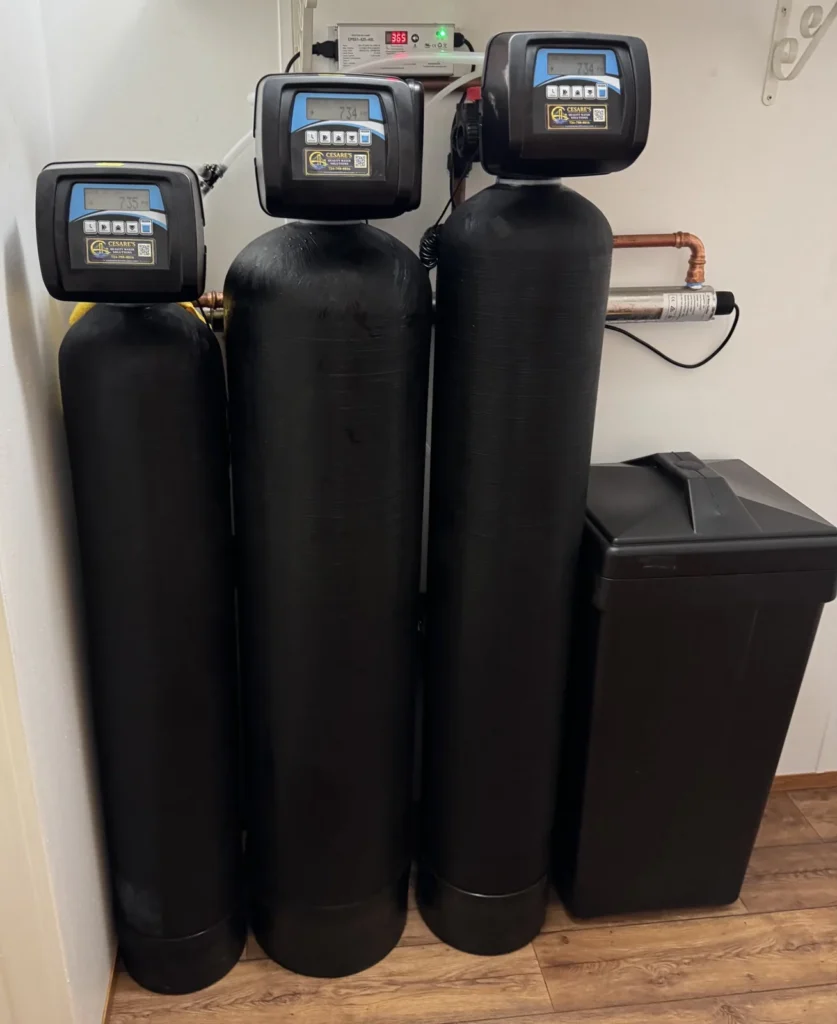
SOMERSET, PA • MUNICIPAL WATER
SOMERSET COUNTY CASE STUDY
On-Site Water Conditions
Free chlorine: 1.2 mg/L
Hardness: 6.3 gpg
TDS at the kitchen tap: 224 ppm
Concern: chlorine taste, odor and spotting
Cesare’s Treatment Design
Our whole-house activated-carbon filtration for chlorine reduction, an ion-exchange softener for hardness, and reverse osmosis at the kitchen sink.
Follow-Up Results
Free chlorine: below 0.10 mg/L
Hardness: 0.6 gpg
TDS at the RO tap: 12 ppm
Reduction: 94.6%
Measured before and after treatment
Chlorine taste and hardness on the Somerset municipal system
A Somerset homeowner wanted less chlorine taste and odor, less mineral buildup on fixtures, and better drinking water at the kitchen. Testing measured a 1.2 mg/L free chlorine residual, 6.3 grains per gallon of hardness and 224 ppm TDS at the tap. Because Somerset Borough runs free chlorine on well water topped up with purchased supply, the build used a Cesare’s activated-carbon bed, an ion-exchange softener, and a reverse osmosis system at the sink. Afterward free chlorine measured below 0.10 mg/L, hardness 0.6 gpg, and the RO tap 12 ppm — a 94.6% reduction.
ROCKWOOD, PA • PRIVATE WELL
MANGANESE, IRON + ACIDIC WATER CASE STUDY
On-Site Water Conditions
pH: 5.6
Iron: 4.8 mg/L
Manganese: 0.62 mg/L
Hardness: 9.7 gpg
Total coliform and E. coli: present
Cesare’s Treatment Design
pH correction for the acidic water, oxidation-based iron and manganese filtration, ion-exchange softening, and UV disinfection as a final microbial barrier.
Follow-Up Results
pH: 7.2
Iron: below 0.05 mg/L
Manganese: below 0.01 mg/L
Hardness: 0.7 gpg
Total coliform and E. coli: absent
Measured before and after treatment
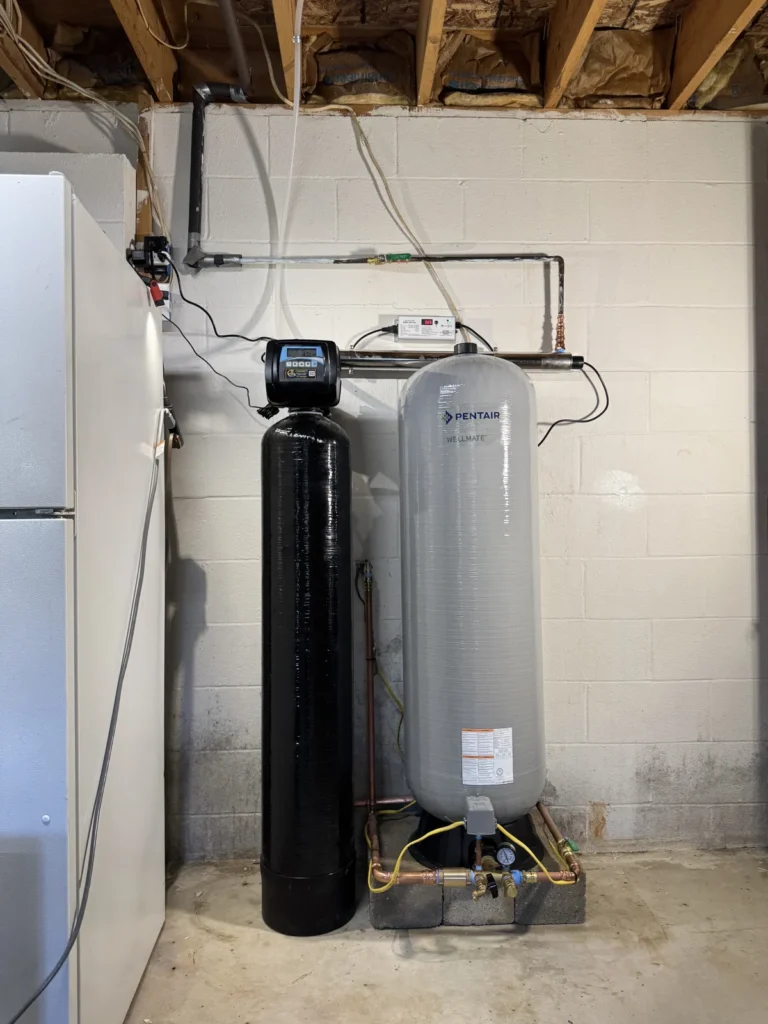
Manganese, iron and acidic water on a Rockwood well
A homeowner near Rockwood called Cesare’s about orange staining, dark deposits around fixtures, a metallic taste and blue-green discoloration on the plumbing. Testing found four mineral conditions and one more besides: manganese at 0.62 mg/L, iron at 4.8 mg/L, pH at 5.6 and 9.7 grains per gallon of hardness — and a positive total-coliform result that had to be treated on its own terms. The well measured pH 5.6, well down toward the low end of Penn State’s published Somerset County range of 4.8 to 9.2. That illustrates why treatment design should start with the water at the property rather than a county median. Cesare’s built it in order: pH correction first, then oxidation-based iron and manganese filtration, then softening, then UV as a final microbial barrier. Afterward pH read 7.2, iron below 0.05 mg/L, manganese below 0.01 mg/L, hardness 0.7 gpg and coliform absent.
Somerset Borough sits at the center of the county on six wells, topped up with water purchased from the Somerset County General Authority. Its 2025 report reads 1.03 to 1.32 ppm chlorine in distribution and 1.4 ppb lead at the 90th percentile with no site over the action level. It is also worth knowing the borough no longer holds a permit for Laurel Hill Creek, whatever older pages online still say. Out past Friedens and Stoystown the mains end and the wells begin.
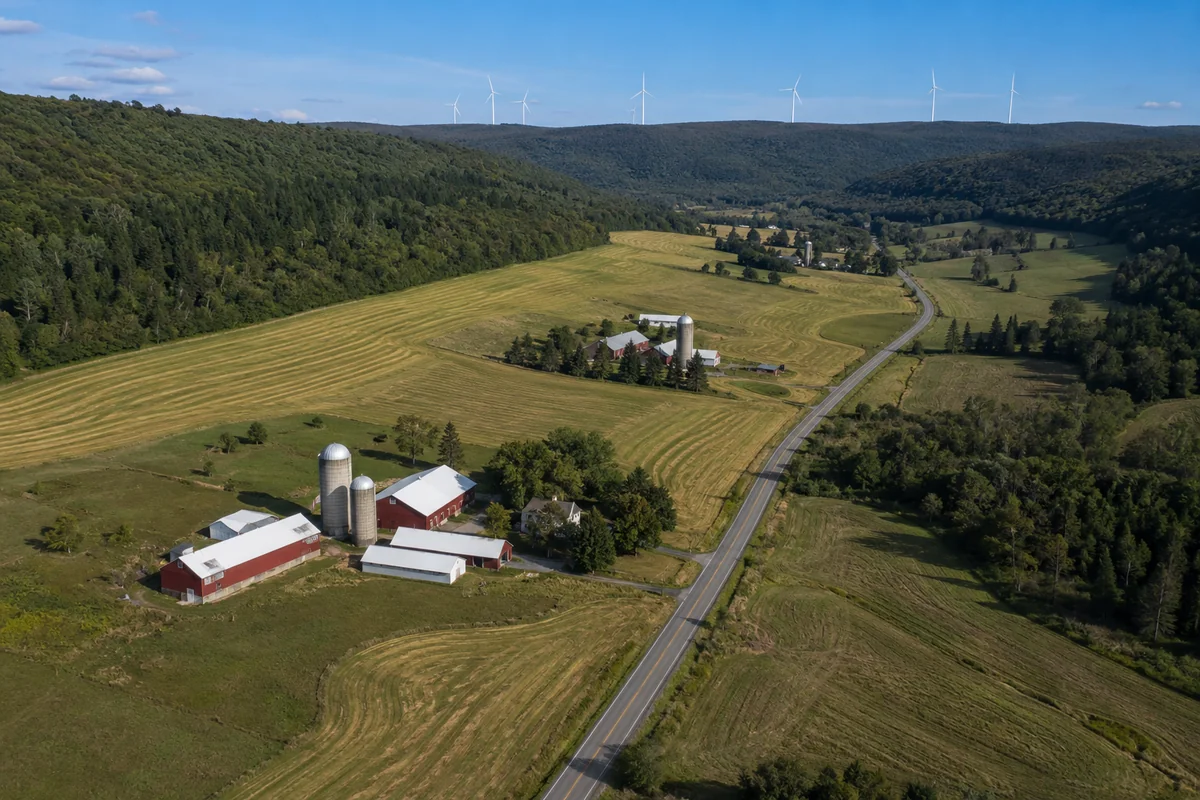
Somerset Somerset Township Friedens Stoystown Shanksville Jennerstown Jenner Township Lincoln Township
Rockwood Confluence Addison New Centerville Seven Springs Middlecreek Township Upper Turkeyfoot Township Black Township
The two ends of the county could hardly be less alike. Windber, on the Johnstown side, is on groundwater — the authority pumps about 1.2 million gallons a day from a series of wells and disinfects with chlorine gas for roughly 10,000 people. Head south to Meyersdale, Berlin and Salisbury and it is high, open farm and ridge country where private wells do the work, and where the pH readings and the arsenic findings matter most.
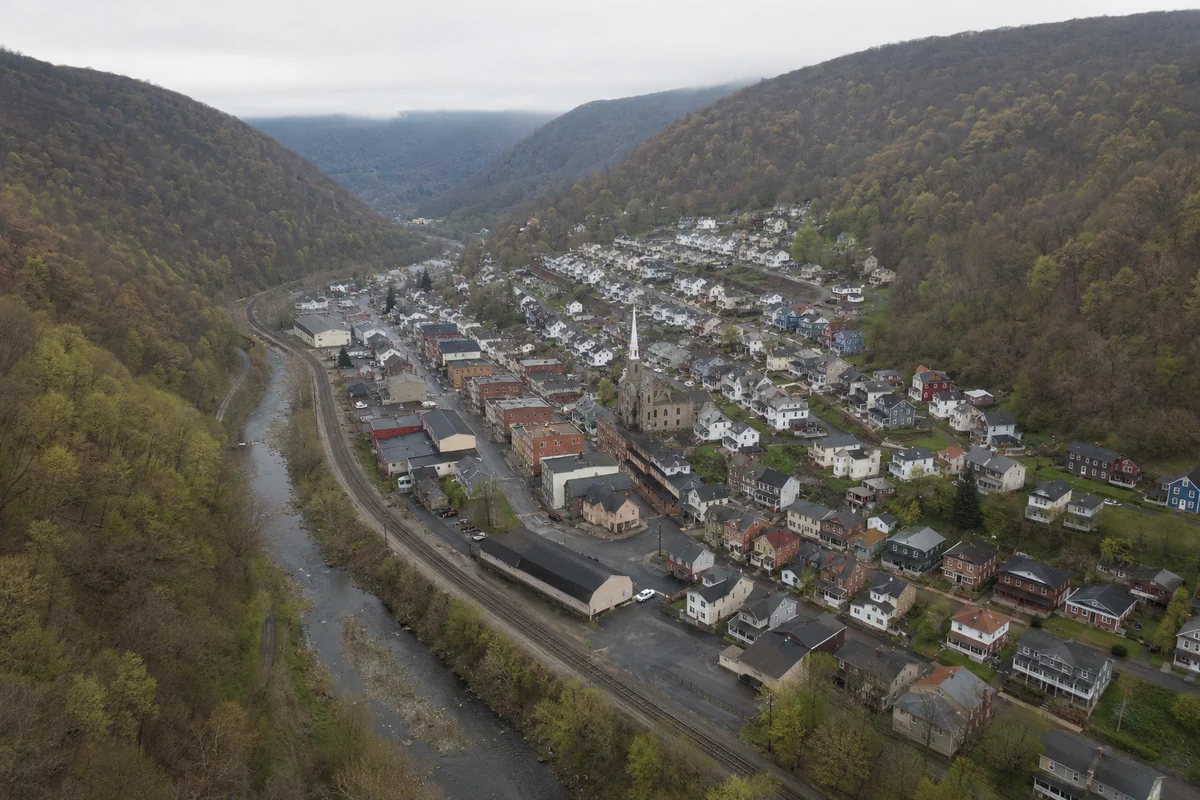
Windber Paint Township Scalp Level Central City Boswell Hooversville Shade Township Quemahoning Township
Meyersdale Berlin Salisbury Garrett Brothersvalley Township Elk Lick Township Summit Township Larimer Township
Cesare’s Quality Water Solutions provides residential water testing, private-well treatment, manganese and iron removal, pH correction, whole-house filtration, water softening, UV disinfection and reverse osmosis throughout Somerset County. We identify the property’s water source and test at the tap before selecting equipment, because Somerset spans groundwater systems, purchased reservoir water and a great many private wells.
All of it. Somerset, Meyersdale, Berlin, Rockwood, Windber, Central City, Boswell, Hooversville, Jennerstown, Stoystown, Confluence, Salisbury, Shanksville and the surrounding rural areas. With three different kinds of public supply plus private wells across the county, treatment needs change substantially by address.
Penn State’s water lab summarizes 107 drinking-water samples submitted from Somerset County between August 2007 and June 2025. Manganese was over the 0.05 mg/L limit in 20 of 40 samples — exactly half — and iron over 0.3 mg/L in 13 of 37. Total coliform bacteria turned up in 49 of 105 and E. coli in 10 of 105. Arsenic was over the standard in 3 of 29. These are homeowner-submitted samples, not a survey of every property, which is why we start with water testing at your tap.
No — the county has three quite different public profiles plus private wells. Somerset Borough runs its own groundwater wells and also purchases water. The Somerset County General Authority distributes water through the Quemahoning Pipeline under agreements with several municipalities. Windber Area Authority runs entirely on its own wells. And rural Somerset is well country. Identify the source before designing anything.
Its own groundwater, plus purchased water. Somerset Borough’s current report lists Well #1 and Well #2 on Shafer Run Road and Wells #7, #8 and #9 on Coxes Creek Road, and states that the borough also purchases water from the Somerset County General Authority Water System. So a Somerset Borough tap can be a blend of local groundwater and purchased supply depending on conditions.
Chlorine. The borough’s current report lists a distribution chlorine result of 1.18 parts per million with a range of 1.03 to 1.32, comfortably under the 4 ppm maximum. Cesare’s carbon filtration for a Somerset Borough home should be sized around the chlorine residual actually measured at the property rather than a system average.
No. The borough’s current water quality report states plainly that Somerset no longer has a permit to use Laurel Hill Creek surface water as a source. Its listed sources today are the Shafer Run and Coxes Creek groundwater wells plus purchased Somerset County General Authority water. Older references online still describe Laurel Hill Creek as a borough source — they are out of date.
The Somerset County General Authority distributes water through the Quemahoning Pipeline, a $23.5 million project the county describes as delivering a safe, reliable supply for both households and economic development. The county lists water agreements with Conemaugh Township, Lincoln Township, Somerset Borough, Somerset Township, Jenner Township and Jefferson Township — so its water reaches a good deal of the county indirectly, including through Somerset Borough’s purchases.
Groundwater, from its own wells. Windber Area Authority says it operates seven production wells drawing from what it calls the Mauch Chunk/Burgoon aquifer, producing about 1.2 million gallons per day for roughly 10,000 people, and that its treatment plant uses chlorine gas to disinfect. That makes Windber a genuinely different supply from either Somerset Borough or the Quemahoning system.
Less than most of the region, but it varies. The median across Penn State’s Somerset County samples is 90.8 mg/L, about 5.3 grains per gallon, with individual results running from under 1 up to 321.3. That is moderate on average — and on a county where corrosion is common, hardness is often not the first thing to treat. A softener makes sense when the hardness measured at your home justifies it and the water chemistry around it has been sorted out first.
It is the county’s signature finding. Penn State found manganese over the 0.05 mg/L limit in 20 of 40 Somerset County samples tested — exactly half — with the highest result at 0.89 mg/L. Indiana County shows the same rate. That does not mean half of Somerset’s wells have elevated manganese; it describes the samples submitted. It does mean manganese deserves a real look whenever a home here has black staining or dark deposits.
Black or dark staining usually points to manganese, orange or rust-colored staining to iron. Penn State found 20 of 40 manganese samples and 13 of 37 iron samples over their limits, with one iron submission reaching 18.4 mg/L — an unusually high single reading. Appearance narrows it down, but testing determines which metal, how much, and in what form before iron and manganese filtration is sized.
Yes, and the spread is the story. Submitted pH ran all the way from 4.8 to 9.2, with 19 of 91 samples outside the recommended 6.5 to 8.5 range — so Somerset has both acidic and alkaline wells, sometimes within a few miles. On top of that, 14 of 31 corrosivity-index samples fell outside the acceptable range, one as low as −5.5. There is no single countywide pH profile here, which is exactly why a neutralizer should never be installed on an assumption.
Pennsylvania DEP recommends testing private well water every year for total coliform bacteria, nitrates, total dissolved solids and pH, through a state-certified lab, plus anything else you have reason to suspect. In Somerset County, manganese, iron, hardness and corrosion-related chemistry are especially worth adding when there is staining, scale or plumbing trouble — and arsenic belongs in the plan for the reasons below.
Treat it as a safety issue. DEP’s guidance is not to consume the water unless it has been brought to a rolling boil for one minute, or to use bottled water for drinking and food preparation while the problem is addressed. Then the well gets investigated for how contamination is entering, corrected or disinfected, and properly retested. A properly designed UV disinfection system disinfects water passing through the reactor, but it does not repair the contamination pathway itself. Locally, 49 of 105 submitted samples were coliform-positive and 10 of 105 carried E. coli.
It is worth testing for here more than in most of the counties we serve. Penn State found 3 of 29 Somerset County samples tested for arsenic — about 10% — above the 0.01 mg/L standard, with the highest at 0.017. Only 29 samples were tested, so that share should never be read as the prevalence across the county. But arsenic has no taste, odor or color, which means the only way to rule it out at your property is a laboratory test.
It is worth considering when a home has an older or unknown service line, older fixtures or lead-containing plumbing. Penn State’s Somerset County submissions included 4 of 30 first-draw samples above 0.015 mg/L — one of them at 0.215, many times the action level — while only 1 of 29 running-water samples exceeded it. Somerset Borough’s own monitoring, by contrast, reported a 1.4 ppb 90th-percentile result with no sites over the action level. Those are two different questions: the utility’s number describes the system, and a first-draw test describes your house.
It depends on the source and what the tests find. A Somerset Borough or Windber home wanting chlorine filtration is a very different project from a Rockwood or Meyersdale-area well needing manganese and iron removal, pH correction, softening or UV together. Flow rate, plumbing and the number of stages all factor in — and on water this variable, the order the stages go in matters as much as the equipment. Cesare’s prices a system after testing the water and identifying what the property actually requires.
Straight answers to the water questions we hear most in Somerset County.
See how Somerset County compares with 12 other Southwestern Pennsylvania counties for hardness, iron, manganese, bacteria and corrosivity in the 2026 Southwestern PA Water Quality Report.
2026 Southwestern PA Water Quality Report →
Get a professional water analysis and a custom treatment plan—clear answers, no pressure.