- Pittsburgh & Southwestern PA • Custom-Engineered Water Treatment
- Fully Licensed & Insured
- 24/7 Emergency Water Service
- 3rd Generation Water Treatment Experts

Greene County is well country with a municipal spine. Waynesburg and the corridor around it drink treated Monongahela River water, Pennsylvania American Water now runs the former East Dunkard system in the southeast, and everywhere else the water comes out of the ground on the property. Cesare’s tests the water at your house and builds residential treatment around what the test actually says.

About 33,900 people live in Greene County across 26 municipalities — six boroughs and twenty townships — which makes it the least crowded county Cesare’s serves and one of the most dependent on private wells. Southwestern Pennsylvania Water Authority carries the largest share of the piped water, serving roughly 50,000 people through 14,500 accounts and 550 miles of pipeline across 23 municipalities in Greene and Fayette counties. Past those mains, households are on their own wells. Two findings run through the county’s submitted samples harder than any others: bacteria, and hardness.
River water treated at a plant on the Monongahela, a system in the southeast under brand-new ownership, and private wells across the rest of the county. Three different starting points, and the treatment that suits one is wrong for the next.
Southwestern Pennsylvania Water Authority has supplied the Waynesburg system since it acquired the Waynesburg Water Company in 1967. Its treatment plant sits in Cumberland Township on the Monongahela River and serves the entire system.
Pennsylvania American Water completed its purchase of the former East Dunkard Water Authority system on April 29, 2025, committing more than $16.1 million over five years. That system reaches Dunkard and Greene townships and parts of Monongahela, Cumberland, Perry and Whiteley.
Outside the mains Greene County runs on private wells. No utility is testing that water, no annual report arrives in the mail, and what reaches the tap is whatever the well and its casing deliver that week.
Penn State’s Agricultural Analytical Services Laboratory has summarized 110 Greene County drinking-water samples submitted between June 2008 and May 2025. These are the results of samples people chose to send in, not a representative survey of every home, well or public supply in the county.
BACTERIA IS THE HEADLINE FINDING
Total coliform — 80 of the 106 samples tested (75.5%) came back positive against a standard of zero. That is the highest coliform rate of any county Cesare’s serves.
E. coli — 41 of the 106 samples tested (38.7%) were positive, with a maximum of 200.5 MPN per 100 mL. Coliform suggests a pathway into the well; E. coli says that pathway is carrying waste.
MINERALS AND PLUMBING
Hardness — the median of the 65 samples tested was 182 mg/L, about 10.6 grains per gallon, which is squarely hard water. The range ran from 0.8 to 507.8 mg/L, so the county median tells you very little about one address.
Corrosivity index — 39 of 63 samples tested (61.9%) fell outside Penn State’s criterion, ranging from —2.7 to 1.2. Greene lands on both sides of that line: some samples aggressive toward plumbing, others scale-forming.
Iron — 5 of only 18 samples tested (27.8%) were above the 0.3 mg/L secondary standard, up to 3.0 mg/L. Manganese — 5 of only 19 tested (26.3%) were above 0.05 mg/L, up to 3.32 mg/L. Both denominators are small; treat them as a signal to test, not as a county rate.
WHAT DID NOT SHOW UP
Arsenic — 0 of 76 samples tested exceeded the standard. Nitrate plus nitrite — 0 of 68. And pH tells a story opposite to the counties east of here: 10 of 94 samples (10.6%) fell outside the recommended range, but the minimum was 6.8 and the maximum 9.5, so the submitted samples lean alkaline more often than acidic. Individual wells still run acidic — the Mount Morris install below started at pH 6.4 — which is why the fix follows the test, not the county trend.
Bacteria is the defining Greene County finding, and it is the one problem that shows no stain, no smell and no taste. Hardness is the one people actually notice. Where a well has both, the order they are treated in matters.
Three out of four submitted samples were coliform-positive and nearly four in ten carried E. coli. Those were voluntarily submitted samples, not a representative survey of every Greene County well. There is no visual symptom — a certified laboratory test is the only way to know, which is why it belongs in every Greene County well workup.
A 182 mg/L median among submitted samples puts a lot of Greene well water in hard territory: crust on fixtures and kettles, spots on glassware, soap that will not lather, and water heaters that lose efficiency years early.
Iron above the secondary standard in 5 of 18 tested samples leaves orange staining; manganese above it in 5 of 19 leaves the darker black-brown deposits. They often arrive together and need oxidation before filtration.
Two things are worth saying plainly, because they cut against the usual sales pitch. Greene County water that fails on pH fails on the high side, so an acid neutralizer is usually not the first fix here, though individual wells still vary. And no submitted sample exceeded the arsenic or nitrate standards. The problems Greene actually has are bacteria and minerals, and both are treatable once the water is measured.
Pennsylvania does not regulate privately owned household wells, so no one tests a Greene County well but its owner. The Department of Environmental Protection recommends testing every year for total coliform bacteria, nitrate, total dissolved solids and pH, always through a state-certified drinking-water laboratory. Given what the county’s submitted samples look like, coliform is the one to start with.
Greene County also sits in active gas country, and there is a sound reason to test before anything changes nearby rather than after. A dated laboratory result taken beforehand is the only way to show what your water looked like to begin with. Pennsylvania recognised the same logic in Act 13 of 2012, which funds a Baseline Water Quality Data Program to document existing groundwater conditions on private supplies — though those grants go to municipalities and organisations, not to individual homeowners. For a household, baseline testing means paying a certified lab and keeping the report. Cesare’s publishes the same tested county data for neighboring Washington and Fayette counties.
Ultraviolet disinfection sized to the household flow rate and installed downstream of filtration so the lamp sees clear water. This is the standard answer to a coliform-positive Greene County well.
Ion exchange sized to the measured hardness and the real household demand. With a county median around 182 mg/L, many Greene homes on wells are worth checking.
Oxidation ahead of filtration for the orange and black staining, and for the rotten-egg sulfur odor that often travels with them in well country.
Cesare’s whole-home carbon filtration for homes on the Southwestern Pennsylvania Water Authority system or the former East Dunkard system, tuned to what is measured at the tap.
Point-of-use treatment at the kitchen for drinking and cooking water, sized after the whole-house work is finished rather than instead of it.
Inspection, repair and service for equipment somebody else installed, including systems that were never sized to the water in the first place.
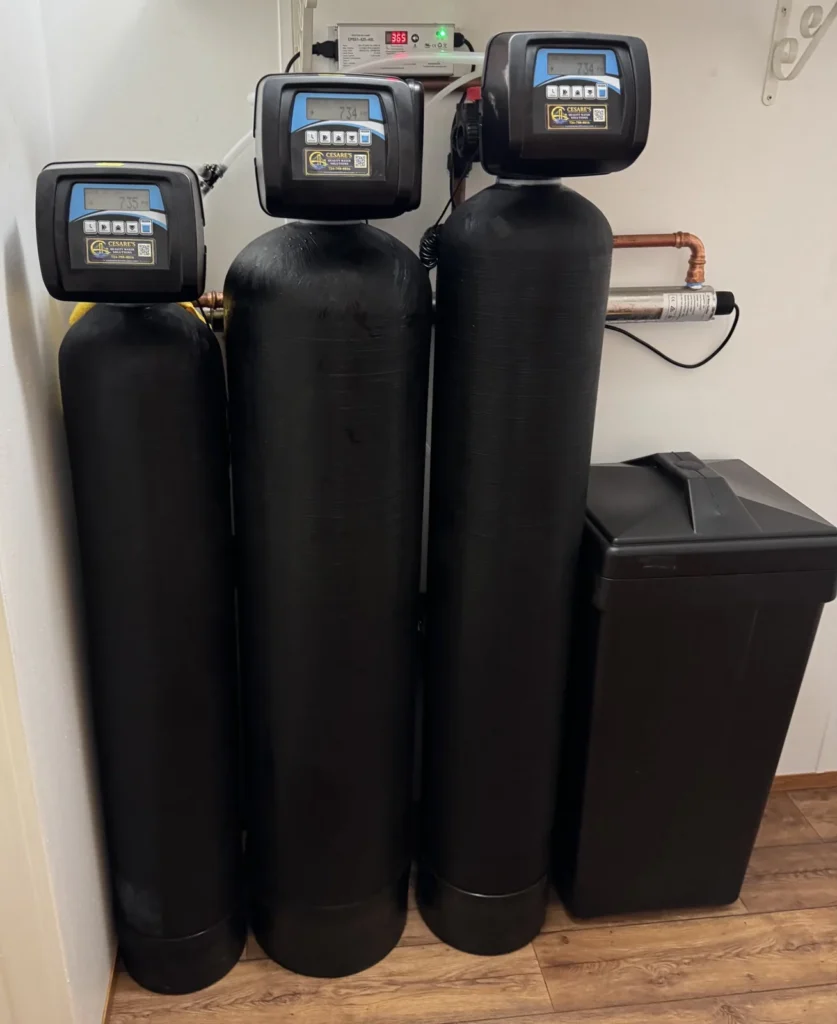
WAYNESBURG, PA • MUNICIPAL WATER
GREENE COUNTY CASE STUDY
On-Site Water Conditions
Free chlorine: 1.5 mg/L
Hardness: 11.2 gpg
TDS at the kitchen tap: 286 ppm
Concern: chlorine taste, odor and spotting
Cesare’s Treatment Design
Our whole-house activated-carbon filtration for chlorine reduction, an ion-exchange softener for hardness, and reverse osmosis at the kitchen sink.
Follow-Up Results
Free chlorine: below 0.10 mg/L
Hardness: 0.6 gpg
TDS at the RO tap: 15 ppm
Reduction: 94.8%
Measured before and after treatment
Chlorine taste and hardness on the Waynesburg municipal system
A Waynesburg homeowner wanted less chlorine taste and odor, less mineral buildup on fixtures, and better drinking water at the kitchen. Testing measured a 1.5 mg/L free chlorine residual, 11.2 grains per gallon of hardness and 286 ppm TDS at the tap. Because the Waynesburg supply is treated Monongahela River water carrying a disinfectant residual, the build used a Cesare’s activated-carbon bed, an ion-exchange softener, and a reverse osmosis system at the sink. Afterward free chlorine measured below 0.10 mg/L, hardness 0.6 gpg, and the RO tap 15 ppm — a 94.8% reduction.
MOUNT MORRIS, PA • PRIVATE WELL
ACIDIC WATER, IRON + MANGANESE CASE STUDY
On-Site Water Conditions
pH: 6.4
Iron: 2.8 mg/L
Manganese: 0.16 mg/L
Hardness: 14.6 gpg
Total coliform and E. coli: present
Cesare’s Treatment Design
pH correction for the acidic water, oxidation-based iron and manganese filtration, ion-exchange softening, and UV disinfection as a final microbial barrier.
Follow-Up Results
pH: 7.2
Iron: below 0.05 mg/L
Manganese: below 0.01 mg/L
Hardness: 0.7 gpg
Total coliform and E. coli: absent
Measured before and after treatment
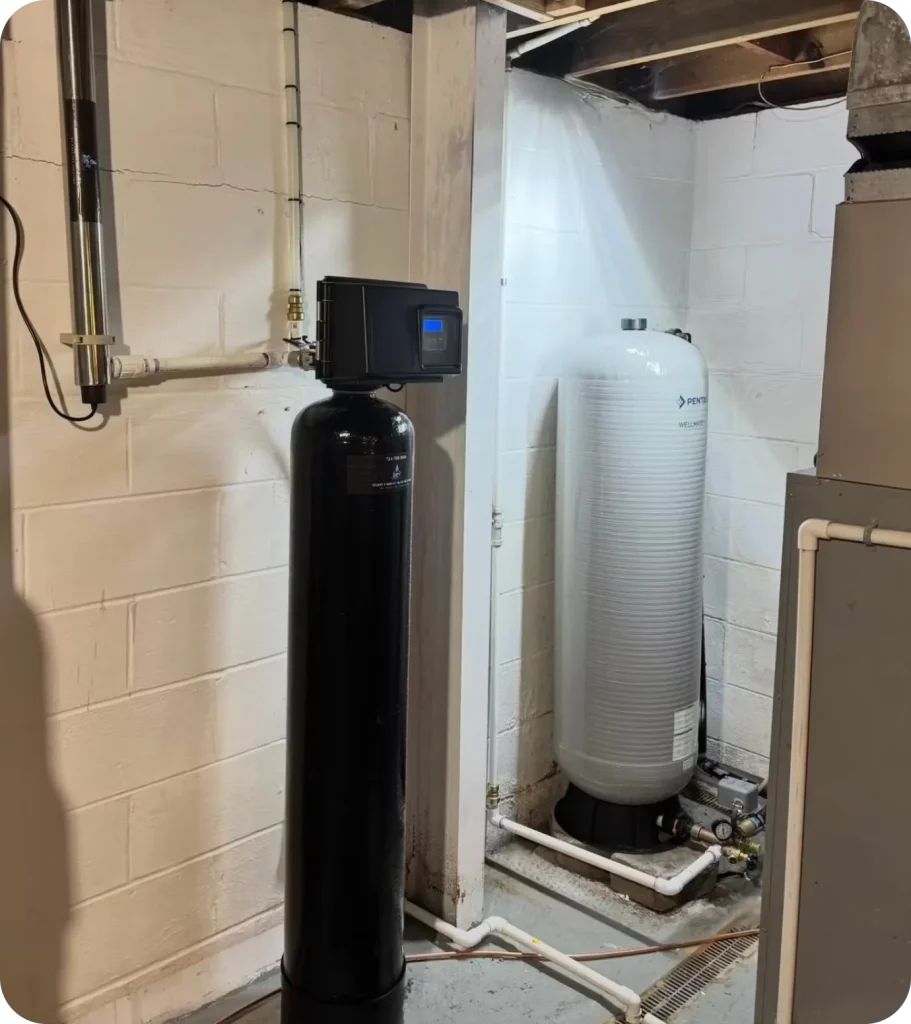
Hard water, staining and a coliform hit on a Mount Morris well
A homeowner near Mount Morris called Cesare’s about orange staining, dark deposits around fixtures, a metallic taste and blue-green discoloration on the plumbing. Testing found four mineral conditions and one more besides: pH at 6.4, iron at 2.8 mg/L, manganese at 0.16 mg/L, 14.6 grains per gallon of hardness — and a positive total-coliform result that had to be treated on its own terms. At 6.4 the pH also ran acidic, lower than anything in Penn State’s Greene County range, which is exactly why the design starts from the test rather than from the county profile. Cesare’s built it in order: pH correction first, then oxidation-based iron and manganese filtration, then softening, then UV as a final microbial barrier. Afterward pH read 7.2, iron below 0.05 mg/L, manganese below 0.01 mg/L, hardness 0.7 gpg and coliform absent.
The county seat and the corridor around it are the one part of Greene County where most homes are on a public main. Southwestern Pennsylvania Water Authority has run the Waynesburg system since 1967 and treats Monongahela River water at its Cumberland Township plant, which means chlorinated surface water rather than groundwater. Move a few miles out along the ridges toward Rogersville and Wind Ridge and the mains end; from there it is well water, and the bacteria numbers start to matter.
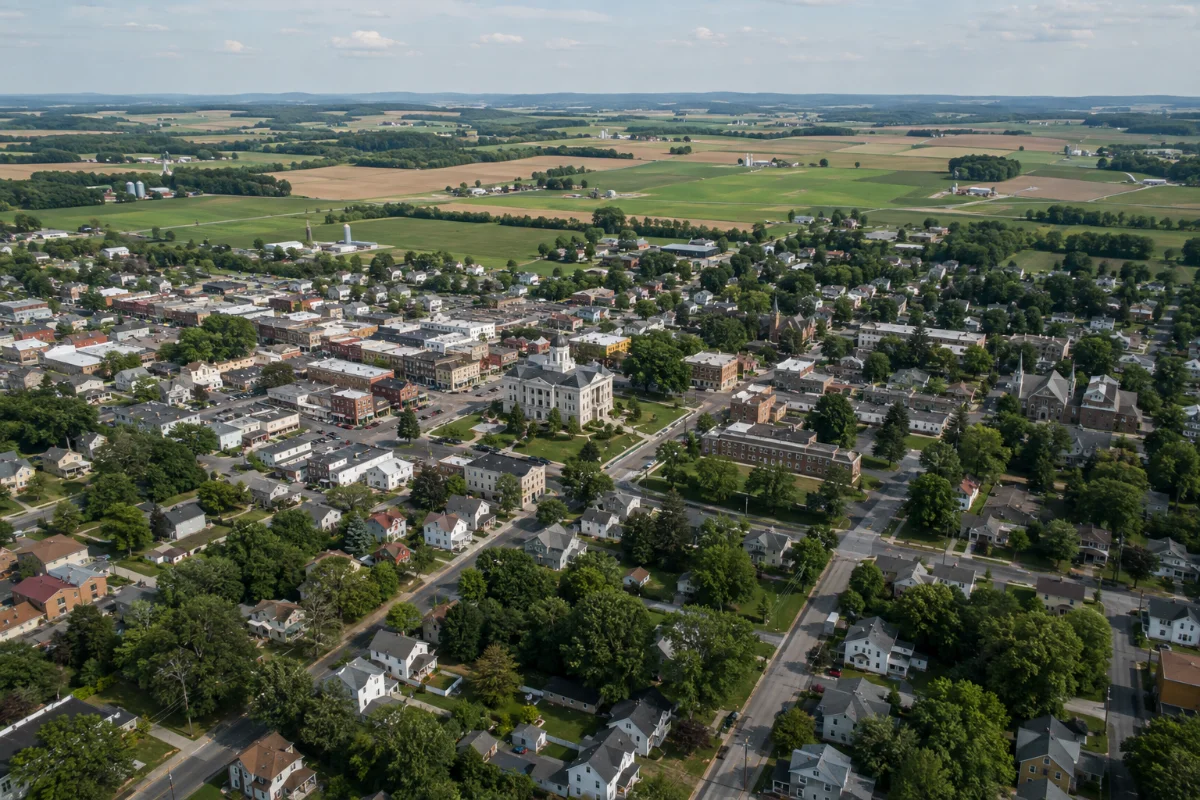
Waynesburg Franklin Township Morgan Township Washington Township Morris Township Center Township Jefferson Jefferson Township
Rogersville Graysville Wind Ridge Richhill Township Aleppo Township Gilmore Township Jackson Township Gray Township
Along the Monongahela the pattern changes again. Carmichaels, Rices Landing and the old coal towns sit close to the river, while the southeastern corner — Dunkard and Greene townships and parts of Monongahela, Cumberland, Perry and Whiteley — is served by the former East Dunkard system, bought by Pennsylvania American Water on April 29, 2025 with more than $16.1 million of work promised over five years. Between and beyond those systems, the hollows run on private wells.
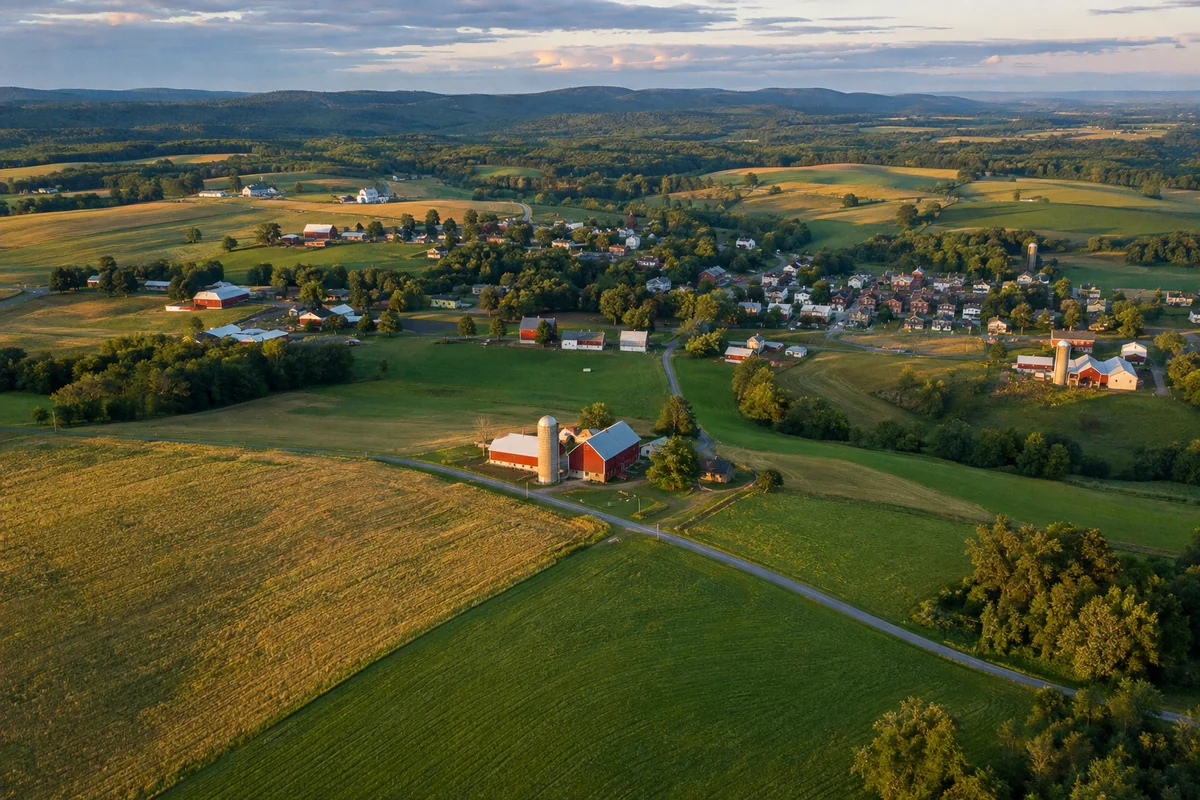
Carmichaels Cumberland Township Rices Landing Clarksville Nemacolin Wayne Township Greene Township Whiteley Township
Greensboro Bobtown Mount Morris Dunkard Township Monongahela Township Perry Township Springhill Township Freeport Township
Cesare’s Quality Water Solutions provides residential water testing, private-well treatment, whole-house filtration, water softening, iron and manganese removal, sulfur treatment, UV disinfection and reverse osmosis throughout Greene County. Treatment begins by identifying the property’s water source and testing the water at the home rather than selecting equipment from a countywide assumption.
No, and it is worth clearing up. Cesare’s Quality Water Solutions does residential drinking-water testing and treatment for homes. The similarly named Greene County Water Treatment operation in Waynesburg is an unrelated industrial business tied to oil-and-gas production and flowback water. If you are looking for whole-house or well-water treatment for a house, that is us — different company, different work entirely.
Communities throughout the county, including Waynesburg, Carmichaels, Jefferson, Rices Landing, Clarksville, Nemacolin, Greensboro, Bobtown, Mount Morris, Rogersville, Graysville, Wind Ridge and the surrounding townships. Greene mixes municipal service areas with a lot of private-well territory, so treatment needs change substantially by address.
Penn State’s water lab summarizes 110 drinking-water samples submitted from Greene County between June 2008 and May 2025. Total coliform bacteria turned up in 80 of 106 samples and E. coli in 41 of 106. Median hardness among 65 tested samples was 182 mg/L, about 10.6 grains per gallon, with results from 0.8 all the way to 507.8. Iron was over the limit in 5 of 18 samples and manganese in 5 of 19. On the good-news side, none of the 76 arsenic samples and none of the 68 nitrate samples exceeded their standards. These are voluntarily submitted samples, not a representative survey of every Greene County well, which is why we start with water testing at your tap.
It is the strongest signal in the county data. Of the samples submitted to Penn State, 80 of 106 tested positive for total coliform and 41 of 106 for E. coli. That does not mean three-quarters of Greene County wells are contaminated — these were samples people chose to submit, often because they already suspected a problem. What makes bacteria worth taking seriously is that it produces no stain, no smell and no taste. A laboratory test is the only way to know whether it is in your well.
Treat it as a safety issue. DEP’s guidance is not to consume the water unless it has been brought to a rolling boil for one minute, or to use bottled water for drinking and food preparation while the problem is addressed. Then the well gets evaluated for how contamination is getting in — a failed cap, casing or grouting, or surface water nearby — corrected or disinfected as appropriate, and properly retested. A correctly sized UV disinfection system treats water passing through the reactor, but it does not repair the well or stop new contamination from entering the source. Finding the entry point is what actually solves it.
Greene runs harder than most of the counties around it, but it varies a lot property to property. The median among 65 submitted Penn State samples was 182 mg/L, about 10.6 grains per gallon, with individual results ranging from under 1 to 507.8 mg/L. At 10 grains you get crust on fixtures and kettles, spotted glassware and soap that will not lather. A softener should still be sized from the hardness measured at your home and what you actually want to change, not from the county median.
The Monongahela River. Waynesburg is supplied by the Southwestern Pennsylvania Water Authority, whose treatment plant sits in Cumberland Township on the Monongahela and serves its entire system. The authority acquired the former Waynesburg Water Company system in 1967 and today serves roughly 50,000 people across two dozen municipalities stretching from western Fayette County into Greene.
Chlorine. Southwestern Pennsylvania Water Authority’s current report lists chlorine at 1.14 parts per million with a distribution range of 0.20 to 2.39. That range is worth noting — the residual at your tap depends partly on how far you sit from the plant, so a Cesare’s carbon system should be sized from what is measured at the property rather than the system average.
Pennsylvania American Water now owns what used to be the East Dunkard Water Authority system. That acquisition closed on April 29, 2025, covering roughly 1,600 customer connections in Greene County, and the company announced plans to invest more than $16.1 million in system improvements over five years. If you were an East Dunkard customer, your water company changed even though your water did not.
Pennsylvania DEP recommends testing private well water every year for total coliform bacteria, nitrates, total dissolved solids and pH, through a state-certified lab, plus anything else you have reason to suspect. Given what Greene County submissions look like, hardness, iron and manganese are worth adding whenever there is scale or staining. And because bacteria is the one problem you cannot see, taste or smell, the annual bacteria test is the one not to skip.
Yes, if the goal is to document the well’s condition before the activity starts. A chain-of-custody laboratory test performed beforehand creates a documented baseline to compare against if the water later changes. Penn State identifies chloride and barium among the parameters worth including when drilling is the reason for testing. Baseline testing does not imply anything has contaminated a well — it establishes what the water looked like first, which is the only way a later comparison means anything.
Orange, reddish-brown or rust-colored staining usually points to iron; dark brown or black deposits usually point to manganese. In Penn State’s Greene County submissions, 5 of 18 iron samples were over the 0.3 mg/L limit and 5 of 19 manganese samples were over 0.05 mg/L. Those are small denominators, so treat them as a reason to test rather than a countywide estimate. The fix is iron and manganese filtration matched to what the test actually finds.
That smell usually points to hydrogen sulfide or another sulfur condition, and where it appears narrows it down. Odor in both hot and cold water suggests the well or supply; odor only on the hot side can involve the water heater. Worth knowing: Penn State’s Greene County summary does not include hydrogen-sulfide testing at all, so sulfur has to be measured at your property rather than inferred from county statistics.
It is worth checking, and the Greene data is more interesting than a simple pH reading suggests. In Penn State’s submissions, 39 of 63 corrosivity-index samples — 61.9% — fell outside the acceptable range, with results from −2.7 to 1.2. Yet the lowest submitted pH was 6.8, meaning the pH failures here ran alkaline rather than acidic. Corrosion potential depends on more than pH, so plumbing protection should be based on the full water analysis for your home, not a county assumption in either direction.
It is worth considering when a home has an older or unknown service line, older fixtures or lead-containing plumbing. In Penn State’s Greene County submissions, 3 of 70 first-draw samples were above 0.015 mg/L while none of the 68 running-water samples exceeded that level. That pattern is typical of lead: it comes from water sitting in the home’s own line and plumbing, which is why a first-draw test at your faucet answers the question and a county or utility figure cannot.
There is no single best system here. A Waynesburg home on chlorinated Monongahela River water needs a very different design from a Mount Morris or Rogersville well carrying hardness, bacteria, iron, manganese or sulfur. On a well, the stages might include oxidation and filtration for iron or manganese, ion exchange for hardness, sulfur treatment when hydrogen sulfide is confirmed, and UV where microbial treatment is appropriate. County statistics tell you what to investigate; the test results decide the equipment and the order it goes in.
It depends on the source and what the tests find. A Waynesburg municipal home wanting chlorine reduction and softening is a different project from a rural well needing iron and manganese removal, sulfur treatment, softening and UV together. Flow rate, plumbing and the number of stages all factor in. Cesare’s prices a system after evaluating the property’s water and identifying the treatment actually required.
Straight answers to the water questions we hear most in Greene County.
See how Greene County compares with 12 other Southwestern Pennsylvania counties for hardness, iron, manganese, bacteria and corrosivity in the 2026 Southwestern PA Water Quality Report.
2026 Southwestern PA Water Quality Report →
Get a professional water analysis and a custom treatment plan—clear answers, no pressure.