- Pittsburgh & Southwestern PA • Custom-Engineered Water Treatment
- Fully Licensed & Insured
- 24/7 Emergency Water Service
- 3rd Generation Water Treatment Experts

Mercer County water depends entirely on where you live. The Shenango Valley drinks treated river water, Grove City pumps its own groundwater, and thousands of homes across the county run on private wells. Cesare’s identifies which supply is yours, tests the water at your tap, and engineers treatment around what it finds.

Aqua Pennsylvania’s Shenango Division treats Shenango River water, fed by a 650-square-mile watershed north of Sharon, serving more than 50,000 residents in the valley. A nearly $35 million plant upgrade wrapped in 2026.
Aqua Pennsylvania acquired the Greenville Municipal Water Authority in 2026 — more than 2,900 customers in Greenville Borough and Hempfield and West Salem townships joined the Aqua system.
Grove City runs its own utility, Sandy Lake’s authority produces water in the southeast, and thousands of homes rely on private wells that no agency tests or treats for the owner.
Penn State’s Agricultural Analytical Services Laboratory has summarized 299 Mercer County drinking-water submissions collected between September 2007 and June 2025. These laboratory results describe the samples submitted to Penn State and are not a representative survey of all homes, wells or public water supplies in the county.
Aesthetic water conditions
Health-related indicators
About the data: Individual parameters were tested on different numbers of samples. These results describe the samples submitted — they cannot determine what is present at an individual property. Test the water at the property before treatment is selected.
Source: Penn State Agricultural Analytical Services Laboratory — Drinking Water Test Summaries by County.
Iron was above the staining standard in 27.8% of tested Penn State samples and manganese in 27.4% — the county’s signature well-water finding.
Which system serves you decides what reaches your tap — river water in the Shenango Valley, groundwater in Grove City. Filtration is matched to the actual supply.
Median hardness in tested samples is about 4.6 gpg — moderate. Metals, not minerals, cause most of the staining Mercer County homeowners see.
Concerned about lead? Aqua began surveying customer-owned service lines in Farrell and Mercer Borough in 2026 to find lead and galvanized lines. Material varies house by house — testing at the tap is how you know.
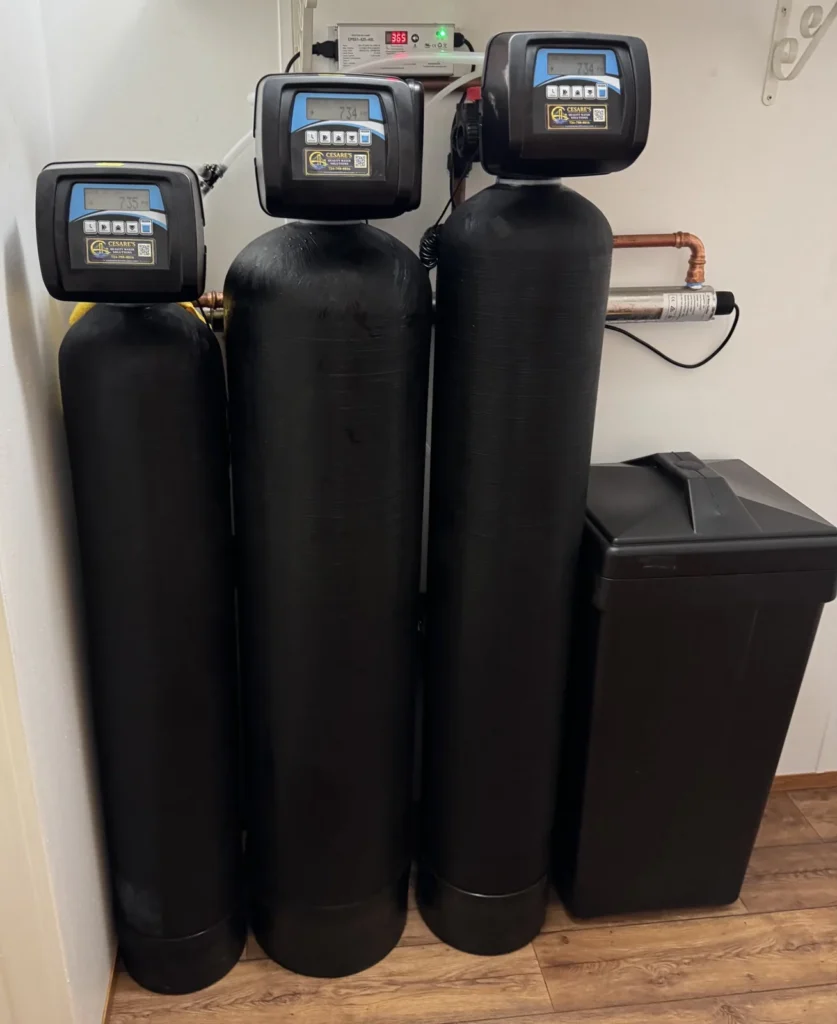
HERMITAGE, PA • MUNICIPAL WATER
MERCER COUNTY CASE STUDY
On-Site Water Conditions
Free chlorine: 2.6 ppm
Hardness: 9 gpg
pH: 7.6
Concern: disinfectant taste and odor, plus scale on fixtures
Cesare’s Treatment Design
Our properly sized whole-house activated-carbon filtration followed by ion-exchange softening, engineered around the measured municipal water and household flow.
Follow-Up Results
Free chlorine: below 0.1 ppm
Hardness: below 1 gpg
pH: 7.5
Taste and odor: homeowner reported improvement
Measured before and after treatment
Hard water and disinfectant concerns in a Shenango Valley home
A Hermitage homeowner contacted Cesare’s about scale on fixtures and a noticeable disinfectant taste and odor on Shenango Valley municipal water. On-site testing measured 2.6 ppm free chlorine and 9 grains per gallon of hardness at a pH of 7.6. After a properly sized Cesare’s whole-house carbon filter followed by ion-exchange softening, free chlorine measured below 0.1 ppm and hardness below 1 grain per gallon at the tested taps, with pH essentially unchanged at 7.5.
GROVE CITY AREA, PA • PRIVATE WELL
IRON + MANGANESE CASE STUDY
On-Site Water Conditions
Iron: 2.8 mg/L
Manganese: 0.32 mg/L
Hardness: 12 gpg
pH: 7.2
Total coliform: present
E. coli: absent
Cesare’s Treatment Design
Oxidation with dedicated iron and manganese filtration, followed by ion-exchange softening, sized to the measured chemistry and household flow.
Follow-Up Results
Iron: below 0.05 mg/L
Manganese: below 0.01 mg/L
Hardness: below 1 gpg
pH: 7.3
Total coliform: absent
E. coli: absent
Measured before and after treatment
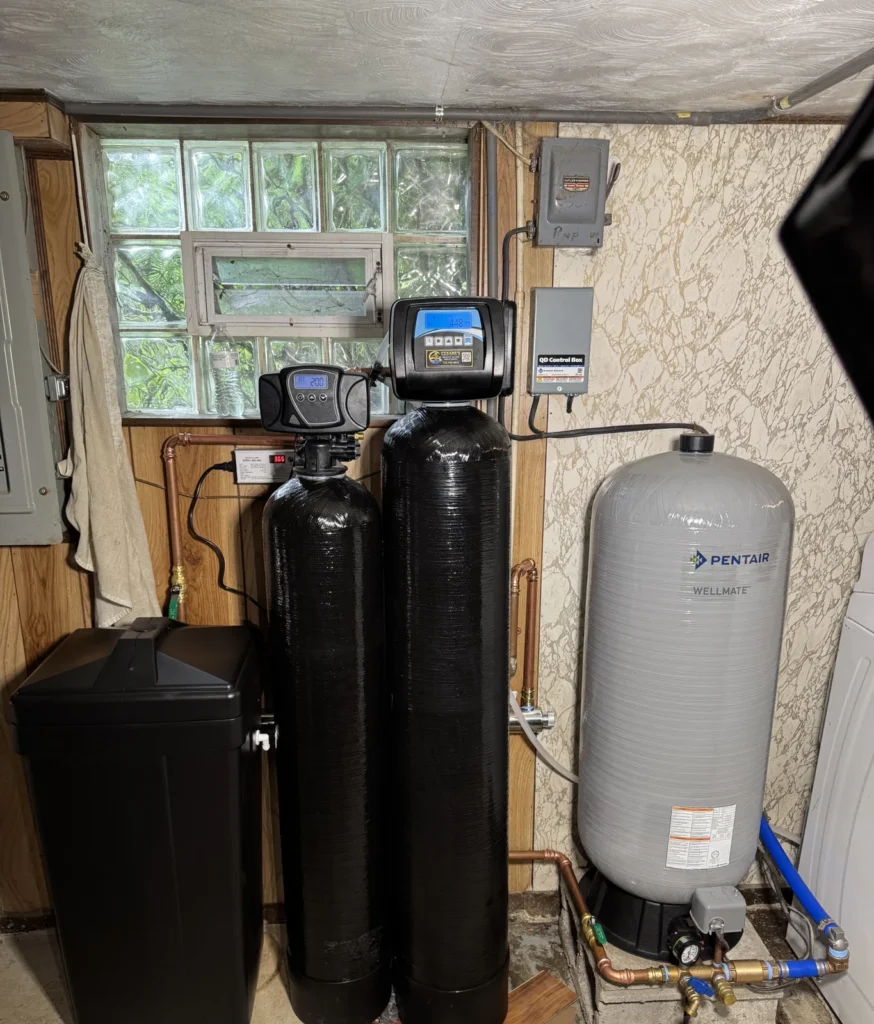
Orange staining, black deposits and mineral buildup in a private well home
A homeowner in the Grove City area called Cesare’s after orange staining and dark deposits from a private well. Testing measured 2.8 mg/L iron, more than nine times the 0.3 mg/L secondary standard, along with 0.32 mg/L manganese, over six times the 0.05 mg/L secondary guideline, and 12 grains per gallon of hardness. Oxidation with dedicated iron and manganese filtration followed by softening brought iron below 0.05 mg/L, manganese below 0.01 mg/L and hardness below 1 grain per gallon, with pH steady at 7.3.
Bacteria were analyzed by an accredited laboratory. Total coliform was present in the pre-treatment sample and absent in the follow-up sample. E. coli was absent in both.
Whole-home filtration matched to the system that actually serves you — river water in the Shenango Valley, groundwater in Grove City.
Sized to measured hardness — about 4.6 gpg at the median in tested Mercer County samples, so oversizing is a real risk.
Point-of-use treatment for taste, dissolved minerals and laboratory-confirmed drinking-water concerns.
Iron and manganese are among Mercer County’s most common aesthetic findings. Treatment starts with measuring the metal, not guessing at it.
Rotten-egg odor traced to its source — water supply, plumbing or water heater — before treatment is chosen.
Inspection, repair and service for existing equipment — including systems Cesare’s didn’t install.
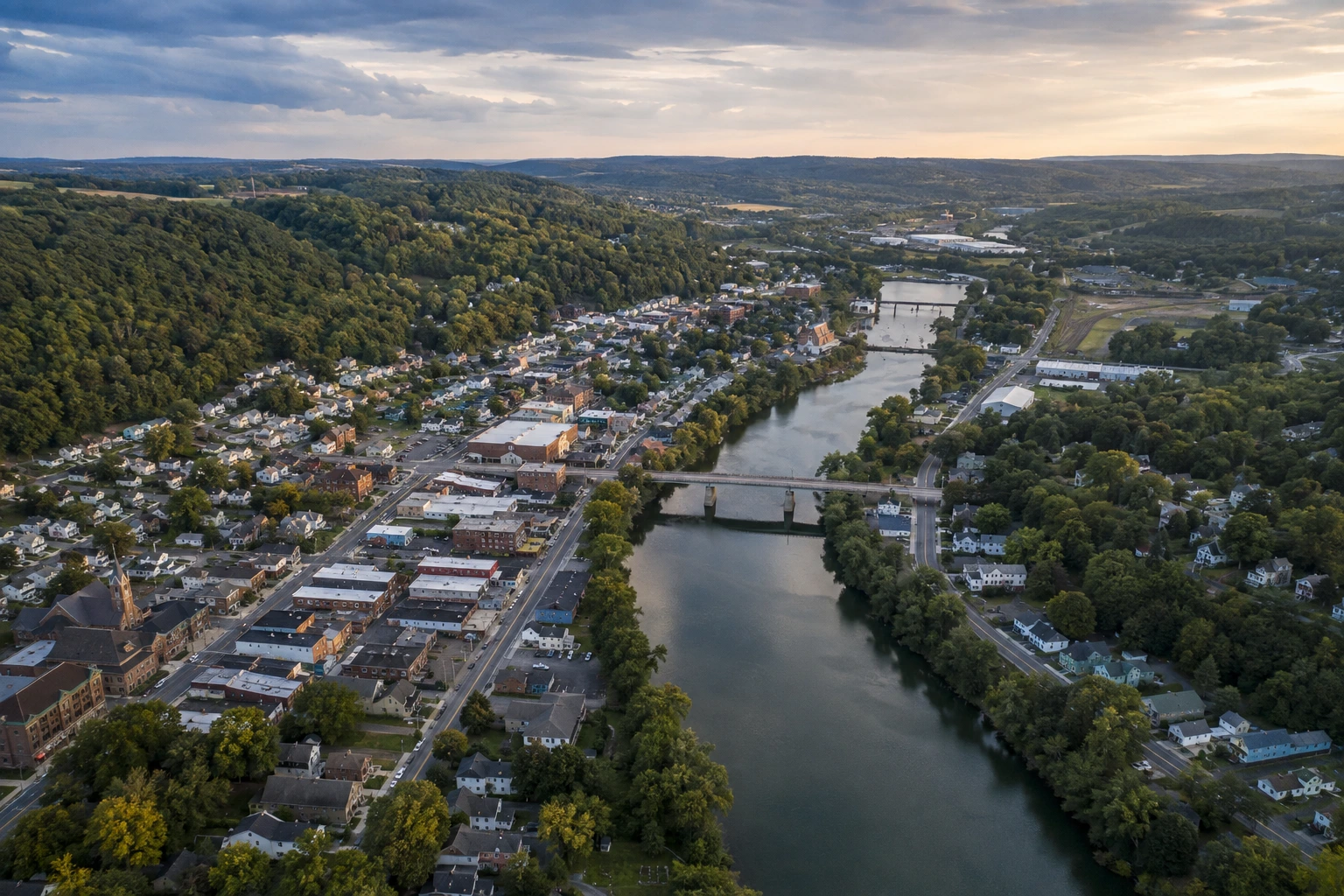
Sharon Hermitage Farrell Sharpsville Wheatland West Middlesex Clark
Greenville Hempfield Township West Salem Township Jamestown Transfer Fredonia South Pymatuning
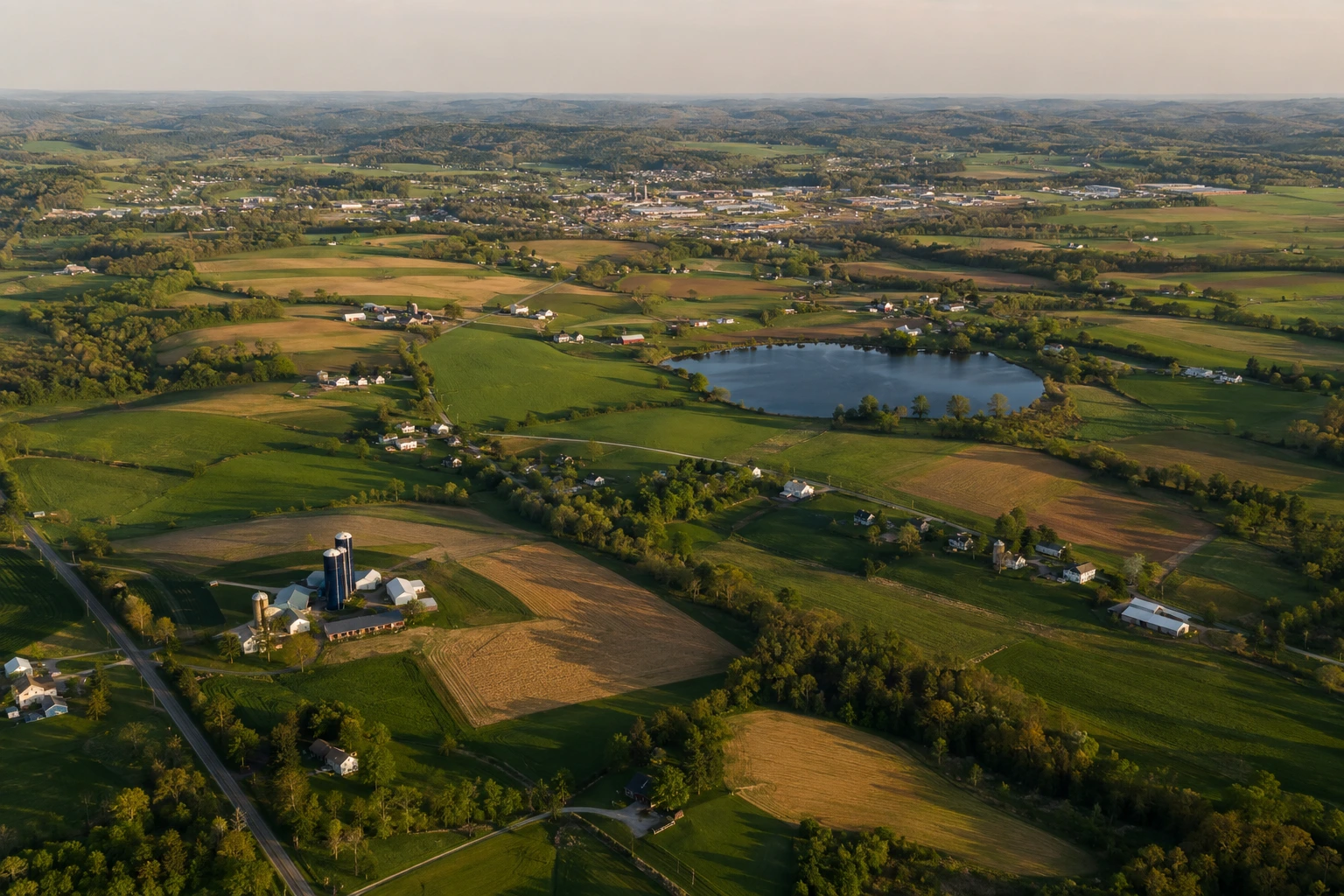
Mercer Coolspring Township East Lackawannock Lackawannock Township Findley Township Jefferson Township Delaware Township
Grove City Pine Township Springfield Township Sandy Lake Stoneboro Lake Latonka Jackson Center Liberty Township Worth Township New Lebanon Sheakleyville
Cesare’s Quality Water Solutions designs, installs and services water treatment across Mercer County, for homes on municipal water and homes on private wells. That includes water testing, whole-house filtration, water softening, iron and manganese removal, sulfur treatment, UV disinfection and reverse osmosis. We identify the property’s water source and test at the tap before selecting anything, because Mercer County water changes completely depending on where you live.
All of it. Sharon, Hermitage, Farrell, Sharpsville, Wheatland, West Middlesex, Greenville, Mercer, Grove City, Sandy Lake, Stoneboro, Jamestown, Fredonia, Jackson Center and the rural townships between them. The county mixes Shenango Valley municipal water, separate borough systems and a lot of private wells, so treatment needs shift substantially by address.
Penn State’s water lab summarizes 299 drinking-water samples submitted from Mercer County between September 2007 and June 2025. Among the samples tested, iron was over the 0.3 mg/L limit in 27 of 97, manganese was over 0.05 mg/L in 29 of 106, total coliform bacteria turned up in 121 of 279, and E. coli in 19 of 279. Median hardness ran 79 mg/L, about 4.6 grains per gallon. These are homeowner-submitted samples, not a survey of every property, which is why we start with water testing at your tap.
There is no single countywide system. Aqua Pennsylvania runs the Shenango Valley system serving the Sharon and Hermitage area, and it acquired the former Greenville Municipal Water Authority in early 2026. Grove City operates its own borough system supplied by groundwater wells. Smaller systems and private wells cover the rest of the county, so the first step is confirming which of these serves your address.
The Shenango Valley system treats Shenango River water and serves more than 50,000 residents in the valley and eastern Ohio. Aqua recently completed a nearly $35 million upgrade of the Shenango Valley treatment plant, including a new 700,000-gallon raw-water basin. Fully treated river water still arrives at homes with disinfectant taste, spotting and scale complaints — the fixable kind.
Groundwater, not the river. Grove City’s own water quality report says the borough draws from three wells set in the upper and lower Connoquenessing sandstone and the Burgoon sandstone formations. That makes Grove City’s municipal water a fundamentally different supply from Aqua’s Shenango Valley system, and the treatment that fits one rarely fits the other.
Aqua Pennsylvania acquired the former Greenville Municipal Water Authority in early 2026. The system serves more than 2,900 customers across Greenville Borough and portions of Hempfield and West Salem townships through about 40 miles of mains, and Aqua has identified roughly $10 million in planned investment over the next decade. For homeowners, the water source did not change overnight — but ownership, maintenance plans and long-term treatment decisions did.
It depends on the system. Grove City’s borough report shows chlorine, with a highest detected level of 1.45 mg/L. Aqua disinfects the Shenango Valley supply at its treatment plant, and disinfection practices can change with upgrades and maintenance, so we confirm what is actually in the water at your address before designing Cesare’s carbon filtration. Chlorine and chloramine call for different filtration approaches, which is why that check comes first.
Hardness here varies enormously. The median across Penn State’s Mercer County samples is 79 mg/L, about 4.6 grains per gallon — on the moderate side — but individual results ran from under 1 all the way to 667 mg/L. A softener makes sense when the hardness measured at your home is high enough to cause scale, spotting or soap problems, and we size it from your tap number, never a county average.
Orange or rust-colored staining commonly points to iron, and black or dark staining commonly points to manganese. Both are locally relevant: Penn State found iron over the limit in 27 of 97 Mercer County samples tested and manganese over the limit in 29 of 106. The fix is iron and manganese filtration matched to the form and concentration in your water, which is what the test establishes.
That smell usually points to hydrogen sulfide or another sulfur condition, and the source matters. If the odor is in both hot and cold water, the well or supply is likely involved; if it only shows up on the hot side, the water heater may be contributing. Sulfur often travels with iron and manganese, so we test for all of it before picking a treatment approach.
It is worth testing for, because arsenic has no taste, odor or color. In Penn State’s Mercer County submissions, 6 of 98 samples tested for arsenic — about 6% — were over the 0.01 mg/L drinking-water standard. That does not mean 6% of the county’s wells have elevated arsenic; only testing your own supply can establish that. When arsenic is confirmed, treatment is designed specifically for it, commonly with reverse osmosis at the drinking tap.
Pennsylvania DEP recommends testing private well water every year for total coliform bacteria, nitrates, total dissolved solids and pH, through a state-certified lab, plus anything else you have reason to suspect. Around Mercer County that often means adding iron, manganese, hardness, sulfur and arsenic depending on the property. Nitrate is not just theoretical here either — 7 of 132 Penn State samples exceeded the 10 mg/L standard.
Treat it as a safety issue. DEP’s guidance is not to consume the water unless it has been brought to a rolling boil for one minute, or to use bottled water for drinking and food preparation until the problem is resolved. Then the well gets evaluated for how contamination is entering, disinfected or repaired, and retested. Properly sized UV disinfection provides an ongoing barrier when bacteria keeps returning — but it does not repair the entry point.
Yes, and the local numbers back it up: 56 of 91 corrosivity-index samples in Penn State’s Mercer County submissions — just over 61% — fell outside the acceptable range in one direction or the other, so some lean scale-forming rather than corrosive. Corrosive water eats at metal plumbing and raises the odds of metals entering the water from your own pipes and fixtures. Corrosion potential depends on more than pH alone, so the fix is designed from the full analysis, usually a neutralizer ahead of the plumbing.
It is worth considering when the home has an older or unknown service line or lead-containing plumbing. In Penn State’s countywide submissions, 6 of 92 first-draw samples were over the 0.015 mg/L action level. Aqua is also surveying roughly 1,700 customer-owned service lines in Farrell and Mercer Borough this year to identify lead and galvanized lines for replacement. A first-draw test at your own tap is what settles the question for your house.
Yes, when treatment is chosen for a confirmed concern. The EPA identifies granular activated carbon, ion exchange and reverse osmosis as technologies capable of reducing PFAS, and recommends equipment carrying an appropriate third-party PFAS-reduction certification. Performance depends on the specific compounds, the concentrations and the upkeep, so testing establishes the problem first and the equipment follows.
It depends on the water source and what the tests find. A Hermitage municipal home that wants disinfectant filtration and softening is a different project from a Grove City-area well carrying iron, manganese, hardness or bacteria. Flow rate, plumbing and the number of treatment stages all factor in. Cesare’s prices a system after testing the water and identifying what the property actually requires — not before.
Straight answers to the water questions we hear most in Mercer County.
See how Mercer County compares with 12 other Southwestern Pennsylvania counties for hardness, iron, manganese, bacteria and corrosivity in the 2026 Southwestern PA Water Quality Report.
2026 Southwestern PA Water Quality Report →
Get a professional water analysis and a custom treatment plan—clear answers, no pressure.