- Pittsburgh & Southwestern PA • Custom-Engineered Water Treatment
- Fully Licensed & Insured
- 24/7 Emergency Water Service
- 3rd Generation Water Treatment Experts


Start here if your tap water tastes or smells like a pool.
Free chlorine and chloramine are the two disinfectants public water systems use to keep water microbiologically safe from the plant to your tap. Chloramine is chlorine combined with ammonia.
Free chlorine gives itself up to carbon fairly easily. Chloramine is more stable and needs media built for it, more of that media, and more time in contact with it.
Find out which one is actually reaching your house. Then choose equipment. Buying a filter first is how people end up treating the wrong problem.
There is no single answer for everyone on “city water” here. It varies by supplier, by plant, and in some systems by season.
| Supplier or system | Reported disinfectant | What that means for you |
|---|---|---|
| Pittsburgh Water | Free chlorine | Allegheny River supply, treated with chlorine before it enters distribution |
| PA American Water — Pittsburgh System | Chloramines | Monongahela River supply; its 2025 report states surface water is treated with chloramines for bacteriological quality in distribution |
| MAWC — Indian Creek & George R. Sweeney | Seasonal — chloramine and free chlorine | Chloramine restarted May 4, 2026, with a return to free chlorine planned for fall 2026 |
| MAWC — McKeesport & Furnace Run (Ligonier) | Free chlorine year-round | These systems were not part of the May 2026 chloramine conversion |
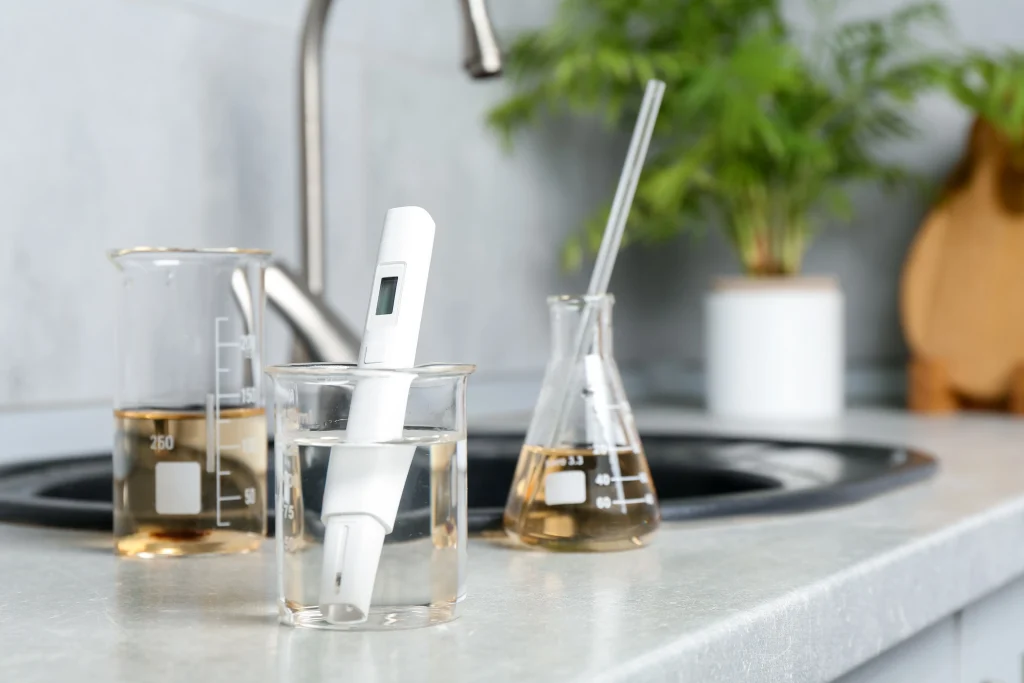
Both do the same job for the utility. They behave very differently once the water reaches your house.
Works quickly, breaks down faster in the pipes, and is often the more noticeable of the two at the tap. Carbon reduces it readily.
Chlorine combined with ammonia. It holds a residual much further through a large distribution system and does not vent off the way free chlorine does.
Reducing chloramine depends on a slower reaction rather than easy adsorption, so it takes media designed for chloramine and considerably more contact time.
Regulatory limits and reported 2025 results for the PA American Water Pittsburgh System.
EPA’s limit for chlorine and for chloramines alike, measured as chlorine. A regulatory ceiling, not a target and not what is in every home.
From 2025 distribution monitoring, with individual results ranging from 1.17 to 2.39 ppm. Compliant, and still enough to taste.
111 ppm leaving the Hays Mine plant and 91 ppm at Aldrich. Moderately hard — which is why disinfectant is often not the only thing on the list.

Water carrying chlorine or chloramine within the regulations is considered suitable for normal household use. EPA sets the maximum residual disinfectant level at 4.0 mg/L for both, measured as chlorine, and Pennsylvania DEP describes chloramine at levels meeting EPA requirements as presenting minimal to no risk.
Disinfection is one of the reasons waterborne disease is rare here. Nobody should read this page as a case against it. What we do is treat the water after it has finished that job and arrived at your property.
Plenty of homeowners still want the residual reduced — for taste, for how coffee and ice turn out, for the shower, or for a specific use like an aquarium. That is a water-quality preference, and it is a legitimate one.
Worth understanding before deciding what to do about it.
Disinfection at the plant handles bacteria, viruses and other organisms in the source water — here, that source is river water from the Allegheny or the Monongahela.
A measurable residual has to survive the trip through reservoirs, tanks and miles of pipe. That requirement is exactly why some systems choose the more persistent chloramine.
EPA and Pennsylvania regulate both the disinfectant and the byproducts it can form, and utilities report results annually in a Consumer Confidence Report.

Six reasons come up over and over, and none of them require anything to be wrong with the utility.
Pool taste or smellMost obvious in drinking water, ice, coffee and tea, and in the steam off a hot shower.
It changed on themA seasonal switch or an operational change shows up as a difference they can taste.
Buying bottled waterThey are paying for water twice because they do not like how the tap tastes.
The others: the shower experience, an aquarium or pond that needs the disinfectant gone before the water goes in, and wanting treated water at every fixture rather than one filtered faucet.
A change in taste or odor does not mean the water became unsafe.
Suppliers switch disinfectants, flush hydrants, respond to maintenance, or adjust treatment to hold water quality. MAWC customers on the Indian Creek and Sweeney systems can notice it when those plants move between chloramine and free chlorine.
Warmer water and shifting demand change how a residual behaves on its way to you. The same dose does not always taste the same in July as it does in January.
A clogged aerator, a neglected hot water tank, or water that has sat in the lines can all change taste and odor. Musty rather than chlorine-like usually points to naturally occurring geosmin and MIB in the source water.
Six steps. The utility name alone is not enough to size equipment.
The testing sequence
Utility, the plant serving the address where we can determine it, and the current Consumer Confidence Report.
Free and total chlorine measured at the property, which is what separates free chlorine from combined chlorine.
One test may not represent what is in the pipe six months from now.
Hardness, pH, TDS, iron or manganese, sediment — plus laboratory panels such as lead or PFAS when the situation calls for one.
Peak household demand, plumbing size and pressure decide tank size and how long water stays in the media.
Retest the residual on treated water instead of assuming the equipment is doing its job.
Why test regulated water at all
Utility testing proves compliance across a public system of tanks, mains and thousands of connections. It was never meant to size equipment for one house. Testing at the property is how we learn the residual arriving at your service entry, the hardness that decides whether you need conditioning or softening, and the flow the system has to keep up with. A test from us is not an accusation that the supplier failed — it is the engineering step that picks the equipment and the baseline that proves it worked.
Same tank, same-looking spec sheet, very different performance.
| What is in the water | What it takes to reduce it | What goes wrong |
|---|---|---|
| Free chlorine | Cesare’s Quality Custom-Designed carbon media sized to the home’s flow | Undersized tank, exhausted media, no verification |
| Chloramine | Media specifically suited to chloramine, more volume, longer contact time | Standard carbon assumed to work the same way |
| Seasonal switching | Design for the chloramine months, not the easy ones | System sized on a spring test that fails by August |
| Hardness alongside it | Conditioning or softening as a separate function | One tank sold as if it does both jobs |
| Taste at the kitchen tap | Point-of-use treatment in addition to whole-home carbon | Expecting whole-home carbon to do a drinking-water polish |
| Lead, PFAS, nitrate | Equipment with a verified claim for that contaminant | Assuming a chlorine filter covers everything else |
Carbon treatment is not decided by the label on the tank.
Custom-Designed media chosen for the disinfectant actually present. What handles free chlorine easily is not automatically the right answer for chloramine.
Enough media that your peak demand does not push water through faster than the reaction needs. Chloramine reduction wants substantially more contact time than chlorine.
Before-and-after testing at realistic flow. A low-flow sample at one sink can look excellent while the whole-house condition tells a different story.
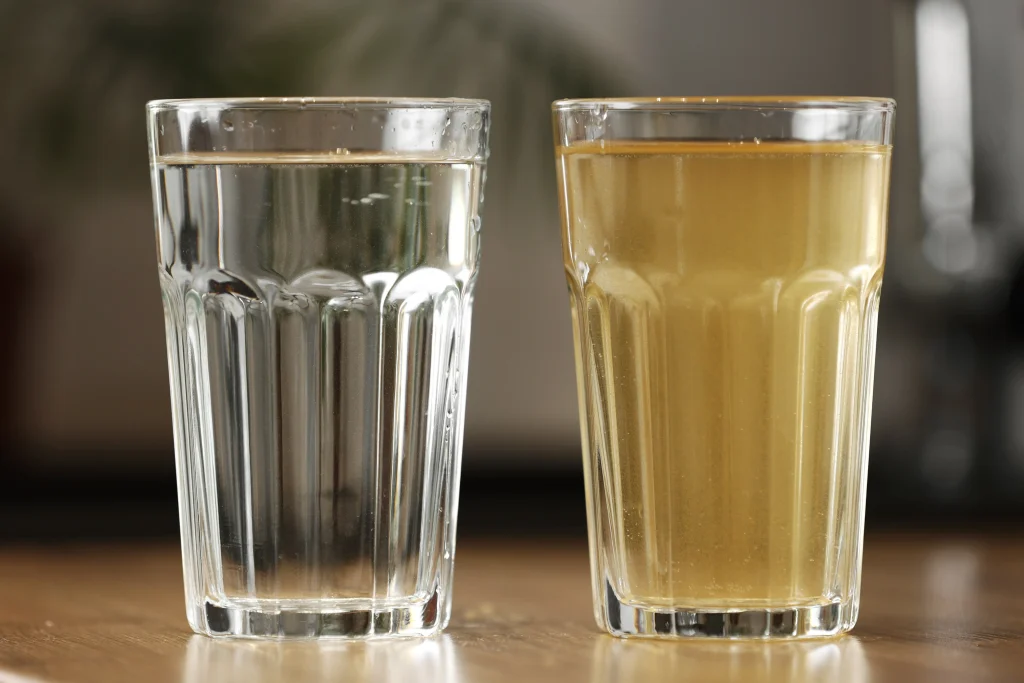
Five configurations cover almost every municipal home we see. Which one you need comes out of the test, not a catalog.
Whole-home Cesare’s Custom-Designed carbon with a full-flow bypass and before-and-after verification. For homes that do not need hardness treatment.
Media suited to chloramine, increased volume and contact time, tank and valve sized to peak flow, verified at more than one flow condition.
Cesare’s carbon stage handles the disinfectant; conditioning or ion exchange handles scale. Two functions, stated separately on the estimate.
Beyond those: Cesare’s whole-home carbon paired with reverse osmosis at the kitchen when someone also wants drinking-water polish for TDS or sodium.
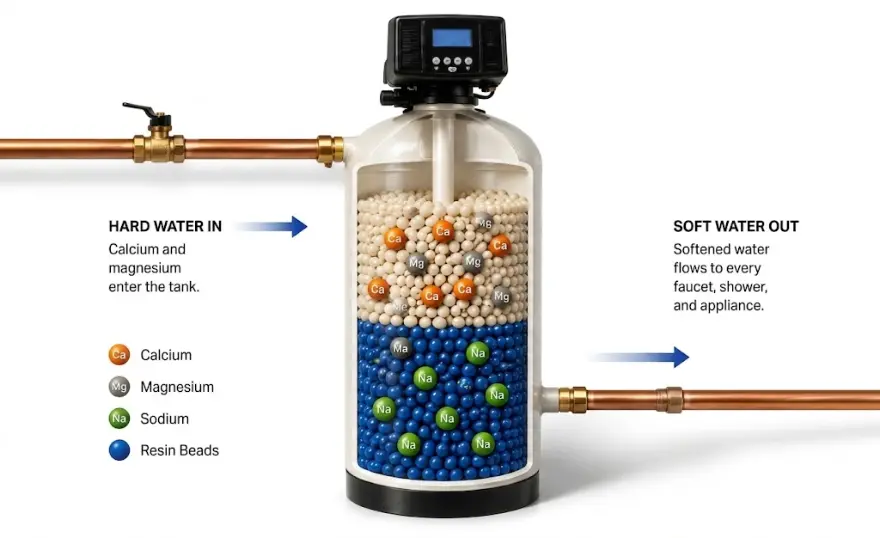
No — not on its own. A conventional ion-exchange softener is built to reduce calcium and magnesium hardness. It should never be presented as a chlorine or chloramine filter unless the system also carries a separate media stage designed for that job.
The standards make the split obvious. NSF/ANSI 44 covers cation-exchange softeners. Chlorine and chloramine reduction claims live in filtration standards such as NSF/ANSI 42. Different standard, different job.
Some of our systems do both, because plenty of municipal homes around here have moderately hard water on top of a disinfectant residual. When that happens, the estimate says which media performs which function.
Improving taste and reducing chlorine is not the same as treating everything else.
| Water concern | Carbon alone? | What it actually takes |
|---|---|---|
| Hardness | No | Softener or an appropriate conditioner |
| High TDS or sodium | No | Reverse osmosis for drinking water |
| Lead | Not automatically | A product with a verified lead-reduction claim |
| PFAS | Not automatically | Media and a system with verified PFAS performance |
| Nitrate or fluoride | Generally no | Contaminant-specific treatment or verified RO |
| Bacteria during a boil advisory | Do not rely on it | Follow the utility’s instructions |
| Sediment | Only if built for particulate filtration | Sediment treatment when it is actually present |
A shower filter certified to NSF/ANSI 177 covers free available chlorine reduction. That certification does not automatically verify chloramine reduction. On a chloraminated supply, that distinction is the whole ballgame — and most product pages blur it.
| Treatment | What it actually covers |
|---|---|
| Pitcher filter | Only water poured through the pitcher |
| Refrigerator filter | The dispenser and the ice maker |
| Shower filter | One shower, subject to its listed claim |
| Whole-home carbon | Water entering the house, every fixture downstream |
| Reverse osmosis | Drinking and cooking water at the tap it serves |
Three uses where removal is not a preference.
Chlorine and chloramine are harmful to fish and other aquatic life. Pennsylvania DEP advises owners to use an appropriate conditioner or a carbon system designed for chloramine before the water goes in.
Both must be removed from water used for dialysis. A residential filter never replaces the treatment, testing and procedures required by your physician, dialysis provider and equipment manufacturer.
Free chlorine will largely vent from an open container. Chloramine will not, which is why “let it sit out overnight” is not a plan for a chloraminated supply.
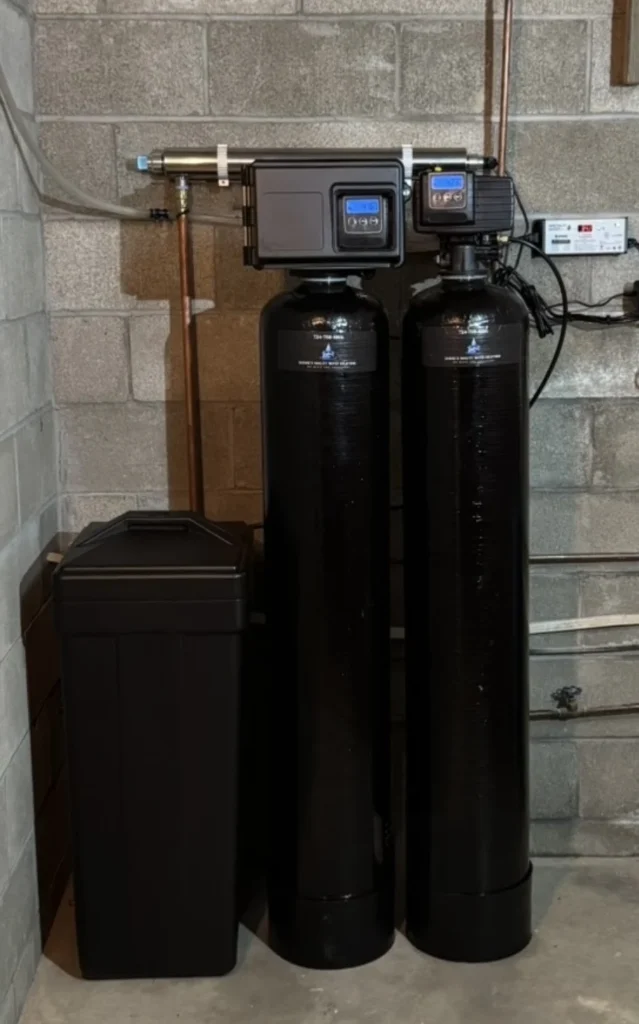
Carbon life cannot be read off a calendar. It depends on which disinfectant is present and at what concentration, household use, media volume, flow rate, organic loading, and whether the utility changes practice mid-year.
Service means checking free and total chlorine, testing the treated water, inspecting valve and bypass, confirming backwash where applicable, and re-bedding on performance rather than on a date. Water can still look perfectly clear after a bed has lost meaningful capacity.
Which disinfectantChloramine generally calls for more specialized media, more volume and more contact time.
Peak flowHigher household demand needs more treatment capacity and larger plumbing.
What else is presentHardness, sediment or a drinking-water goal each add a separate function.
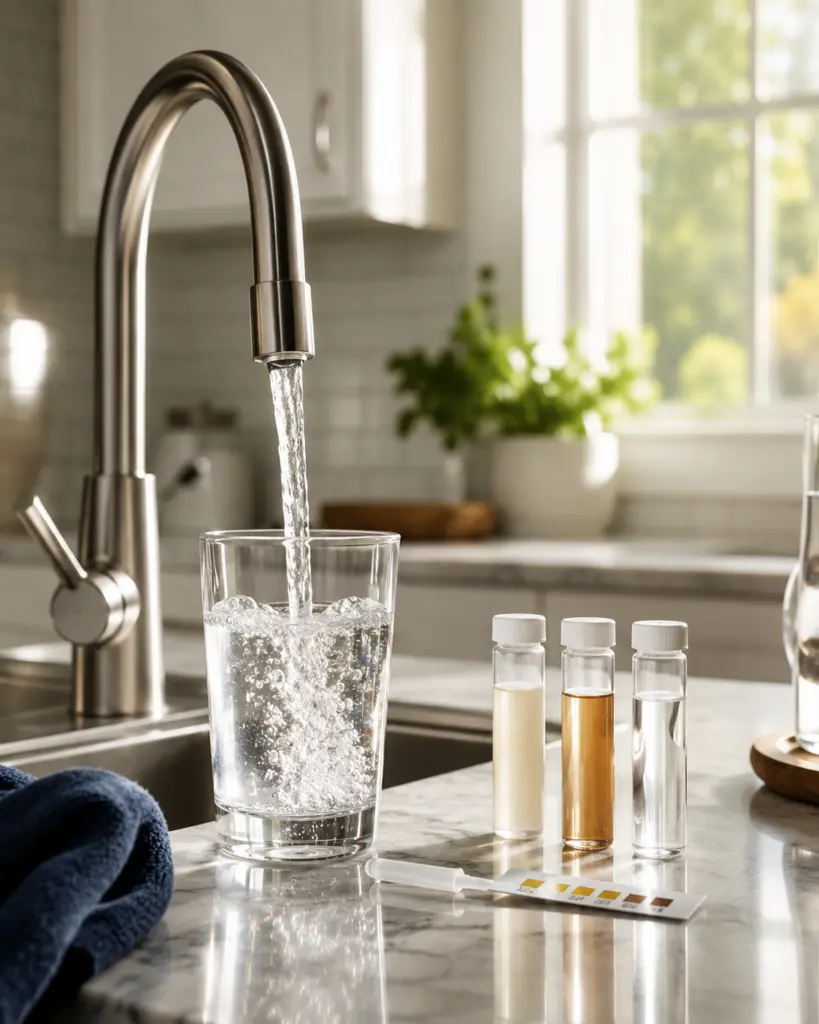
This is a disinfectant residual you can actually taste. Two jobs, stated separately on the estimate — Cesare’s carbon for the chlorine, softening for the scale — exactly as this page argues they should be.
Edgeworth Borough Municipal Authority · Reports CWS-PA-062826-472 and CWS-PA-072826-472 · Published with the customer’s permission.
The three most useful next reads for a municipal-water home.
Moderately hard municipal water is common here. Softening and conditioning are separate decisions from disinfectant reduction.
Point-of-use treatment for TDS, sodium and drinking-water polish, alongside Cesare’s whole-home carbon rather than instead of it.
What gets tested, why property-level testing matters, and how results turn into a design.
Every claim on this page traces back to a primary source — regulators, accredited standards bodies, and the utilities that publish local water quality.
Reviewed July 2026 by Lance Cesare, third-generation water-treatment specialist. Water testing referenced on this page is on-site field analysis performed by Cesare’s Quality Water Solutions, not certified laboratory analysis.
More answers in our Municipal & City Water Knowledge Center.