- Pittsburgh & Southwestern PA • Custom-Engineered Water Treatment
- Fully Licensed & Insured
- 24/7 Emergency Water Service
- 3rd Generation Water Treatment Experts


The most important answers up front — then the full guide below.
Water with a pH below 7. In a home, the real concern is its ability to corrode plumbing and release metals into your water.
The EPA’s secondary guideline range is 6.5–8.5. Below 6.5, water can contribute to metallic taste and corrosion.
The pH itself is usually not the main issue — the concern is copper or lead that corrosive water dissolves from plumbing. Testing tells you.
Blue-green stains, metallic taste, pinhole leaks in copper pipe, green crust on fittings, and fixtures that wear out early.
A properly sized Cesare’s calcite neutralizer, blended neutralizing media, or a chemical-feed system — selected from your complete water analysis, never from pH alone.
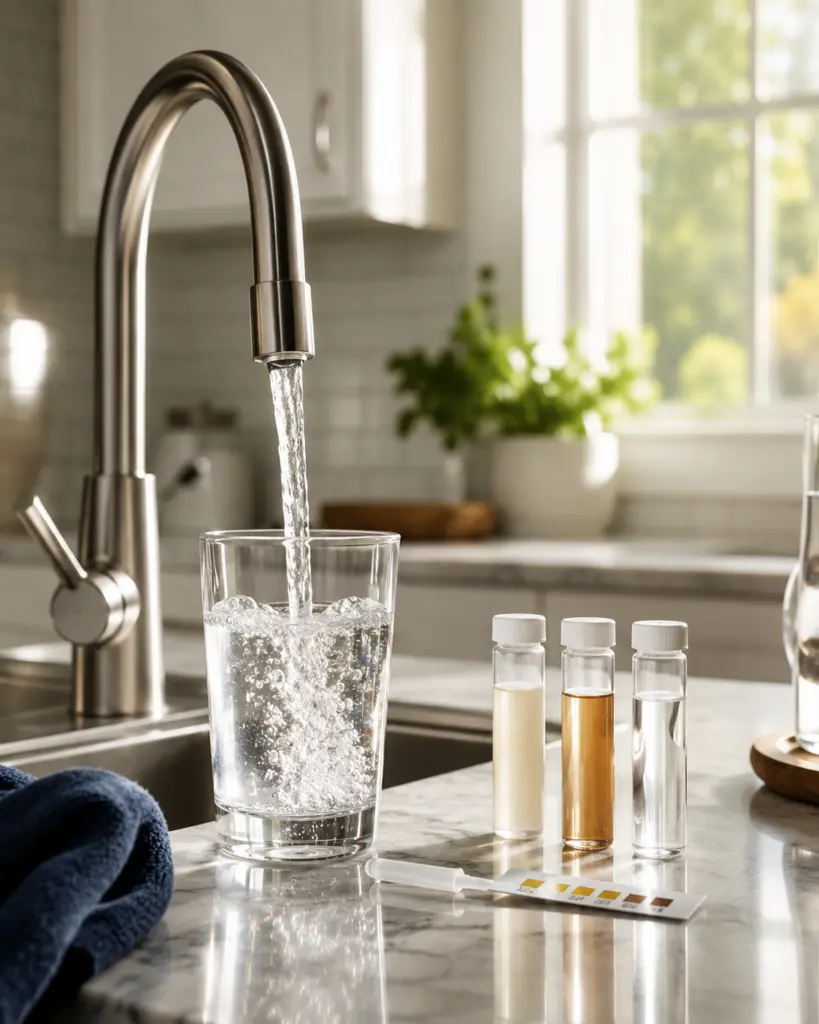
Acidic water is water with a pH below 7.0. The lower the number, the more acidic the water — and the scale is logarithmic, so each whole number is a tenfold change. But in a home, the concern is not the number itself: it is whether the complete water chemistry can corrode plumbing and release metals.
Low pH and corrosive water are related — but not identical. The full corrosion risk also depends on alkalinity, calcium hardness, dissolved solids, temperature, dissolved gases, and your pipe and fixture materials. That is why treatment is never selected from a pH number alone.
The EPA lists 6.5–8.5 as the secondary guideline range for drinking-water pH — an aesthetic and infrastructure guideline, not a health-based contaminant limit.
Treatment often requires special design.
Corrosion potential should be evaluated.
The secondary, aesthetic guideline for drinking water.
May contribute to taste, deposits, or a slippery feel.

Private wells here draw from fractured sandstone, shale, siltstone, and coal-associated geology. Low-pH water is more likely where groundwater moves through mineral-poor rock, has limited contact with limestone, carries dissolved carbon dioxide, or has low alkalinity — and USGS groundwater studies in Pennsylvania have documented well pH ranging from roughly 5.0 to 8.8 depending on the bedrock.
Across Westmoreland, Allegheny, Washington, Beaver, Butler, Armstrong, Indiana, Fayette, Somerset, and surrounding counties, two neighboring wells can produce very different pH, alkalinity, and hardness results. The only reliable way to know your water is to test that specific well.
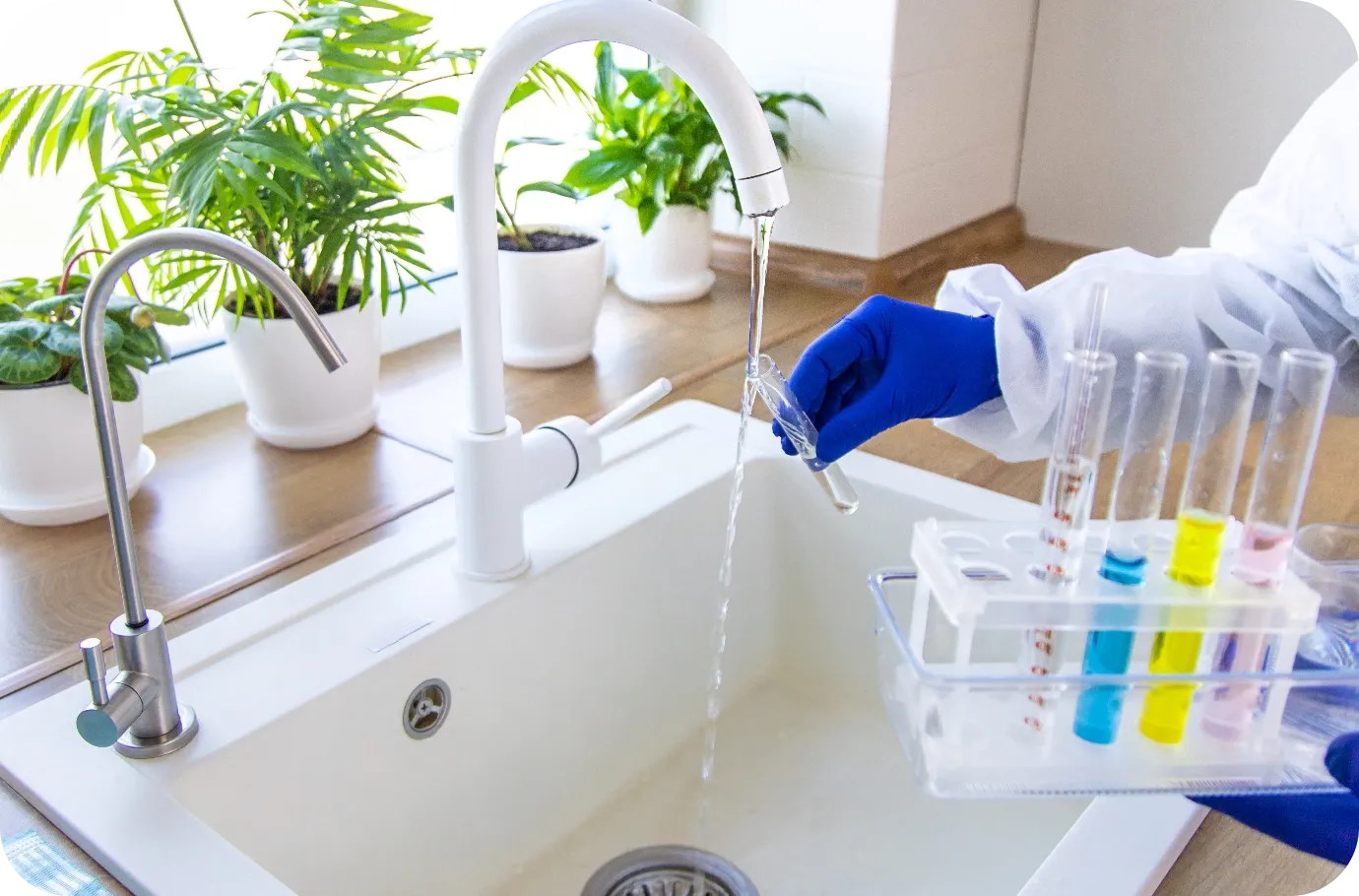
Acidic water attacks plumbing instead of leaving scale — so the clues look different:
These symptoms overlap with iron, manganese, and hard water problems — testing is what separates them.
Yes — acidic or otherwise corrosive water can gradually dissolve copper, brass, solder, and galvanized pipe. The damage builds invisibly, long before the first leak.
The water does not need to look dirty to be damaging the plumbing.
Copper and lead: copper enters water from copper pipe and fittings; lead typically comes from older solder, brass, and lead-containing components — the EPA notes lead can enter drinking water when plumbing corrodes, especially in water with high acidity or low mineral content. For regulated public systems, the action levels are 1.3 mg/L for copper and 0.015 mg/L for lead — those are public-water program triggers, not private-well pass/fail guarantees. Lab testing is how you actually know.
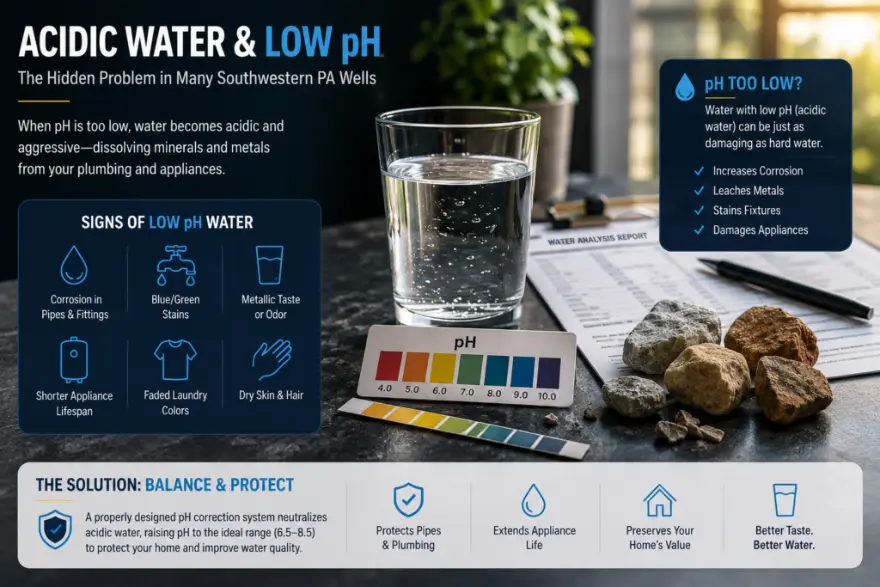
Low pH is generally a corrosion and water-quality concern — the larger potential health issue is the copper or lead that corrosive water releases from your plumbing. The pH number alone does not reveal metal concentrations, lead cannot be identified by taste or appearance, and clear water is not proof of safe water.
Pennsylvania recommends annual private-well testing for pH, TDS, nitrate, and total coliform bacteria through a certified laboratory — with additional metals testing where plumbing age or corrosion symptoms raise the risk. That is exactly how we approach it: test first, then treat what the numbers show.
Stain color is a clue — not a diagnosis. Here is what each one usually points to.
Copper corrosion from acidic water
You are on the right pageIron
Iron in well water →Manganese
Manganese removal →Hardness
Hard water guide →Requires testing to identify
Well water testing →With a Cesare’s calcite neutralizer, blended neutralizing media, or an alkaline chemical-feed system — selected from your pH, alkalinity, hardness, flow rate, and the rest of the analysis.
Mild to moderate acidity
Stronger mineral correction
Severe or variable acidity
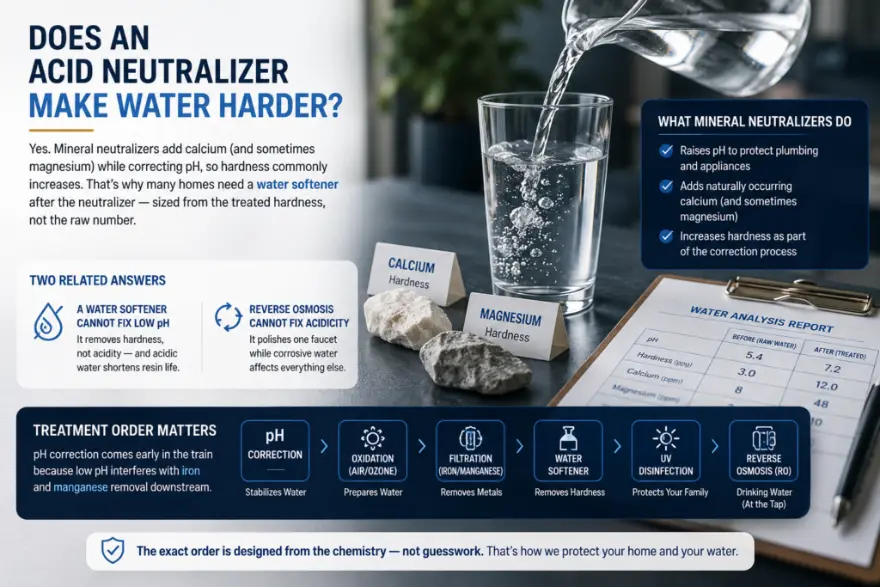
Yes — mineral neutralizers add calcium (and sometimes magnesium) while correcting pH, so hardness commonly increases. Mildly hard water can become moderately hard, and already-hard water gets harder. That is why some homes need a water softener after the neutralizer — sized from the treated hardness, not the raw number.
Two related answers worth knowing: a water softener cannot fix low pH (it removes hardness, not acidity — and acidic water shortens resin life), and reverse osmosis cannot fix whole-house acidity (it polishes one faucet while corrosive water reaches everything else). Treatment order matters too — pH correction typically comes early in the treatment train, because low pH interferes with iron and manganese removal downstream. The exact order is designed from the chemistry.
Real numbers from a real well: comprehensive testing on a Boswell private well measured pH 6.2 — slightly acidic — alongside very hard water, elevated iron and manganese, and bacteria. pH correction was engineered into the whole-house treatment train, and follow-up testing measured pH 7.3 — balanced.
BeforepH 6.2 — slightly acidic, with 24.7 gpg hardness, 3.82 mg/L iron, and 0.41 mg/L manganese riding along.
TreatmentpH correction ahead of oxidation and filtration, softening, and UV disinfection — one system designed from the full analysis.
AfterpH 7.3 — balanced and stable at household flow, verified by retest along with the iron, manganese, and bacteria results.
Read the complete analysis on our well water testing case study — the same well, every number, before and after.
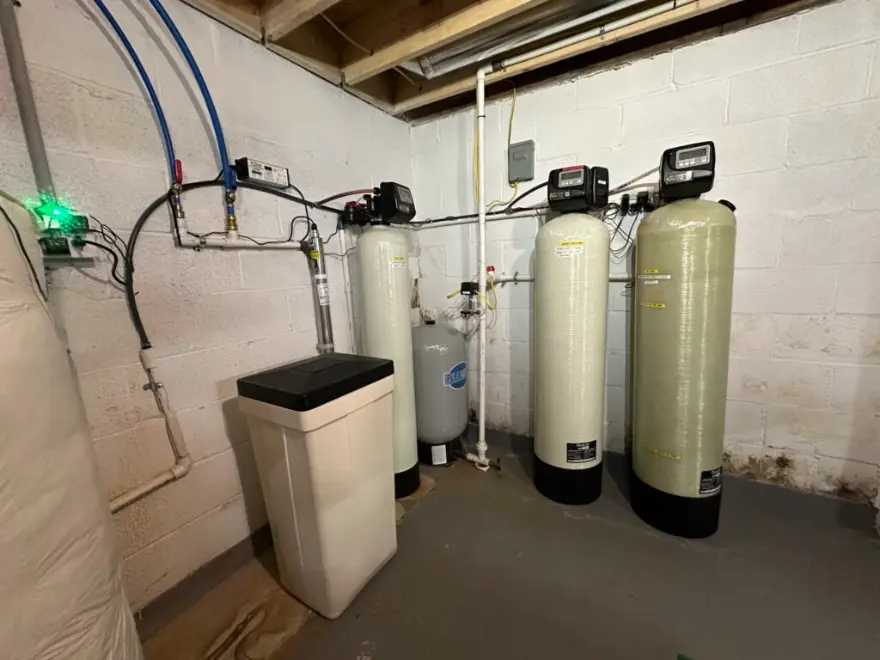
“I started losing hope after three different water treatment companies couldn’t fix my water… Lance and Monica came out that night and tested my water and took a sample for a third party lab. This guy really knows his stuff. He was informative and made sure I was getting the right system for my water. Install went great and now my water is better than bottled.”
moonlight Paige — Boswell, Somerset County, PA · Google reviewEvery claim on this page traces back to a primary source — regulators, accredited standards bodies and the utilities that publish local water quality.
Reviewed July 2026 by Lance Cesare, third-generation water-treatment specialist. Water testing referenced on this page is on-site field analysis performed by Cesare’s Quality Water Solutions, not certified laboratory analysis. Bacteria, lead, nitrate, PFAS and disinfection by-product results require an accredited laboratory and are not published from field methods.