- Pittsburgh & Southwestern PA • Custom-Engineered Water Treatment
- Fully Licensed & Insured
- 24/7 Emergency Water Service
- 3rd Generation Water Treatment Experts

Allegheny County is not one water supply. Roughly 39 separate systems draw from three different rivers, one runs entirely on groundwater wells, and private wells still serve the outer townships. Cesare’s identifies who supplies your water, reads that system’s current report, and tests what actually comes out of your tap.

Water quality can vary throughout Allegheny County depending on the water provider, source and property. Pittsburgh-area municipal water may contain chlorine, chloramine, hardness or other treatment-related concerns, while private wells can have iron, sulfur odor, manganese, low pH or bacteria. Cesare’s Quality Water Solutions tests the water first, then designs the right treatment around the actual chemistry, flow rate and plumbing conditions.
A utility report describes a regulated system up to the distribution main. It cannot describe your service line, your basement pipe or your kitchen fixture. In Allegheny County that gap matters: more than three quarters of homes here were built before 1980.
What is treated and tested before it enters the distribution network, reported publicly every year.
What carries water from the main to your property. Material varies by age, and part of it is usually owned by the property.
The pipe, solder and fixtures the water touches last. The only stretch no utility report can speak for.
Pittsburgh Water has made real progress, and it deserves saying plainly. It reported a system-wide 90th percentile lead result of 2.0 parts per billion in 2025, the lowest it has ever recorded, with no sample sites above the action level. In January 2026 it replaced its 14,000th lead service line, working toward finishing residential replacements before the end of 2027.
What a system result cannot tell you is what comes out of your particular faucet. It is an average across sampled homes. Your own service line, interior plumbing, fixtures and how long the water sat still all move an individual result. Testing your tap is about understanding one house, not doubting the utility.
As the federal Lead and Copper Rule Improvements currently stand, the lead action level drops from 15 to 10 parts per billion, with a compliance date of November 1, 2027.
Penn State’s Agricultural Analytical Services Laboratory has summarized 343 Allegheny County drinking-water submissions collected between August 2007 and June 2025. These laboratory results describe the samples submitted to Penn State and are not a representative survey of all homes, wells or public water supplies in the county.
Aesthetic water conditions
Health-related indicators
About the data: Individual parameters were tested on different numbers of samples. Submissions skew toward private wells, so these results describe the samples submitted — they cannot determine what is present at an individual property. Test the water at the property before treatment is selected.
Noticing scale, chlorine, discoloration or an unusual taste? The symptom can help narrow down what should be tested before choosing treatment.
White buildup on faucets, shower glass and fixtures usually points to dissolved hardness minerals.
Chemical taste or odor can come from the disinfectant used by your local Allegheny County water provider.
Discoloration may come from sediment, corrosion or aging plumbing. Testing helps determine what is actually reaching the tap.
Concerned about lead or PFAS? These cannot be identified by taste, smell or appearance and require proper testing.
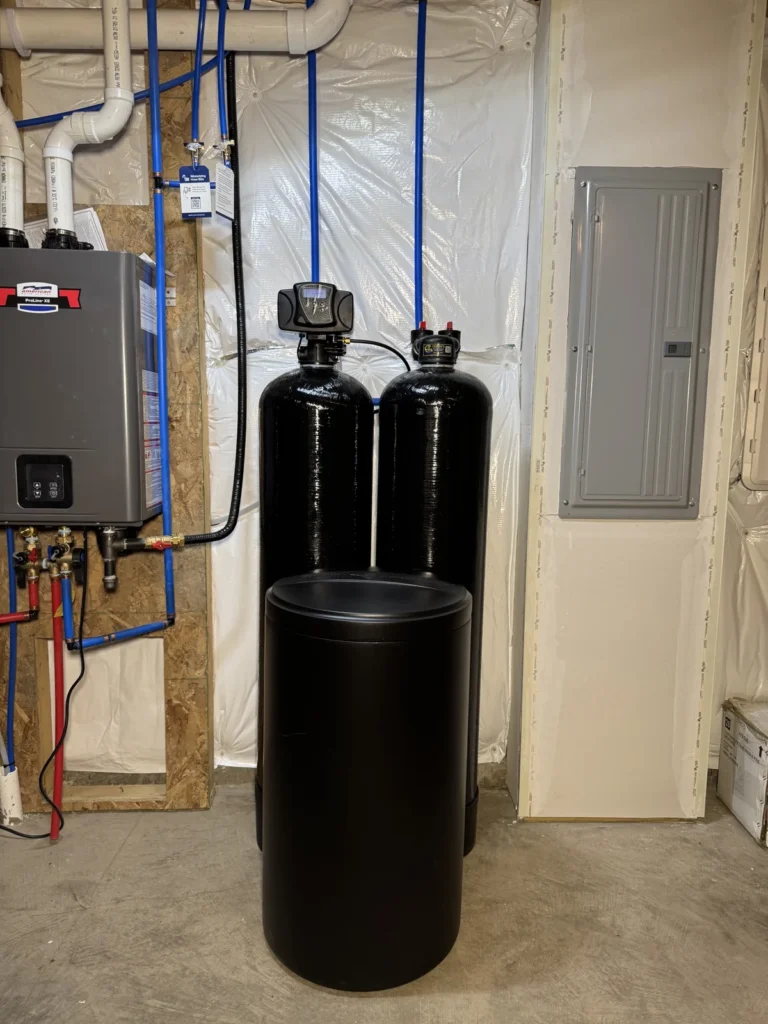
NORTH HILLS, PA • WEST VIEW WATER AUTHORITY
ALLEGHENY COUNTY MUNICIPAL WATER CASE STUDY
On Site Water Conditions
9 gpg hardness
2.6 ppm total chlorine
2.8 ppb lead screening
Cesare’s Treatment Design
Whole-home treatment built around the home’s measured water and flow
Follow-Up Results
0 gpg hardness
Chlorine below field detection
Screening below field detection
Hard Water & Chlorine in a North Hills Home
A North Hills homeowner served by West View Water Authority called Cesare’s about hard-water scale and concerns with their drinking water. Testing found 9 gpg hardness, 2.6 ppm total chlorine and a 2.8 ppb lead screening reading. We designed the treatment around the water measured at that specific home—not a generic Allegheny County package.
Follow-up testing measured 0 gpg hardness, with chlorine and the screened drinking-water concerns below the field method’s detection limits.
FOX CHAPEL, PA • MUNICIPAL WATER
ALLEGHENY COUNTY CASE STUDY
On Site Water Conditions
Hardness: 6 gpg
Chlorine: 2.2 ppm
Lead screening: 3.66 ppb
Cesare’s Treatment Design
Whole-home treatment built around the home’s measured water chemistry and flow
Follow-Up Results
Hardness: 0 gpg
Chlorine below field detection
Lead/byproduct screening below field detection
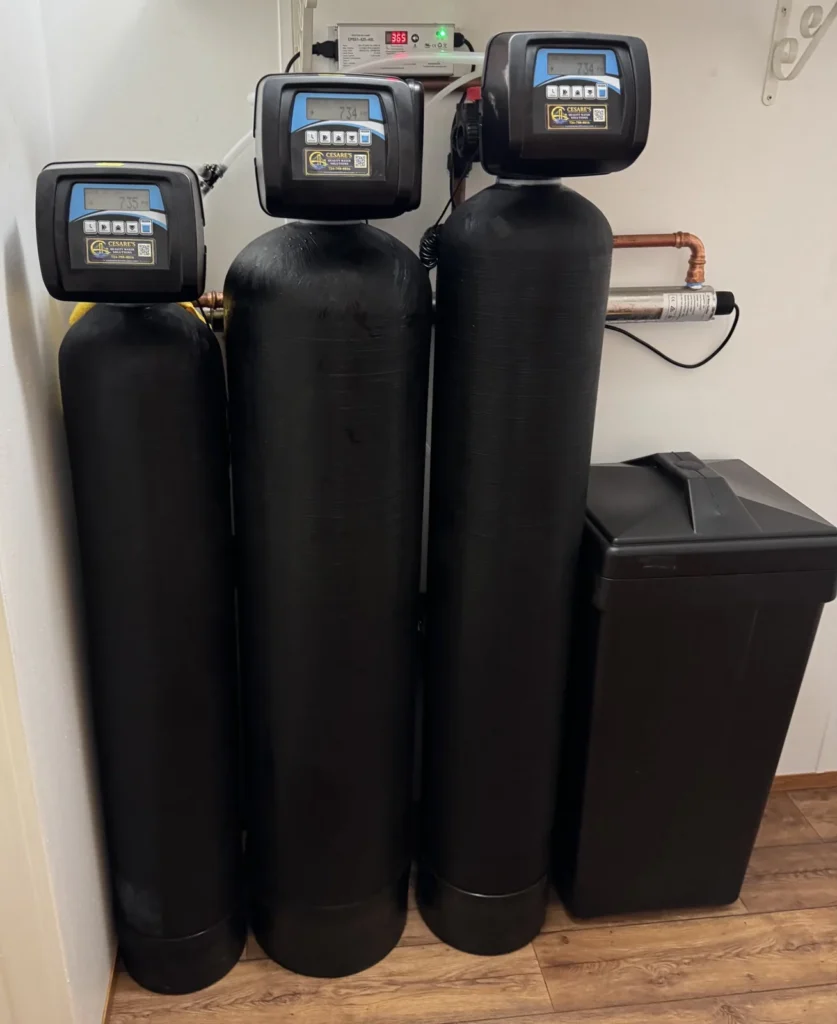
Hard Water & Chlorine in a Fox Chapel Home
A Fox Chapel homeowner served by Fox Chapel Authority called Cesare’s about hard-water scale, chlorine and drinking-water concerns. Testing measured 6 gpg hardness, 2.2 ppm chlorine and a 3.66 ppb lead screening reading. We designed the treatment around the water measured at that specific home—not a preset Allegheny County package.
Follow-up testing measured 0 gpg hardness, with chlorine and the screened drinking-water concerns below the field method’s detection limits.
About 97% of Allegheny County is served by public water, but private wells are still used in some outer communities. The Allegheny County Health Department provides coliform test kits for private-well owners.
For private wells, Cesare’s commonly evaluates iron, manganese, sulfur odor, hardness, low pH, sediment and bacteria concerns. Allegheny County’s coal-mining history is another reason to test the individual property instead of assuming what is in the well. Cesare’s publishes the same tested county data for neighboring Westmoreland, Butler and Washington counties.
Built around the disinfectant your provider actually uses and the chemistry measured at your tap.
True softening where hardness removal is the goal, sized to the water and the household.
Point-of-use treatment for taste, dissolved minerals and laboratory-confirmed drinking water concerns.
Staining, metallic taste and dark deposits on wells across the outer townships.
Rotten egg odour on private wells, treated after the cause is measured rather than guessed.
Inspection, repair and servicing of water treatment equipment, including systems another company installed.
Cesare’s provides water testing, filtration, water softeners, and custom water treatment throughout Pittsburgh, the eastern suburbs, North Hills, and Allegheny Valley.

We provide custom water filtration, softening, and water treatment throughout western and southern Allegheny County, including the Airport Corridor, South Hills, and Mon Valley.

Cesare’s Quality Water Solutions designs, installs and services water treatment across Allegheny County, for homes on city water and homes on wells. That covers water softening, whole-house filtration, iron and manganese removal, UV disinfection and reverse osmosis. Every job starts with testing the water at your tap, because water here changes block to block depending on who supplies it.
All of it. Pittsburgh, Penn Hills, Monroeville and Plum, North Hills communities like Ross, McCandless, Shaler, Hampton and Fox Chapel, the South Hills from Mt. Lebanon to Bethel Park, the airport corridor around Moon and Robinson, the Mon Valley and the outer townships. Allegheny County has 130 municipalities, and the water supply really does differ from one to the next.
Yes. Cesare’s installs whole-home filtration, water softeners and reverse-osmosis drinking-water systems in Pittsburgh homes, from the East End to the North Side and the South Hills. City homes are on Pittsburgh Water or one of the county’s other municipal systems, so the work usually comes down to chlorine taste and odor, hardness scale, and what an older home’s plumbing adds between the main and your faucet. We test at your tap first, then design around what that water actually shows.
Yes. Ross Township, McCandless and Wexford are regular service territory for Cesare’s, along with the rest of the North Hills: Shaler, Hampton, Franklin Park, Pine and West View among them. Much of the North Hills is served by West View Water Authority, which draws mainly from the Ohio River, while homes farther out in Pine, Marshall and Richland can be on private wells. We start with a water test at your address, then match treatment to that supply — chlorine filtration and softening on authority water, or iron, bacteria and pH treatment on a well.
Penn State’s water lab summarizes 343 drinking-water samples submitted from Allegheny County between August 2007 and June 2025. Among the samples tested, iron was over the 0.3 mg/L limit in 27 of 115, manganese was over 0.05 mg/L in 29 of 117, total coliform bacteria turned up in 169 of 308, and E. coli in 72 of 308. Those are homeowner-submitted samples, not a survey of every property, which is exactly why we start with water testing at your tap instead of guessing from county averages.
No. About 97% of the county is on public water, but that water comes from many separate systems, each with its own source and treatment. Pittsburgh Water and West View Water Authority are two of the largest, and a long list of smaller municipal authorities serves individual boroughs and townships. The rest of the county relies on private wells. Even on the same system, the service line and plumbing inside your home change what actually reaches the faucet.
The Allegheny River. Pittsburgh Water treats river water at its plant, a process the utility says takes up to three days, and adds orthophosphate, a food-grade additive that forms a protective layer inside lead service lines. From there the water travels through miles of mains, and in older neighborhoods through service lines of varying age and material, before it reaches your home.
West View’s main source is the Ohio River, along with wells on Davis Island, and its treatment plant sits on Neville Island. The authority supplies 32 municipalities and more than 200,000 people across parts of Allegheny, Beaver and Butler counties, including much of the North Hills. Before we size any equipment, we confirm whether your home is on West View, Pittsburgh Water or a smaller authority, because the water is not the same.
Chlorine. Pittsburgh Water’s own treatment materials say chlorine is added to begin disinfection, and like every public system it carries a disinfectant residual out to the tap. That residual is what some people taste or smell at home. Other Allegheny County suppliers can run different disinfection practices, so we confirm who serves your address before recommending Cesare’s carbon filtration.
Mostly moderately hard to hard. Pittsburgh Water describes its own water as moderately hard, and the median across 113 Penn State hardness samples from the county is 118.5 mg/L, about 6.9 grains per gallon, with results ranging from under 1 to nearly 900. That is enough to scale water heaters and spot shower glass in plenty of homes. A softener should always be sized from the hardness measured at your tap.
Only if your water is actually hard. A softener earns its keep when testing shows enough calcium and magnesium to cause scale, spotting, dry skin after showers or poor soap performance. If your complaint is chlorine taste or odor, that is a job for Cesare’s carbon filtration, not a softener. The two solve different problems, and plenty of Allegheny County homes benefit from one, the other or both.
Because your utility disinfects the water and a residual stays in it all the way to your faucet. Some people barely notice it. Others cannot stand it in coffee or drinking water. Cesare’s properly sized activated-carbon filtration, whole-house or at the kitchen tap, takes the taste and odor out. We identify your supplier and measure the residual first so the filter is matched to your actual water.
It is worth considering when the home has an older or unknown service line or original plumbing. Pittsburgh Water reported a record-low 2 ppb 90th-percentile lead result for 2025, far below the 15 ppb federal action level, and has replaced more than 14,000 public-side lead service lines since 2016. But lead enters water from the individual home’s own line and plumbing, so a strong systemwide number does not settle the question at your faucet. In Penn State’s countywide submissions, 11 of 84 first-draw samples were over the action level.
Yes. Wells still serve outer townships and rural pockets of the county. Pennsylvania DEP recommends testing well water every year for total coliform bacteria, nitrates, total dissolved solids and pH, through a state-certified lab, plus anything else you have reason to suspect. Around here that often means iron, manganese, hardness and sulfur. Coliform showed up in more than half of the county’s Penn State samples, so the annual bacteria test is the one not to skip.
Orange or rust-colored staining is iron. Black or dark brown staining is usually manganese. Both are common in Allegheny County wells: Penn State found iron over the limit in 27 of 115 samples tested and manganese over the limit in 29 of 117. The fix is iron and manganese filtration designed around the form and concentration in your water, which is why we test before we build anything.
That smell is hydrogen sulfide gas, and it is common in wells across this region. It is often strongest on the hot side. The right treatment depends on the concentration and on what else is in the water, since sulfur often travels with iron and manganese. Aeration and oxidizing filtration both work when they are matched to a proper test, which is where we start.
Yes. Acidic water slowly dissolves copper pipe and fittings, and the first signs are usually blue-green staining around drains and pinhole leaks. Allegheny County samples at Penn State ran from pH 3.9 to 9.7, with 34 of 235 outside the recommended range, and roughly half of the corrosivity tests (50 of 104) fell outside Penn State’s ±0.5 window, in one direction or the other. Where the test confirms acidic, aggressive water, an acid neutralizer ahead of the plumbing stops the damage at the source.
Pittsburgh Water has monitored for PFAS since 2018, currently tests quarterly, and reports it has never exceeded the EPA’s limits for the six regulated PFAS compounds. For homes that want an extra layer at the tap, the EPA identifies granular activated carbon, ion exchange and reverse osmosis as treatment technologies capable of reducing PFAS. Design and upkeep matter, so PFAS treatment should be selected from a test, not off a shelf.
There is no single best system for a county with this much variety in water. Chlorine taste and odor calls for Cesare’s carbon. Hardness calls for a softener. Iron and manganese need oxidizing filtration, bacteria in a well calls for UV, and high-purity drinking water is a job for reverse osmosis at the kitchen sink. Most homes need one or two of those, not all of them. The test results decide, and the equipment follows.
It depends on what your water actually needs. A home that only needs hardness removed is a very different project from one that needs chlorine filtration, softening and reverse osmosis together. Supplier, well chemistry, household size and plumbing all factor in. Cesare’s prices a system after testing the water and identifying the treatment the property really requires, so you are never paying for stages you do not need.
Straight answers to the water questions we hear most in Allegheny County.
See how Allegheny County compares with 12 other Southwestern Pennsylvania counties for hardness, iron, manganese, bacteria and corrosivity in the 2026 Southwestern PA Water Quality Report.
2026 Southwestern PA Water Quality Report →
Get a professional water analysis and a custom treatment plan—clear answers, no pressure.