- Pittsburgh & Southwestern PA • Custom-Engineered Water Treatment
- Fully Licensed & Insured
- 24/7 Emergency Water Service
- 3rd Generation Water Treatment Experts

Lawrence County splits three ways. New Castle and Ellwood City drink chloraminated river water from two different rivers, New Wilmington buys chlorinated water piped down from the Shenango, and the farm country between them runs on private wells. Cesare’s works out which one is yours, tests the water at the house, and designs residential treatment around the result.

About 83,900 people live in Lawrence County across 27 municipalities, most of them in and around New Castle. Two Pennsylvania American Water systems cover the population centres from two separate surface sources, New Wilmington Municipal Authority buys its water from Aqua Pennsylvania, and past those mains the county is well country. What sets Lawrence apart from its neighbours is the shape of the problem: the bacteria numbers are among the lowest of the counties Cesare’s serves, and the mineral numbers are among the highest. Manganese is the one to watch.
Two Pennsylvania American Water systems inside one county do not share a source, a hardness or a taste. Add a third system buying water from outside the county and a large private-well population, and the address decides the treatment.
Pennsylvania American Water treats surface water from the Shenango River, drawn off a watershed of roughly 790 square miles across Pennsylvania and Ohio. Distribution is chloraminated at 1.83 to 2.35 ppm, and the 2025 report lists average hardness of 115 mg/L, about 6.7 grains per gallon.
The Ellwood City system draws from Connoquenessing Creek and the Beaver River, also chloraminated, at 1.62 to 2.46 ppm. Its 2025 average hardness is 150 mg/L, about 8.8 grains per gallon — noticeably harder than New Castle, in the same county and under the same utility.
New Wilmington Municipal Authority buys Shenango River water from Aqua Pennsylvania and runs free chlorine, not chloramine, at 0.63 to 1.78 ppm in distribution. Everywhere past the mains, households are on private wells that nobody tests but the owner.
Penn State’s Agricultural Analytical Services Laboratory has summarized 96 Lawrence County drinking-water samples submitted between December 2007 and May 2025. These describe the samples people chose to send in. They are not a representative survey of every home, well or public supply in the county, and each parameter was tested on a different number of samples.
MANGANESE IS THE LAWRENCE COUNTY FINDING
Manganese — 14 of the 34 samples tested (41.2%) were above EPA’s 0.05 mg/L secondary standard, with a maximum of 2.97 mg/L. That puts Lawrence near the top of the thirteen counties Cesare’s has data for.
Iron — 8 of 32 tested (25.0%) were above the 0.3 mg/L secondary standard, up to 6.4 mg/L. Iron and manganese usually arrive together and are usually removed together.
Corrosivity index — 20 of 34 tested (58.8%) fell outside Penn State’s criterion, median —0.4, ranging from —3.0 to 1.0.
HARDNESS AND SOLIDS
Hardness — the median of the 36 samples tested was 131.1 mg/L, about 7.7 grains per gallon. The range ran from 0.8 all the way to 912.9 mg/L, a spread so wide that a county median is worth very little at one address.
Total dissolved solids — median 339 mg/L, with 10 of 74 tested (13.5%) above 500. Sulfate reached 852.7 mg/L in one of only eight samples tested.
WHERE LAWRENCE DIFFERS FROM ITS NEIGHBOURS
Bacteria — 30 of 92 samples tested (32.6%) were positive for total coliform and 7 of 92 (7.6%) for E. coli. That is the lowest total coliform rate of the 13 counties, and among the lowest for E. coli; Greene, in the region’s southwest corner, sits at 75.5%. Lawrence still needs testing, but it does not have Greene’s problem.
Nitrate plus nitrite — 3 of 35 tested (8.6%) were above the 10 mg/L standard, topping out at 12.5 mg/L. That is a notably higher nitrate rate than the other counties in the set and worth attention in farm country, particularly for households with an infant.
pH — only 2 of 74 tested (2.7%) fell outside the recommended range, median 7.4. Lawrence is the least acidic county Cesare’s serves. Arsenic — 0 of 33 exceeded the standard. Lead at first draw — 3 of 36 (8.3%) were above 0.015 mg/L, which points at household plumbing rather than at the source.
In most of the counties around it the first question is bacteria. In Lawrence the first question is minerals — what is staining the fixtures, what is scaling the water heater, and what the plumbing is doing to the water on its way to the tap.
Manganese was above the secondary standard in 14 of the 34 samples tested. It leaves brown-to-black deposits in toilet tanks, dark flecks in the dishwasher and grey marks on laundry, and it needs oxidation before it will filter out.
Iron above 0.3 mg/L in 8 of 32 tested samples, up to 6.4 mg/L. It stains porcelain and laundry orange and gives water a metallic edge. Treated the same way as manganese, in the same pass.
A 131.1 mg/L median means at least half of the samples tested were in the hard range or above, and one submitted sample reached 912.9. Scale on fixtures, spotted glassware and water heaters that give out early are the usual signs.
Two findings are worth stating plainly because they cut against the standard pitch. Lawrence has the lowest bacteria rate and the least acidic water of any county Cesare’s serves, so a UV lamp and an acid neutralizer are not automatic here the way they are further south. What the data does support is manganese, iron and hardness, and in farm country a nitrate test.
Pennsylvania does not regulate privately owned household wells, so nobody tests a Lawrence County well but its owner. The Department of Environmental Protection recommends testing every year for total coliform bacteria, nitrate, total dissolved solids and pH, through a state-certified drinking-water laboratory.
For Lawrence County specifically, two additions are worth the money. Manganese and iron, because 41.2% and 25.0% of submitted samples were above their secondary standards. And nitrate, because Lawrence had the highest nitrate+nitrite exceedance rate in the region — 3 of 35 samples above the 10 mg/L standard, with one at 12.5. Nitrate has no taste, colour or smell, and the standard exists mainly to protect bottle-fed infants. Cesare’s publishes the same tested county data for neighboring Mercer, Butler and Beaver counties.
Oxidation ahead of filtration for the black and orange staining that 41.2% and 25.0% of submitted Lawrence samples pointed at. The county’s most common treatment need.
Ion exchange sized to the measured hardness and the household demand, whether that is New Castle at 6.7 grains or an Ellwood City tap at 8.8.
Both Pennsylvania American Water systems in the county chloraminate. Chloramine does not break down the way free chlorine does, so Cesare’s carbon has to be specified for it.
Point-of-use treatment at the kitchen for drinking and cooking water, and the practical answer for nitrate at a single tap.
Less common here than south of the county line, but still measured and treated when a well calls for it rather than fitted by default.
Inspection, repair and service for equipment somebody else installed, including softeners fouled by iron and manganese they were never sized to handle.
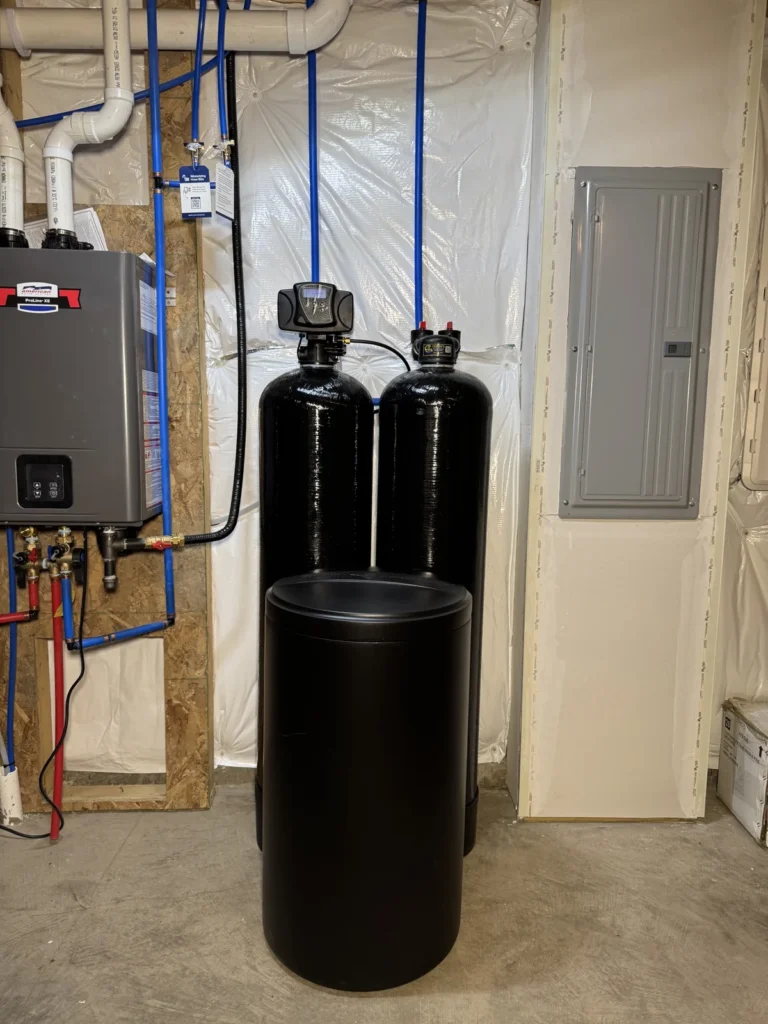
NEW CASTLE, PA • MUNICIPAL WATER
LAWRENCE COUNTY CASE STUDY
On-Site Water Conditions
Total chlorine: 2.1 mg/L
Hardness: 6.9 gpg
TDS at the kitchen tap: 242 ppm
Concern: chlorine taste, odor and spotting
Cesare’s Treatment Design
Our whole-house activated-carbon filtration for chlorine reduction, an ion-exchange softener for hardness, and reverse osmosis at the kitchen sink.
Follow-Up Results
Total chlorine: below 0.10 mg/L
Hardness: 0.6 gpg
TDS at the RO tap: 13 ppm
Reduction: 94.6%
Measured before and after treatment
Chlorine taste and hardness on the New Castle municipal system
A New Castle homeowner wanted less disinfectant taste and odor, less mineral buildup on fixtures, and better drinking water at the kitchen. Testing measured a 2.1 mg/L total chlorine residual, 6.9 grains per gallon of hardness and 242 ppm TDS at the tap. Because the New Castle supply is chloraminated Shenango River water, and chloramine does not dissipate the way free chlorine does, the build used a Cesare’s chloramine-capable carbon bed, an ion-exchange softener, and a reverse osmosis system at the sink. Afterward total chlorine measured below 0.10 mg/L, hardness 0.6 gpg, and the RO tap 13 ppm — a 94.6% reduction.
PULASKI, PA • PRIVATE WELL
MANGANESE, IRON + HARD WATER CASE STUDY
On-Site Water Conditions
pH: 6.2
Iron: 3.9 mg/L
Manganese: 0.46 mg/L
Hardness: 10.8 gpg
Total coliform and E. coli: present
Cesare’s Treatment Design
pH correction for the acidic water, oxidation-based iron and manganese filtration, ion-exchange softening, and UV disinfection as a final microbial barrier.
Follow-Up Results
pH: 7.2
Iron: below 0.05 mg/L
Manganese: below 0.01 mg/L
Hardness: 0.7 gpg
Total coliform and E. coli: absent
Measured before and after treatment
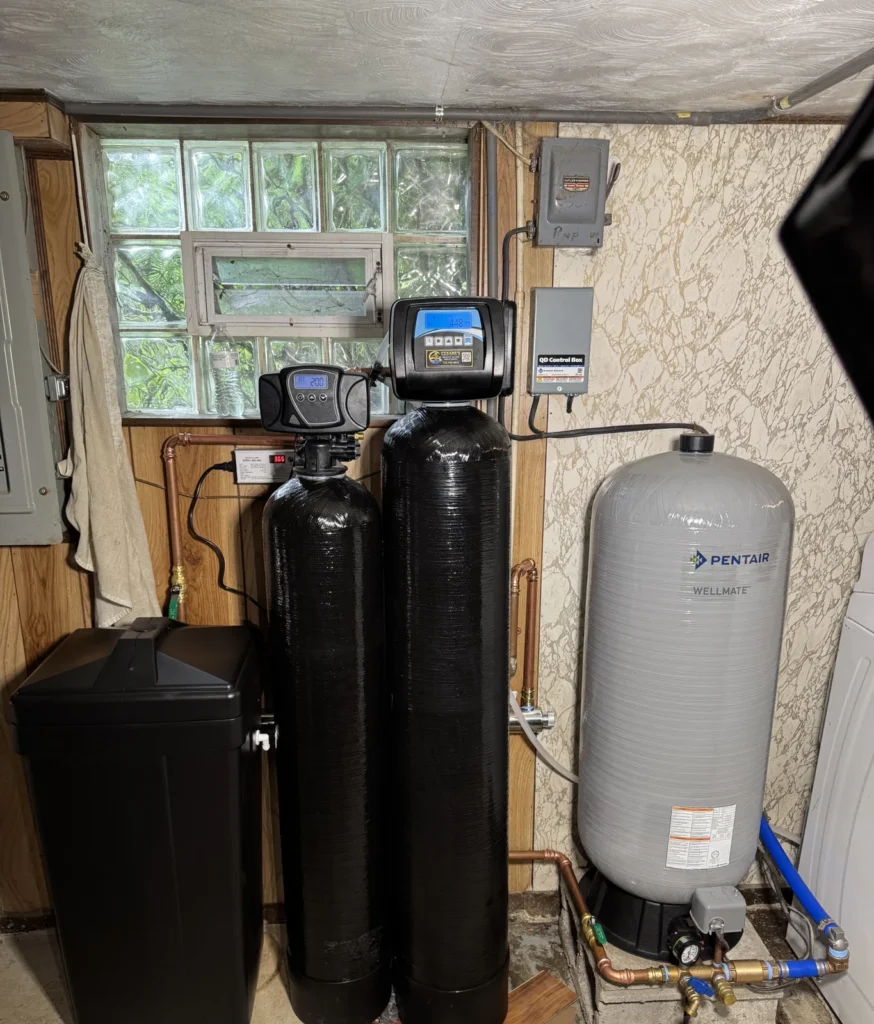
Manganese, iron and hard water on a Pulaski well
A homeowner near Pulaski called Cesare’s about orange staining, dark deposits around fixtures, a metallic taste and blue-green discoloration on the plumbing. Testing found four mineral conditions and one more besides: manganese at 0.46 mg/L, iron at 3.9 mg/L, pH at 6.2 and manganese at 0.46 mg/L, 10.8 grains per gallon of hardness — and a positive total-coliform result that had to be treated on its own terms. The well measured pH 6.2, lower than the minimum reported in Penn State’s published Lawrence County summary table. That illustrates why treatment design should start with the water at the property rather than a county median. Cesare’s built it in order: pH correction first, then oxidation-based iron and manganese filtration, then softening, then UV as a final microbial barrier. Afterward pH read 7.2, iron below 0.05 mg/L, manganese below 0.01 mg/L, hardness 0.7 gpg and coliform absent.
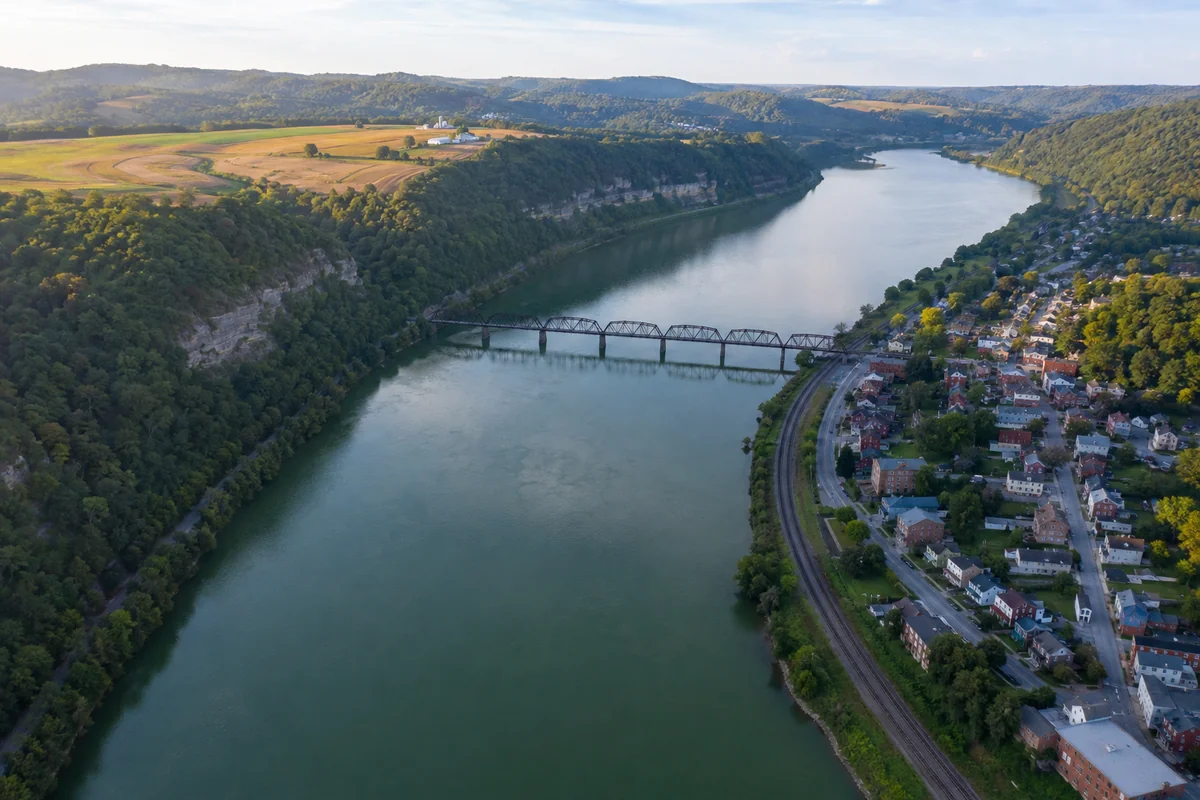
New Castle and the townships around it are on Pennsylvania American Water’s Shenango River system: chloraminated surface water, average hardness 6.7 grains per gallon, and a 2025 lead result of 2 ppb at the 90th percentile with none of the 31 sampled sites above the action level. The utility is separately replacing about 550 lead service lines in the city under a $9.5 million PENNVEST project that began in February 2026 — its own report says the water meets all standards, so that work is about plumbing materials, not a water-quality failure. If your house is old enough that the service line material is unknown, that is a reason to test at your own tap.
New Castle South New Castle Neshannock Township Shenango Township Union Township Hickory Township Taylor Township Mahoning Township
New Wilmington Volant Wilmington Township Pulaski Township Washington Township Plain Grove Township Scott Township Slippery Rock Township
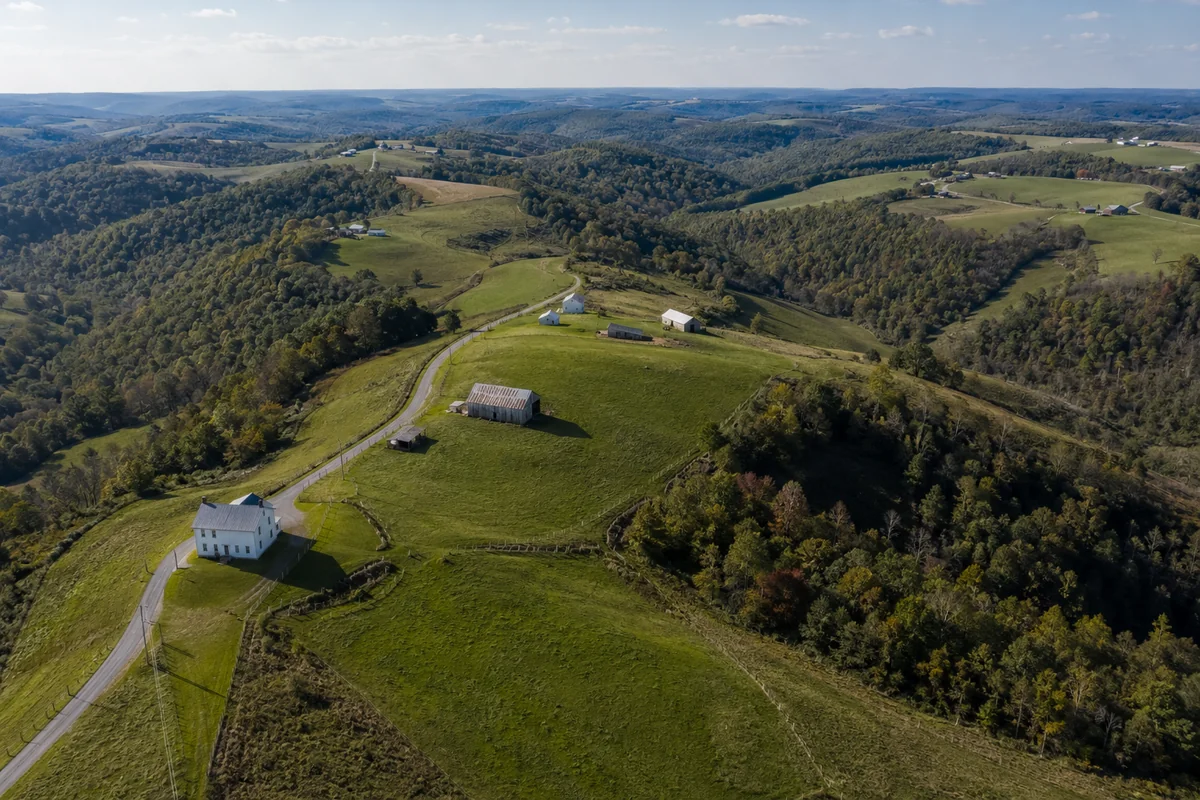
Ellwood City is on the same utility as New Castle but not on the same water. Its supply comes from Connoquenessing Creek and the Beaver River, and the 2025 average hardness is 150 mg/L — 8.8 grains per gallon against New Castle’s 6.7. Two systems, one county, one utility, and roughly two extra grains of hardness. Out through Wampum, Bessemer and Enon Valley the mains give way to private wells, where the manganese and iron numbers do the talking.
Ellwood City Ellport Wayne Township Perry Township Wampum New Beaver Little Beaver Township North Beaver Township
Bessemer Enon Valley SNPJ Big Beaver Falls Road Edinburg Eastbrook Princeton Hillsville
Cesare’s Quality Water Solutions provides residential water testing, private-well treatment, whole-house filtration, water softening, manganese and iron removal, chlorine and chloramine filtration, UV disinfection and reverse osmosis throughout Lawrence County. We identify the home’s water source and test at the tap before selecting treatment, because Lawrence runs three distinct municipal profiles plus a lot of rural wells.
All of it. New Castle, Neshannock Township, Shenango Township, Union Township, Ellwood City, Ellport, New Wilmington, Wampum, New Beaver, Volant, Pulaski, Bessemer, North Beaver Township and the surrounding rural communities. The county mixes municipal systems with private wells, so treatment needs change substantially by address.
Penn State’s water lab summarizes 96 drinking-water samples submitted from Lawrence County between December 2007 and May 2025. Manganese was over the 0.05 mg/L limit in 14 of 34 samples and iron over 0.3 mg/L in 8 of 32. Total coliform bacteria turned up in 30 of 92 and E. coli in 7 of 92 — noticeably lower rates than most of the surrounding counties. Median hardness was 131.1 mg/L, about 7.7 grains per gallon. These are homeowner-submitted samples, not a survey of every property, which is why we start with water testing at your tap.
No, and the differences are sharper here than in most counties. Pennsylvania American Water runs two separate systems — New Castle on the Shenango River and Ellwood City on Connoquenessing Creek and the Beaver River. New Wilmington buys treated water from Aqua Pennsylvania’s Shenango Valley system. And rural Lawrence runs on private wells. Same county, four different starting points.
The Shenango River. Pennsylvania American Water’s New Castle system treats surface water from a watershed covering roughly 790 square miles across Pennsylvania and Ohio. Average hardness runs about 115 mg/L, or 6.7 grains per gallon, with a range of 74 to 156.
Chloramine. Pennsylvania American Water’s New Castle report records chloramine in the distribution system from 1.83 to 2.35 parts per million. Chloramine takes different Cesare’s carbon filtration than free chlorine — a filter sized for chlorine will fall short — so it is worth confirming what serves your address before buying anything.
Ellwood City is Pennsylvania American Water’s other Lawrence County system, and it draws from Connoquenessing Creek and the Beaver River rather than the Shenango. Its surface supply is treated with chloramines too, recorded at 1.62 to 2.46 parts per million. Ellwood City also runs harder than New Castle — about 150 mg/L, or 8.8 grains per gallon, ranging 82 to 206.
New Wilmington Municipal Authority purchases treated water from Aqua Pennsylvania’s Shenango Valley system, so the source is the Shenango River — the same river that feeds New Castle. But the finished water is not the same: New Wilmington’s local distribution runs on free chlorine at 0.63 to 1.78 parts per million, not chloramine. Same river, different disinfectant, different filter.
The utility announced in March 2026 that it had begun replacing approximately 550 lead service lines in New Castle, with the physical work starting February 23 after inspections in 2025. It is funded by more than $9.5 million from PENNVEST — a combination of grant and low-interest loan — at no direct charge to customers. The company frames it as proactive rather than a response to a failed test, noting its water meets all standards. Lead reaches a tap through the service line and the home’s own plumbing, which is exactly what the program replaces.
Generally yes, though it depends where the water comes from. Penn State’s countywide median is 131.1 mg/L, about 7.7 grains per gallon, but submitted wells ranged from under 1 all the way to 912.9 mg/L. On the municipal side, New Castle averages 6.7 grains and Ellwood City 8.8. At those levels you see scale on fixtures and spotting on glassware. A softener still gets sized from the hardness measured at your home, not from any of those averages.
It is the county’s standout finding. Penn State found manganese over the 0.05 mg/L limit in 14 of 34 Lawrence County samples tested — 41.2% — with the highest result at 2.97 mg/L. That does not mean 41.2% of the county’s wells have elevated manganese; it describes the samples submitted. What it does mean is that manganese deserves a real look whenever a Lawrence County home has dark staining, and it needs different handling than iron.
Black or dark staining usually points to manganese; orange, reddish-brown or rust-colored staining points to iron. In Penn State’s Lawrence County submissions, 14 of 34 manganese samples and 8 of 32 iron samples were over their limits. Appearance narrows it down, but only testing tells us which metal, how much, and in what form — the details that decide the iron and manganese filtration design and the order the stages go in.
Yes, and Lawrence is the clearest example of it we deal with. Only 2 of 74 submitted pH samples were outside the recommended 6.5 to 8.5 range — just 2.7%, with readings never dropping below 6.5. Yet 20 of 34 corrosivity-index samples, 58.8%, fell outside the acceptable range. A near-neutral pH reading does not mean the water is not attacking your plumbing. Corrosion potential depends on the full mineral balance, which is why it gets evaluated from a complete analysis rather than a pH strip.
Pennsylvania DEP recommends testing private well water every year for total coliform bacteria, nitrates, total dissolved solids and pH, through a state-certified lab, plus anything else you have reason to suspect. In Lawrence County, manganese, iron, hardness and corrosion-related chemistry are worth adding whenever there is staining, scale or plumbing trouble — and nitrate deserves particular attention here, for reasons the next answer covers.
More than in most of the counties around it. In Penn State’s Lawrence County summary, 3 of 35 nitrate-plus-nitrite samples — 8.6% — were above the 10 mg/L standard, topping out at 12.5 mg/L. Most neighboring counties show zero exceedances, so this one stands out. Nitrate cannot be tasted, smelled or seen, and it matters most for households with an infant, so it belongs in routine testing rather than being assumed away.
Treat it as a safety issue. DEP’s guidance is not to consume the water unless it has been brought to a rolling boil for one minute, or to use bottled water for drinking and food preparation while the problem is addressed. Then the well gets evaluated for how contamination is getting in, corrected or disinfected, and retested. A properly sized UV disinfection system treats water passing through the reactor but does not repair the well or stop new contamination entering. Lawrence fares better than its neighbors here — 30 of 92 submitted samples were coliform-positive and 7 of 92 carried E. coli — but better odds are not the same as a clean result at your address.
It is worth considering when the home has an older or unknown service line, older fixtures or lead-containing plumbing. In Penn State’s Lawrence County submissions, 3 of 36 first-draw samples were above 0.015 mg/L while none of the 27 running-water samples exceeded it. That split is the whole story of household lead: it comes from water sitting in your own line and plumbing overnight, not from the treatment plant. A first-draw test at your faucet is what answers it.
It depends on which water you have and what the tests find. A New Castle or Ellwood City home on chloraminated municipal water needs Cesare’s carbon matched to chloramine plus softening sized to 6.7 or 8.8 grains. A New Wilmington home on free chlorine needs something different again. A Pulaski-area well might need manganese and iron removal, corrosion control and softening in a particular order. Flow rate, plumbing and the number of stages all factor in, and Cesare’s prices the system after testing the water — not before.
Straight answers to the water questions we hear most in Lawrence County.
See how Lawrence County compares with 12 other Southwestern Pennsylvania counties for hardness, iron, manganese, bacteria and corrosivity in the 2026 Southwestern PA Water Quality Report.
2026 Southwestern PA Water Quality Report →
Get a professional water analysis and a custom treatment plan—clear answers, no pressure.