- Pittsburgh & Southwestern PA • Custom-Engineered Water Treatment
- Fully Licensed & Insured
- 24/7 Emergency Water Service
- 3rd Generation Water Treatment Experts

Armstrong County water depends on where you live. Kittanning drinks treated Allegheny River water, Ford City pumps its own groundwater from wells inside the borough, and a large share of the county runs on private wells. Cesare’s identifies which supply is yours, tests the water at your tap, and engineers treatment around what it finds.

About 63,700 people live in Armstrong County, and their water arrives three different ways. Pennsylvania American Water treats Allegheny River water at Kittanning and disinfects with chloramines. Ford City Borough runs its own system on groundwater wells located inside the borough. In the southern tip, Apollo is served by the Municipal Authority of Westmoreland County off Beaver Run Reservoir. Everywhere else — most of the county’s land area — homes draw from private wells that get no treatment at all unless the owner installs it.
Pennsylvania American Water’s Kittanning system draws from the Allegheny River and disinfects with chloramines. Its 2025 report lists hardness at 67 mg/L (about 3.9 gpg) and pH 7.3, with a 90th-percentile lead result of 3 ppb and none of 20 sampled sites above the action level.
Ford City’s drinking water comes from groundwater wells located within the borough — a different source, and a different mineral profile, than the river water treated a few miles upstream. Its 2025 report shows none of 10 sampled sites above the lead or copper action level.
Apollo Borough in the southern tip is served by the Municipal Authority of Westmoreland County from Beaver Run Reservoir. Beyond the river towns, most of Armstrong County is on private wells — untested and untreated unless the homeowner handles it.
Penn State’s Agricultural Analytical Services Laboratory has summarized 126 Armstrong County drinking-water submissions collected between November 2007 and May 2025. These laboratory results describe the samples submitted to Penn State and are not a representative survey of all homes, wells or public water supplies in the county.
Aesthetic water conditions
Health-related indicators
About the data: Individual parameters were tested on different numbers of samples. These results describe the samples submitted — they cannot determine what is present at an individual property. Test the water at the property before treatment is selected.
Source: Penn State Agricultural Analytical Services Laboratory — Drinking Water Test Summaries by County.
Iron was above the staining standard in 28.6% of tested Penn State samples and manganese in 37.5% — one of the higher manganese rates among the counties Cesare’s serves.
Which system serves you decides what reaches your tap. Pennsylvania American’s Kittanning supply is disinfected with chloramines, which are more persistent than free chlorine and need a properly sized Cesare’s carbon filter to remove.
Median hardness in tested well samples is about 5.9 gpg — moderate. It is the metals, not the minerals, that cause most of the staining Armstrong County homeowners see: manganese was above the secondary standard in 37.5% of samples tested.
Concerned about lead? Pennsylvania American reported a 90th-percentile result of 3 ppb at Kittanning with no sampled site above the action level, and Ford City reported the same across its 10 sites. Lead is a plumbing problem far more than a source problem — testing at the tap is how you know.
Whole-home filtration matched to the system that serves you — Cesare’s chloramine-reducing carbon for Pennsylvania American’s Kittanning supply, and hardness and metals treatment where Ford City’s borough wells or the Apollo line come in.
Sized to measured hardness — about 5.9 gpg at the median in Armstrong County well samples, and 3.9 gpg on the Kittanning municipal system. The number that matters is the one from your water, not a county average.
Point-of-use treatment for taste, dissolved minerals and laboratory-confirmed drinking-water concerns.
Iron and manganese are the most common aesthetic findings in Armstrong County well samples — 28.6% and 37.5% of tested samples above the secondary standards. Treatment depends on the form the metal is in, so we test before we specify.
Rotten-egg odor traced to its source — water supply, plumbing or water heater — before treatment is chosen.
Inspection, repair and service for existing equipment — including systems Cesare’s didn’t install.
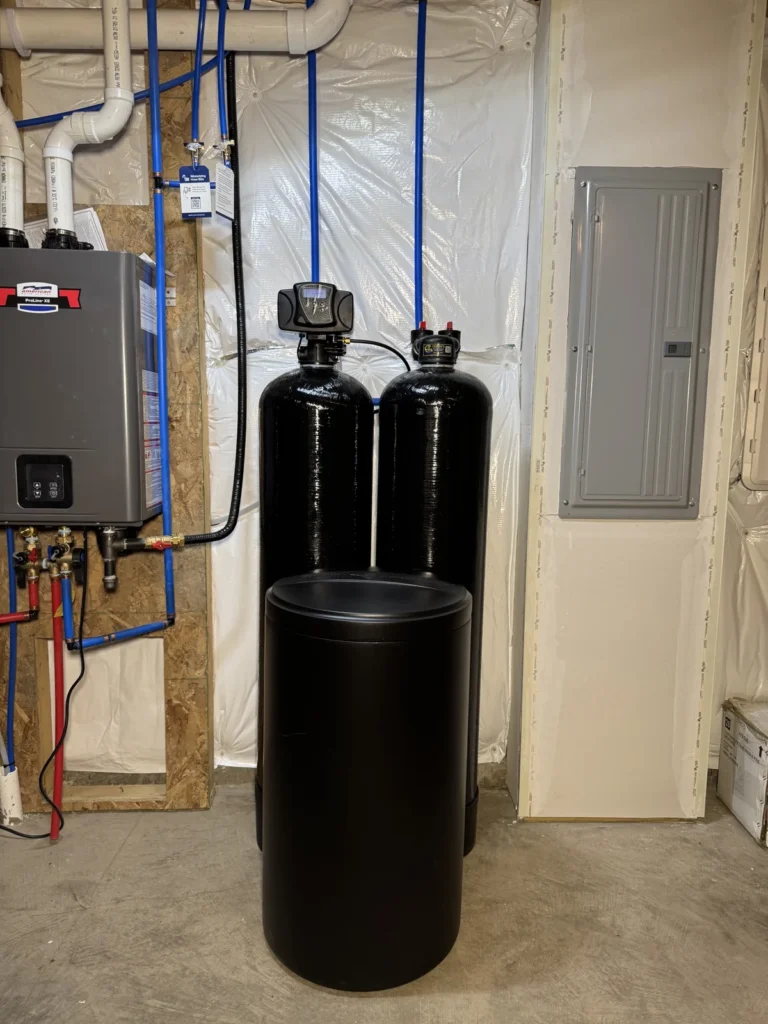
KITTANNING, PA • MUNICIPAL WATER
ARMSTRONG COUNTY CASE STUDY
On-Site Water Conditions
Total chlorine: 2.1 mg/L
Hardness: 4.0 gpg
TDS at the tap: 168 ppm
Concern: chemical taste and odor
Cesare’s Treatment Design
Our whole-house carbon filtration sized for chloramine, plus under-sink reverse osmosis. No softener, so hardness is unchanged by design.
Follow-Up Results
Total chlorine: 0.0 mg/L
TDS at the RO tap: 7 ppm
Reduction: 95.8%
Hardness: 4.0 gpg, unchanged
Measured before and after treatment
Chloramine taste on the Kittanning municipal system
A Kittanning homeowner on the Pennsylvania American system called about a chemical taste at every tap. Testing measured 2.1 mg/L total chlorine, 4.0 gpg hardness and 168 ppm TDS. Because Kittanning is disinfected with chloramine rather than free chlorine, the build used a properly sized Cesare’s whole-house carbon bed followed by under-sink reverse osmosis. Total chlorine measured 0.0 mg/L afterward and the RO tap 7 ppm, a 95.8% reduction. Hardness stayed at 4.0 gpg — no softener was part of this build.
RURAL VALLEY & ELDERTON, PA • PRIVATE WELL
IRON, MANGANESE + SULFUR CASE STUDY
On-Site Water Conditions
Iron: 5.6 mg/L
Manganese: 0.51 mg/L
Hardness: 11.7 gpg
Hydrogen sulfide: 1.8 mg/L
pH: 6.6
Cesare’s Treatment Design
Oxidation with dedicated iron and manganese filtration, then ion-exchange softening and pH correction, sized to the measured chemistry.
Follow-Up Results
Iron: below 0.05 mg/L
Manganese: below 0.01 mg/L
Hardness: below 1 gpg
Hydrogen sulfide: non-detect
pH: 7.2
Measured before and after treatment
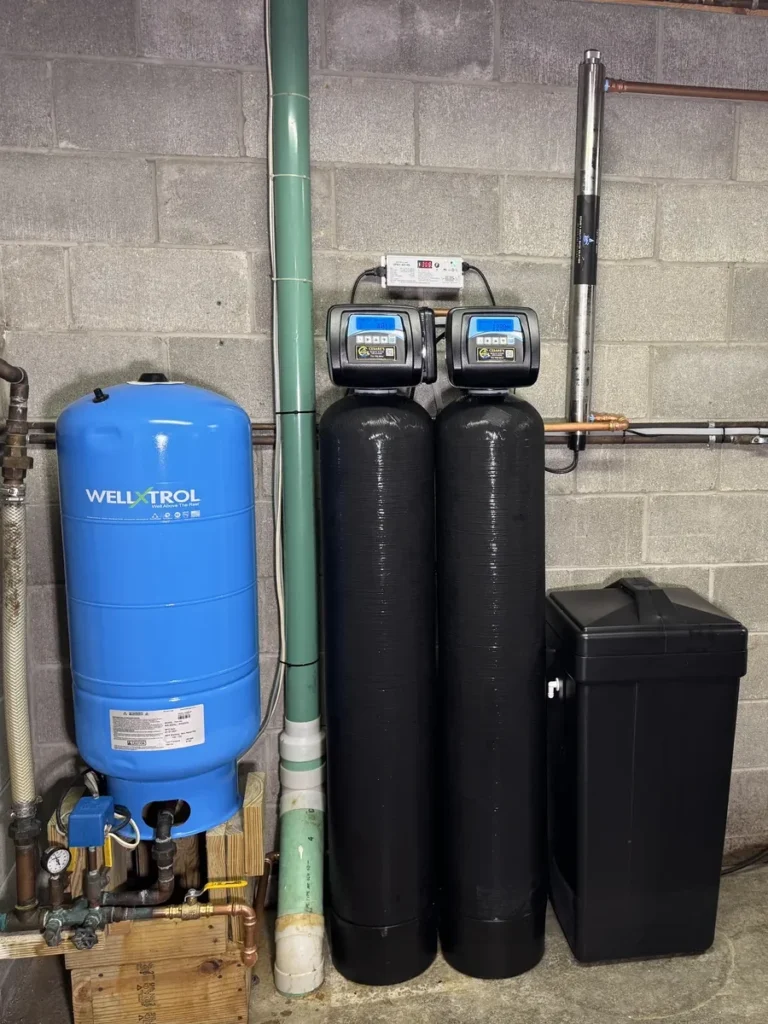
Orange staining, rotten-egg odor and scale on a rural Armstrong County well
A homeowner between Rural Valley and Elderton called Cesare’s about orange staining, dark deposits, a rotten-egg smell and a metallic taste. Testing measured 5.6 mg/L iron — more than eighteen times the 0.3 mg/L secondary standard — along with 0.51 mg/L manganese, ten times the 0.05 mg/L guideline, 11.7 grains per gallon of hardness, 1.8 mg/L hydrogen sulfide and a pH of 6.6.
Oxidation with dedicated iron and manganese filtration, followed by softening and pH correction, brought iron below 0.05 mg/L, manganese below 0.01 mg/L and hardness below 1 grain per gallon. Hydrogen sulfide was non-detect and pH settled at 7.2.
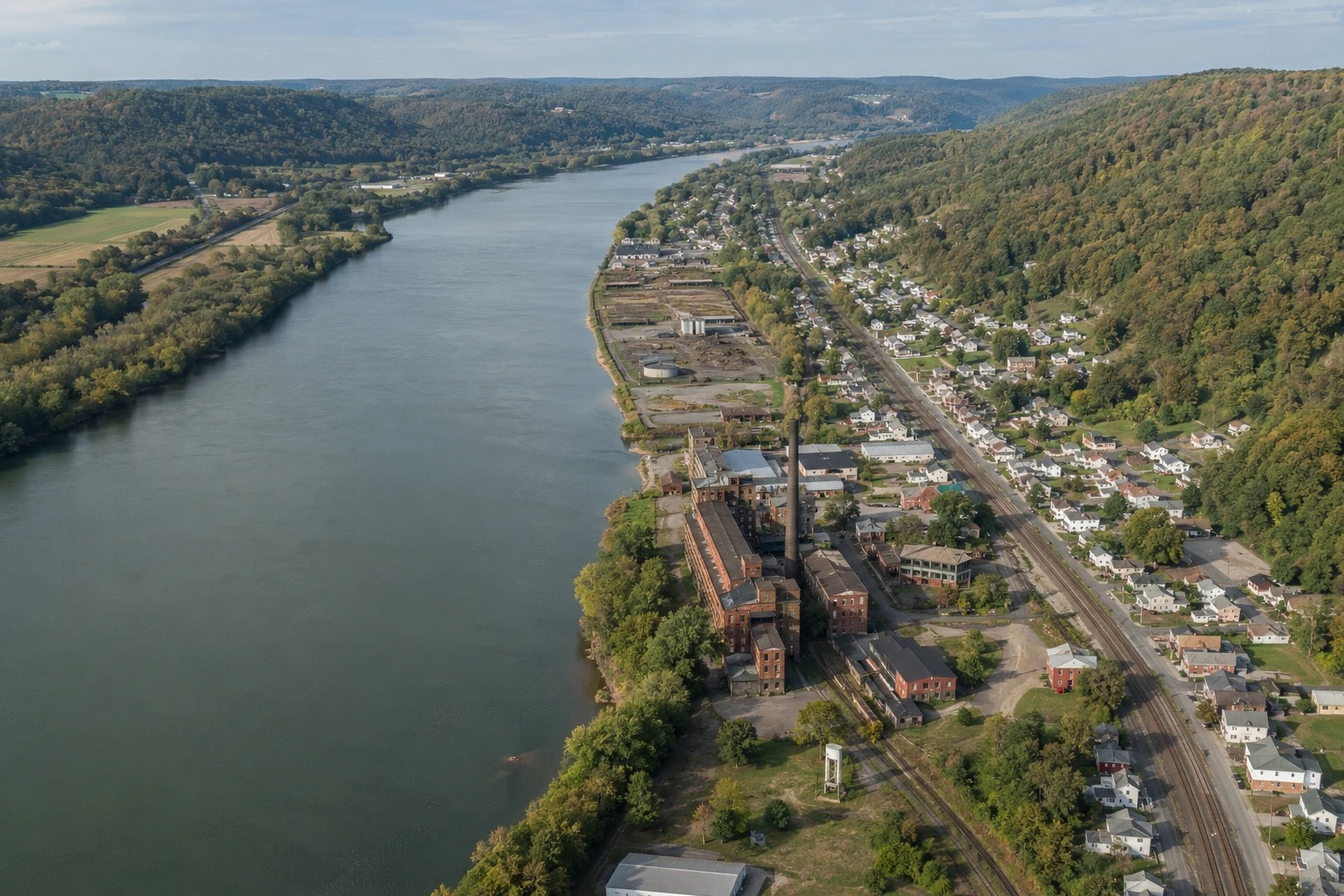
Kittanning, Ford City and the boroughs along the Allegheny sit on three different public supplies — river water at Kittanning, borough wells at Ford City, and Westmoreland reservoir water at Apollo. Filtration, softening and drinking-water systems built for the supply that actually reaches your street.
Kittanning West Kittanning Applewold Manorville Ford City Rayburn Township East Franklin Township Manor Township
Freeport Leechburg Apollo North Apollo South Buffalo Township Gilpin Township Parks Township Kiskiminetas Township
Outside the river boroughs, eastern and northern Armstrong is well country — farmland, wooded ridges and scattered villages where nearly every home runs on its own supply. Iron, manganese, sulfur and bacteria treatment here starts with what the tap test shows, not with what the neighbors installed.

Rural Valley Elderton Atwood Dayton Plumcreek Township Cowanshannock Township Redbank Township Wayne Township
Worthington South Bethlehem Parker West Franklin Township Sugarcreek Township Madison Township Bradys Bend Township Boggs Township
Cesare’s Quality Water Solutions designs, installs and services water treatment across Armstrong County, for homes on municipal water and homes on private wells. That includes water testing, whole-house filtration, water softening, iron and manganese removal, sulfur treatment, UV disinfection and reverse osmosis. We identify the water source and test at the tap first, because Armstrong County runs on four different municipal systems plus a lot of wells.
All of it. Kittanning, West Kittanning, Ford City, Manorville, Applewold, Freeport, Leechburg, Apollo, North Apollo, Rural Valley, Elderton, Dayton, Worthington, Parker and the rural townships between them. Water conditions shift substantially between the Allegheny River systems, borough groundwater and private wells, so the address matters before anything else.
Penn State’s water lab summarizes 126 drinking-water samples submitted from Armstrong County between November 2007 and May 2025. Among the samples tested, manganese was over the 0.05 mg/L limit in 15 of 40, iron was over 0.3 mg/L in 10 of 35, total coliform bacteria turned up in 87 of 124, and E. coli in 29 of 124. Median hardness ran 100.2 mg/L, about 5.9 grains per gallon. These are homeowner-submitted samples, not a survey of every property, which is why we start with water testing at your tap.
No, and this county is unusual for how much the answer varies. Pennsylvania American Water runs the Kittanning system. Kittanning Suburban Joint Water Authority runs a separate system nearby. Ford City operates its own groundwater system. And the Municipal Authority of Westmoreland County serves Apollo and other southern Armstrong communities. Four systems, four different profiles — plus private wells across the rural townships.
The Allegheny River. Pennsylvania American Water’s Kittanning system treats river water from a watershed of roughly 9,000 square miles across Pennsylvania and New York. Its current report lists average hardness of 67 mg/L, about 3.9 grains per gallon, average pH of 7.3, and a 3 ppb 90th-percentile lead result with none of at least 20 sampled sites over the action level.
No — and this is the local distinction most people miss. Pennsylvania American Water’s Kittanning system uses chloramines, reported at 0.89 to 2.0 ppm. Kittanning Suburban Joint Water Authority, right next door, also draws from the Allegheny River but keeps two underground wells as an alternate source and reports free chlorine in distribution at 0.21 to 2.50 ppm. Two Kittanning-area homes can need different Cesare’s carbon filtration depending purely on which utility bills them.
Groundwater, not the river. Ford City’s own report says its drinking water comes from groundwater wells located within the borough, and that none of the 10 sites tested for lead and copper exceeded the action level. That makes Ford City a fundamentally different supply from the Allegheny River systems a few miles up the road, and the treatment that suits one rarely suits the other.
Apollo Borough is served by the Municipal Authority of Westmoreland County’s George R. Sweeney plant, which is supplied by Beaver Run Reservoir. Several other southern Armstrong communities sit under the same plant, including North Apollo, Leechburg, West Leechburg, Vandergrift and Parks Township. MAWC uses chloramine seasonally, switching between chloramine and free chlorine on an annual schedule, so the disinfectant in an Apollo home is not the same year-round.
It depends on your source. The median across Penn State’s Armstrong County samples is 100.2 mg/L, about 5.9 grains per gallon, with individual wells running from under 1 up to 607 mg/L. Pennsylvania American’s Kittanning water is milder at 3.9 grains. A softener makes sense when the hardness measured at your home is high enough to cause scale, spotting or soap problems — sized from your tap number, not a county average.
Orange or rust-colored staining commonly points to iron, and black or dark staining commonly points to manganese. Both show up here: Penn State found iron over the limit in 10 of 35 Armstrong County samples tested and manganese over the limit in 15 of 40, with one manganese result as high as 6.59 mg/L. The fix is iron and manganese filtration matched to the form and concentration in your water, which is what the test establishes.
Yes, and it is the county’s most-failed test. In Penn State’s Armstrong County submissions, 24 of 34 corrosivity-index samples — nearly 71% — fell outside the acceptable range, while pH readings ran from 5.4 to 8.7. Corrosive water eats at metal plumbing and raises the odds of metals leaching from your own pipes and fixtures. Corrosion potential depends on more than pH alone, so the fix comes from the full analysis, usually a neutralizer ahead of the plumbing.
That smell usually points to hydrogen sulfide or another sulfur condition, and where it shows up is a clue. If the odor is in both hot and cold water, the well or supply is likely involved; if it only appears on the hot side, the water heater may be contributing. Sulfur often travels with iron and manganese around here, so we test for all of it before choosing a treatment approach.
Pennsylvania DEP recommends testing private well water every year for total coliform bacteria, nitrates, total dissolved solids and pH, through a state-certified lab, plus anything else you have reason to suspect. In Armstrong County it is worth adding iron, manganese, hardness and sulfur whenever there is staining, scale or odor. Nitrate has been the quiet good news locally — none of the 42 Penn State samples tested exceeded the standard.
Treat it as a safety issue. DEP’s guidance is not to consume the water unless it has been brought to a rolling boil for one minute, or to use bottled water for drinking and food preparation while the problem is investigated. Then the well gets evaluated for how contamination is entering, disinfected or repaired, and retested. Properly designed UV disinfection provides an ongoing barrier — but it does not repair the well or stop new contamination from getting in, so the evaluation is the part that actually fixes the cause. This matters here: 87 of 124 submitted Armstrong samples tested positive for total coliform and 29 of 124 for E. coli.
It is worth considering when the home has an older or unknown service line, older fixtures or lead-containing plumbing. The utilities report well: Pennsylvania American’s Kittanning system came in at 3 ppb with no sites over the action level, and Ford City reported 0 of 10 sites over. But in Penn State’s countywide submissions, 2 of 31 first-draw samples were over 0.015 mg/L — which is the point. A systemwide number cannot tell you what is happening at one individual faucet.
The county data is reassuring, with a caveat. None of the 18 Armstrong County samples tested for arsenic in Penn State’s summary exceeded the 0.01 mg/L standard, with the highest result sitting right at 0.010. But 18 samples cannot establish the arsenic status of every well in the county, and arsenic has no taste, odor or color. If it belongs in your testing plan, it gets tested — not assumed.
There is no single best system in a county running chloraminated river water, chlorinated river water, borough groundwater and private wells all at once. A Kittanning municipal home may need Cesare’s carbon and softening; a Rural Valley well may need oxidizing filtration for iron and manganese, sulfur treatment, a neutralizer and UV. Cesare’s carbon, softening, oxidation, neutralizing and UV each solve a different problem. Your test results pick the pieces and the order they go in.
It depends on the water source and what the tests find. A Kittanning home wanting Cesare’s municipal carbon filtration is a different project from a rural well needing iron and manganese removal, sulfur treatment and softening together. Flow rate, plumbing and the number of stages all factor in. Cesare’s prices a system after testing the water and identifying what the property actually requires — not before.
Straight answers to the water questions we hear most in Armstrong County.
See how Armstrong County compares with 12 other Southwestern Pennsylvania counties for hardness, iron, manganese, bacteria and corrosivity in the 2026 Southwestern PA Water Quality Report.
2026 Southwestern PA Water Quality Report →
Get a professional water analysis and a custom treatment plan—clear answers, no pressure.