CUSTOM-ENGINEERED pH CORRECTION • 3RD GENERATION EXPERTS

Why Are There Blue-Green Stains Around My Drains and Fixtures?

Acidic well water often looks clear and harmless — while it quietly corrodes copper pipes, fixtures, and appliances from the inside. Learn what causes low pH, how it is tested, and how a professionally sized neutralization system protects your home.
Light blue wave section divider

Acidic Water at a Glance

The most important answers up front — then the full guide below.

What is acidic water?

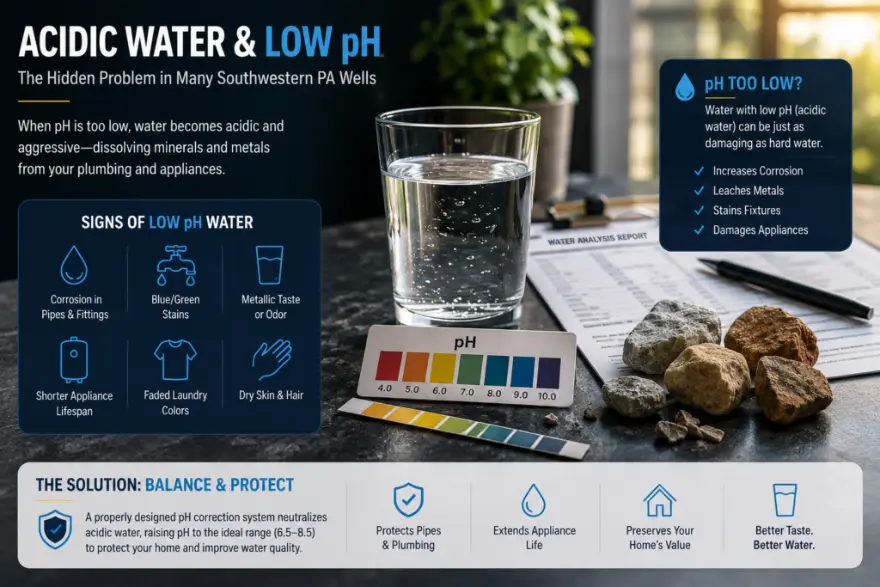
Water with a pH below 7. In a home, the real concern is its ability to corrode plumbing and release metals into your water.

What pH is considered low?

The EPA’s secondary guideline range is 6.5–8.5. Below 6.5, water can contribute to metallic taste and corrosion.

Is it safe to drink?

The pH itself is usually not the main issue — the concern is copper or lead that corrosive water dissolves from plumbing. Testing tells you.

Common warning signs

Blue-green stains, metallic taste, pinhole leaks in copper pipe, green crust on fittings, and fixtures that wear out early.

Typical treatment

A properly sized calcite neutralizer, blended neutralizing media, or a chemical-feed system — selected from your complete water analysis, never from pH alone.
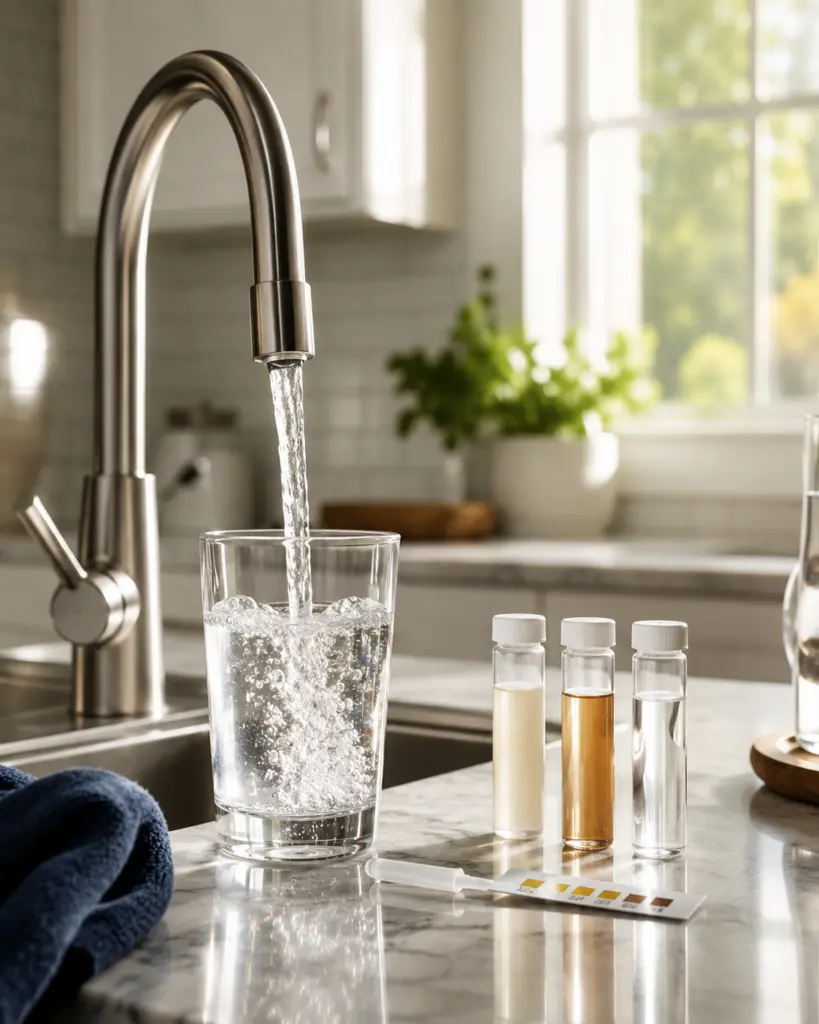
Testing the pH of Southwestern Pennsylvania well water with a field kit and lab vials

What Does Low pH Mean in Well Water?

Acidic water is water with a pH below 7.0. The lower the number, the more acidic the water — and the scale is logarithmic, so each whole number is a tenfold change. But in a home, the concern is not the number itself: it is whether the complete water chemistry can corrode plumbing and release metals.

Low pH and corrosive water are related — but not identical. The full corrosion risk also depends on alkalinity, calcium hardness, dissolved solids, temperature, dissolved gases, and your pipe and fixture materials. That is why treatment is never selected from a pH number alone.

FREE CONSULTATION

What Is a Normal pH for Well Water?

The EPA lists 6.5–8.5 as the secondary guideline range for drinking-water pH — an aesthetic and infrastructure guideline, not a health-based contaminant limit.

EPA guideline range 6.5–8.5
024678101214
More acidicNeutralMore alkaline
Below 5.5Strongly acidic

Treatment often requires special design.

5.5 – 6.4Acidic

Corrosion potential should be evaluated.

6.5 – 8.5EPA guideline range

The secondary, aesthetic guideline for drinking water.

Above 8.5Alkaline

May contribute to taste, deposits, or a slippery feel.

Fractured Southwestern Pennsylvania bedrock where groundwater with limited limestone contact develops low pH

Why Do Some Southwestern PA Wells Have Acidic Water?

Private wells here draw from fractured sandstone, shale, siltstone, and coal-associated geology. Low-pH water is more likely where groundwater moves through mineral-poor rock, has limited contact with limestone, carries dissolved carbon dioxide, or has low alkalinity — and USGS groundwater studies in Pennsylvania have documented well pH ranging from roughly 5.0 to 8.8 depending on the bedrock.

Across Westmoreland, Allegheny, Washington, Beaver, Butler, Armstrong, Indiana, Fayette, Somerset, and surrounding counties, two neighboring wells can produce very different pH, alkalinity, and hardness results. The only reliable way to know your water is to test that specific well.
TEST + TREAT YOUR WATER
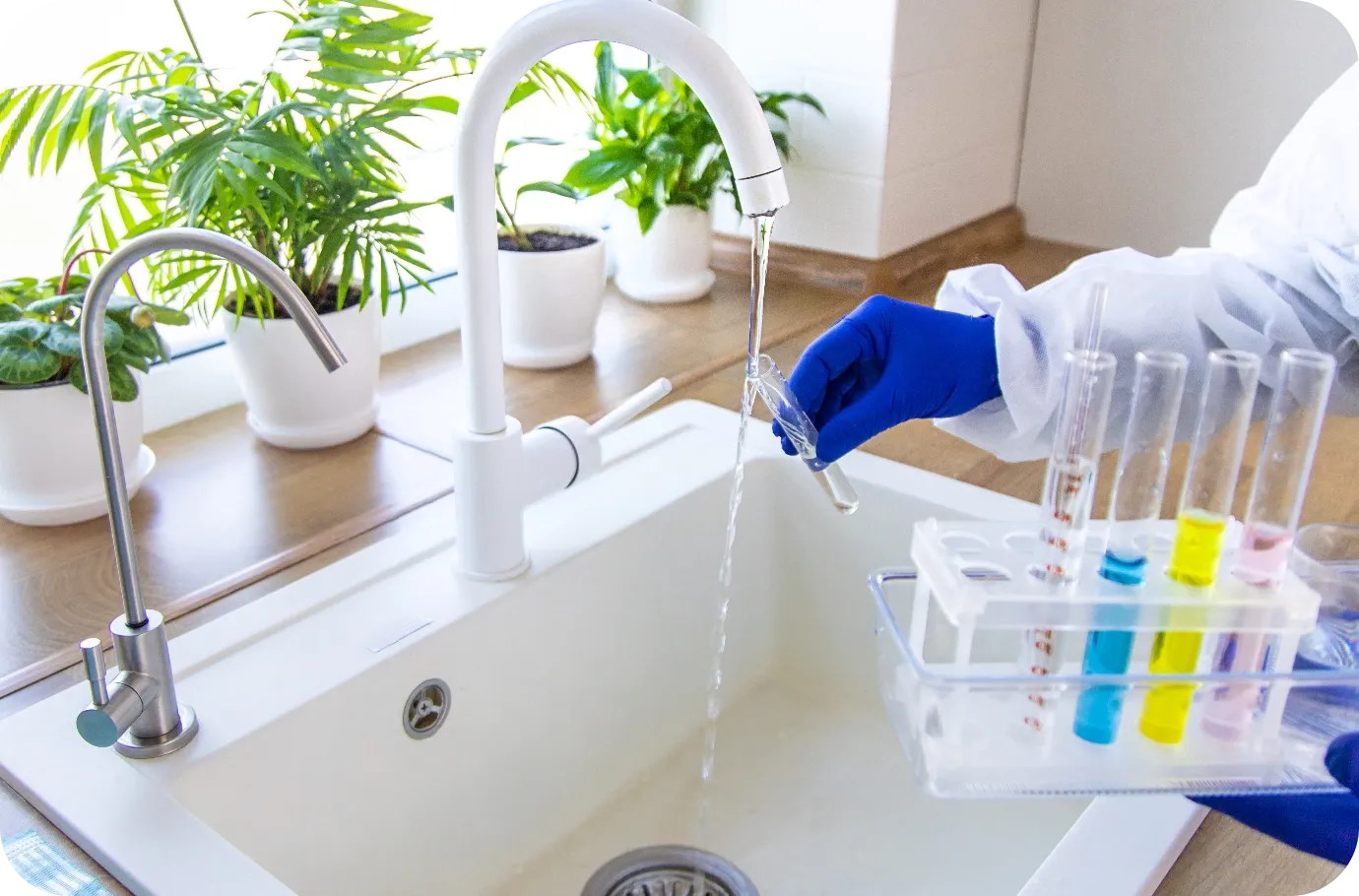
Signs of acidic well water being evaluated with water samples from a Southwestern Pennsylvania home

Signs Your Well Water May Be Acidic or Corrosive

Acidic water attacks plumbing instead of leaving scale — so the clues look different:

  • Blue-green stains in sinks, tubs, and toilets (dissolved copper)
  • Metallic or sour taste, strongest in first-draw morning water
  • Pinhole leaks in copper supply lines
  • Green or crusty deposits around fittings and soldered joints
  • Rust particles or orange staining from corroding iron or galvanized pipe
  • Faucets, valves, and water heaters wearing out early

These symptoms overlap with iron, manganese, and hard water problems — testing is what separates them.

GET MY WATER FIXED

How Low-pH Water Corrodes Plumbing

Yes — acidic or otherwise corrosive water can gradually dissolve copper, brass, solder, and galvanized pipe. The damage builds invisibly, long before the first leak.

Acidic or unstable waterContacts copper, brass & solderGradually dissolves metalMetals enter your waterStains, taste, pinhole leaks

The water does not need to look dirty to be damaging the plumbing.

Acidic water and low pH warning guide for Southwestern Pennsylvania private wells

Is Low-pH Well Water Dangerous to Drink?

Low pH is generally a corrosion and water-quality concern — the larger potential health issue is the copper or lead that corrosive water releases from your plumbing. The pH number alone does not reveal metal concentrations, lead cannot be identified by taste or appearance, and clear water is not proof of safe water.

Pennsylvania recommends annual private-well testing for pH, TDS, nitrate, and total coliform bacteria through a certified laboratory — with additional metals testing where plumbing age or corrosion symptoms raise the risk. That is exactly how we approach it: test first, then treat what the numbers show.

Schedule My Water Test

What Is Causing the Stains?

Stain color is a clue — not a diagnosis. Here is what each one usually points to.

Blue-green stains

Copper corrosion from acidic water

You are on the right page
Orange or rust stains

Iron

Iron in well water →
Black or dark brown

Manganese

Manganese removal →
White chalky scale

Hardness

Hard water guide →
Clear, metallic taste

Requires testing to identify

Well water testing →

How Is Low-pH Well Water Corrected?

With a calcite neutralizer, blended neutralizing media, or an alkaline chemical-feed system — selected from your pH, alkalinity, hardness, flow rate, and the rest of the analysis.

Calcite Neutralizer

Mild to moderate acidity

How it works
Water dissolves calcium carbonate media, raising pH
Adds hardness
Yes
Maintenance
Replenish media
Adjustability
Limited by chemistry

Blended Media

Stronger mineral correction

How it works
Calcite plus reactive magnesium media
Adds hardness
Usually more
Maintenance
Replenish media
Adjustability
Limited by blend

Chemical Injection

Severe or variable acidity

How it works
Metering pump injects alkaline solution
Adds hardness
Usually less
Maintenance
Refill solution, service pump
Adjustability
Highly adjustable
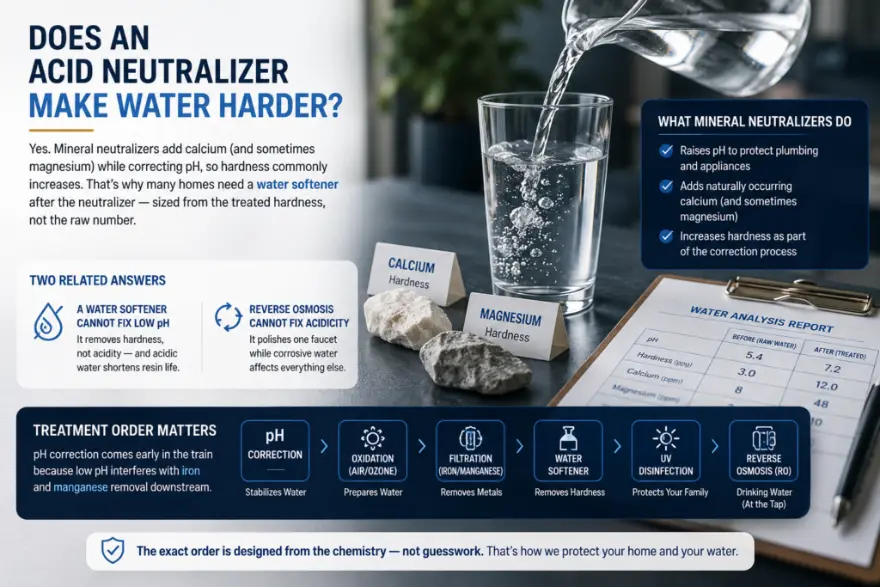
Guide showing how an acid neutralizer raises pH while adding calcium hardness to well water

Does an Acid Neutralizer Make Water Harder?

Yes — mineral neutralizers add calcium (and sometimes magnesium) while correcting pH, so hardness commonly increases. Mildly hard water can become moderately hard, and already-hard water gets harder. That is why some homes need a water softener after the neutralizer — sized from the treated hardness, not the raw number.

Two related answers worth knowing: a water softener cannot fix low pH (it removes hardness, not acidity — and acidic water shortens resin life), and reverse osmosis cannot fix whole-house acidity (it polishes one faucet while corrosive water reaches everything else). Treatment order matters too — pH correction typically comes early in the treatment train, because low pH interferes with iron and manganese removal downstream. The exact order is designed from the chemistry.

SCHEDULE MY WELL WATER TEST

Low-pH Correction Verified in Somerset County

BOSWELL, SOMERSET COUNTY, PARETEST VERIFIED

Real numbers from a real well: comprehensive testing on a Boswell private well measured pH 6.2 — slightly acidic — alongside very hard water, elevated iron and manganese, and bacteria. pH correction was engineered into the whole-house treatment train, and follow-up testing measured pH 7.3 — balanced.

BeforepH 6.2 — slightly acidic, with 24.7 gpg hardness, 3.82 mg/L iron, and 0.41 mg/L manganese riding along.

TreatmentpH correction ahead of oxidation and filtration, softening, and UV disinfection — one system designed from the full analysis.

AfterpH 7.3 — balanced and stable at household flow, verified by retest along with the iron, manganese, and bacteria results.

Read the complete analysis on our well water testing case study — the same well, every number, before and after.
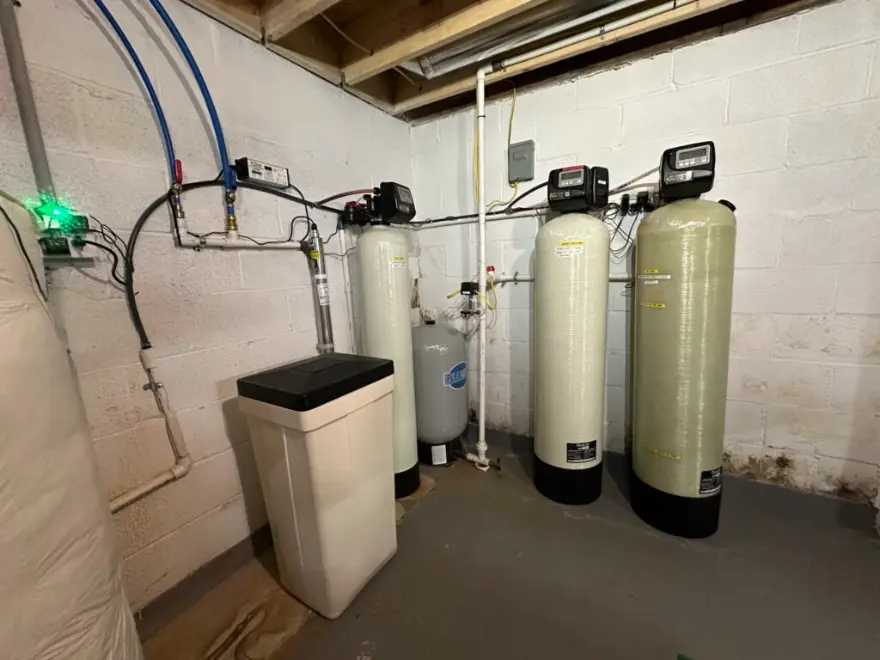
Acidic water and low-pH treatment system with pH correction installed in a Southwestern Pennsylvania home
★★★★★

“I started losing hope after three different water treatment companies couldn’t fix my water… Lance and Monica came out that night and tested my water and took a sample for a third party lab. This guy really knows his stuff. He was informative and made sure I was getting the right system for my water. Install went great and now my water is better than bottled.”

moonlight Paige — Boswell, Somerset County, PA · Google review

Sources & References

Every claim on this page traces back to a primary source — regulators, accredited standards bodies and the utilities that publish local water quality.

PENN STATE

Corrosive Water

  • Corrosive (low pH) water problems in Pennsylvania wells
  • Alkalinity, not pH alone, drives corrosivity
EPA

Federal Standards

  • Secondary drinking water guideline: pH 6.5–8.5
  • Lead and Copper Rule — corrosion control for public systems
PA DEP

State Program

  • Safe Drinking Water Program requirements for public water systems
  • Private wells are not regulated at the state level in Pennsylvania
PA DOH

Public Health Guidance

  • Private well water and health guidance for Pennsylvania households
  • Copper and plumbing metals in household water
NSF/ANSI

Treatment Certification

  • NSF/ANSI 42 and 61 standards for treatment components
  • Calcite and neutralizing media considerations
USGS

Regional Geology

  • Acidic groundwater across the Appalachian Plateau
  • Historic mining influence on Southwestern PA groundwater chemistry

Reviewed July 2026 by Lance Cesare, third-generation water-treatment specialist. Water testing referenced on this page is on-site field analysis performed by Cesare’s Quality Water Solutions, not certified laboratory analysis. Bacteria, lead, nitrate, PFAS and disinfection by-product results require an accredited laboratory and are not published from field methods.
Acidic Water & Low pH FAQs

What is considered acidic well water?
Water below pH 7 is technically acidic. The EPA's secondary guideline range for drinking water is 6.5 to 8.5, and water below 6.5 can contribute to corrosion and metallic taste.
Is low-pH well water safe to drink?
The pH itself is usually not the only issue. Acidic or corrosive water can dissolve copper, lead, and other metals from plumbing, so the water should be tested rather than judged by appearance or taste.
What causes low pH in well water?
Common causes include low-alkalinity groundwater, dissolved carbon dioxide, limited contact with limestone and other carbonate minerals, and the local bedrock chemistry your well draws from.
What causes blue-green stains in my sink or bathtub?
Blue-green stains form when acidic well water dissolves copper from your pipes and fixtures. As the copper-carrying water sits on porcelain and evaporates, it leaves the turquoise residue behind.
Can low-pH water cause pinhole leaks?
Yes. Persistent corrosion gradually thins copper tubing until small pinhole leaks develop — often the first visible symptom after years of invisible damage.
Can acidic water contain lead?
Acidic or low-mineral water can corrode lead-containing plumbing materials — older solder, brass fixtures, and fittings. Laboratory testing is the only way to know whether lead is present.
Can I test acidic water with pH strips?
A strip gives a rough screening result, but it cannot measure alkalinity, hardness, dissolved metals, or corrosion potential — and it cannot size a treatment system. Professional testing can.
What should be tested before choosing a neutralizer?
At minimum: pH, alkalinity, hardness, TDS, flow rate, and related contaminants like iron, manganese, copper, and lead. See our well water testing guide for the full picture.
How does a calcite neutralizer work?
Acidic water passes through a tank of calcium carbonate media. A controlled amount dissolves into the water, raising pH and alkalinity — and adding some calcium hardness along the way.
Does a calcite neutralizer add hardness?
Yes. Calcite is calcium carbonate, so mineral neutralizers generally increase hardness while correcting pH. Some homes need a water softener sized to the post-neutralizer hardness.
Will I need a water softener after an acid neutralizer?
Possibly. If the added calcium pushes hardness high enough to cause scale or soap problems, a softener sized from the treated (not raw) hardness is the right follow-up.
What is blended neutralizing media?
A mix of calcite with a more reactive magnesium-based media, used when stronger pH correction is needed than calcite alone provides. Misapplied, it can overshoot — it must be selected from the full analysis.
When is soda-ash injection used?
When water is severely acidic or the chemistry and flow make a mineral neutralizer unreliable, a metering pump injects an alkaline solution for precise, adjustable pH correction.
Does a water softener correct low pH?
No. A conventional softener removes hardness minerals — it does not neutralize acidity. Acidic water can even shorten the life of a softener's resin bed. pH correction comes first.
Does reverse osmosis fix whole-house acidic water?
No. An under-sink RO system polishes drinking water at one faucet. It does nothing to protect the rest of the home's plumbing from corrosive water at the point of entry.
How often does neutralizer media need replaced?
It depends on water use, raw pH, alkalinity, and tank size — the media dissolves by design. The level should be inspected periodically and replenished before correction drops off.
Should treated water be retested?
Yes. Retesting confirms the pH correction is stable, measures the hardness increase, and rechecks copper or lead where plumbing risk exists. A neutralizer should never be installed and forgotten.
Can acidic water damage a water heater?
Yes — corrosive water attacks metallic components, fittings, and heat-exchanger surfaces throughout the plumbing system, shortening equipment life well before leaks appear.
What treated pH should a neutralizer produce?
The goal is stable, non-aggressive water — not forcing every home to exactly 7.0. The right treated chemistry depends on alkalinity, hardness, plumbing materials, and the rest of the analysis.
How much does an acid neutralizer cost?
It depends on your water chemistry, household flow, tank size, and whether additional treatment is needed. A complete water test comes first — call or text 724-708-8816 for a straight answer.
Homeowner filling a glass with fresh, clean drinking water from a kitchen faucet after whole-home water treatment.

Ready for Better Water at Home?

Get a professional water analysis and a custom treatment plan—clear answers, no pressure.

Address(Required)

What You’ll Get