- Pittsburgh & Southwestern PA • Custom-Engineered Water Treatment
- Fully Licensed & Insured
- 24/7 Emergency Water Service
- 3rd Generation Water Treatment Experts


The answers people actually need — up front. The full guide is below.
No. Water with elevated PFAS can look, smell, and taste completely normal.
No. PFAS are measured in parts per trillion. Only laboratory analysis can find them — no handheld meter or test strip can.
No. The EPA is direct about this: these chemicals cannot be removed by heating or boiling water.
No. PA DEP does not regulate private wells. If you are on a well, testing is your responsibility.
Certified activated carbon, anion exchange, or reverse osmosis — and only the exact model’s verified claim counts. A generic cartridge or a TDS-only RO is not proof.
Test the treated water at a laboratory and stay on the maintenance schedule. Media wears out, and performance drops when it does.
The distinction that matters: “PFAS treatment technology” and “a specific system proven to reduce the PFAS in your water” are not automatically the same thing. This guide explains the difference.

PFAS — per- and polyfluoroalkyl substances — are a large family of man-made chemicals prized for resisting water, grease, heat, and stains. The same carbon-fluorine bond that makes them useful also makes them extremely hard to break down. Many PFAS persist in the environment for decades, which is where the nickname “forever chemicals” comes from. The EPA describes them as long-lasting chemicals now found in water, soil, air, and food because of how widely they were used.
They showed up in firefighting foam, stain-resistant fabrics, food packaging, nonstick coatings, and industrial processes. Water concentrations are measured in parts per trillion (ppt). One part per trillion is one nanogram per liter, which is why only laboratory instruments can find them.
The path to a tap is land use: a release reaches soil or surface water, moves into groundwater, and arrives at a public supply or private well. Using nonstick pans does not contaminate your own well — what matters is what has happened on the land around your water source.
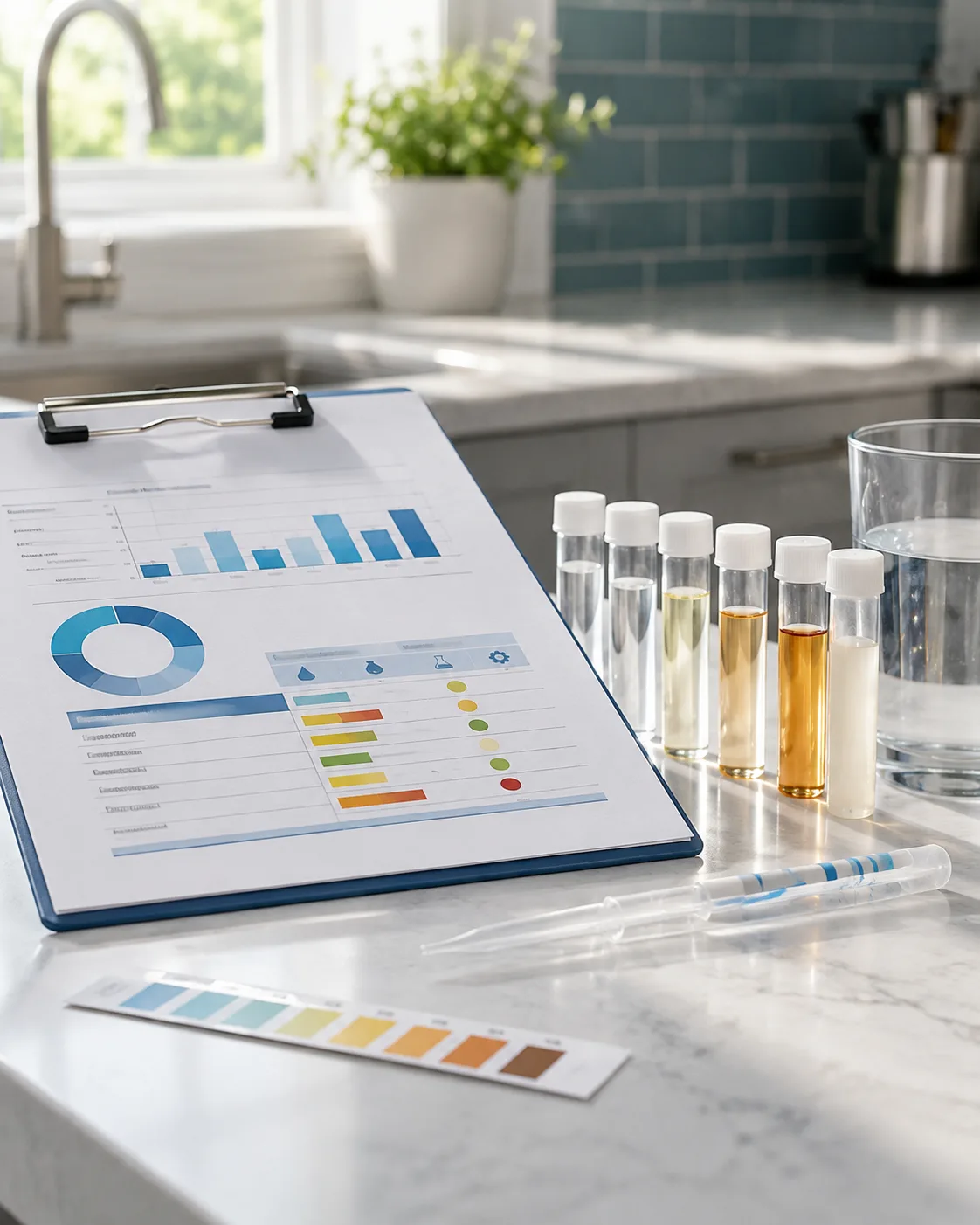
“PFAS detected” by itself tells you very little. Check which compounds were found, the concentration of each, the units (ppt or ng/L), the lab’s reporting limit, and whether the lab is accredited for PFAS.
EPA’s advice: use an alternate source or treatment with a verified PFAS reduction claim for drinking, cooking, brushing teeth, and infant formula. Ingestion is generally the primary drinking-water exposure route. Follow current health-agency guidance for questions involving bathing, children, pregnancy or specific exposure circumstances.
On public water, ask your supplier for its latest PFAS results. On a private well, testing and follow-up are yours to arrange — PA DEP and the Department of Health publish guidance.
A drinking-water result measures the water, not a person. Blood testing, pregnancy, and medical monitoring questions belong with a healthcare provider, not a water contractor.

Iron, manganese, hardness, and low pH come out of our geology. PFAS does not — it follows human activity. The question is not what rock your well is drilled through, but what has happened on the land near your water source.
PA DEP’s statewide sampling plan targeted supplies near common PFAS sources — military bases, fire-training sites, landfills, and manufacturing — and DEP’s PFAS site list includes the Pittsburgh Air National Guard Base and Air Reserve Station in Allegheny County.
February 2026 reporting by 90.5 WESA and The Allegheny Front documented stream sampling that found PFAS up to 430 ppt in Montour Run below Pittsburgh International Airport’s fire-training area — surface water, not drinking water, but exactly why proximity to foam-use sites is what regulators watch.
Keep it in proportion: living near an airport, landfill, or industrial site does not prove your water contains PFAS. It means laboratory testing is more justified than guessing — in either direction.
| Compound | 2024 federal MCL | Pennsylvania MCL | Status, July 2026 |
|---|---|---|---|
| PFOA | 4.0 ppt | 14 ppt | Federal limit stands. EPA has proposed letting qualifying systems extend the compliance deadline from 2029 to 2031. |
| PFOS | 4.0 ppt | 18 ppt | Same as PFOA — limit stands, compliance extension proposed. |
| PFHxS | 10 ppt | No separate PA MCL | In the 2024 rule; EPA has proposed rescinding this limit. |
| PFNA | 10 ppt | No separate PA MCL | In the 2024 rule; EPA has proposed rescinding this limit. |
| HFPO-DA (GenX) | 10 ppt | No separate PA MCL | In the 2024 rule; EPA has proposed rescinding this limit. |
| Certain mixtures | Hazard Index of 1 | No PA equivalent | In the 2024 rule; EPA has proposed removing the mixture provision. |
Regulatory status reviewed July 31, 2026. Pennsylvania’s 14/18 ppt limits are enforceable now; the stricter federal limits apply as compliance deadlines arrive, and the May 2026 EPA changes are proposals until finalized. An MCL is a requirement for a water system — not a personal medical threshold — and none of these limits apply to private wells.

On city water, your first stop is your supplier’s own published results — not an old article or a neighbor’s opinion.
Pittsburgh Water has monitored PFAS since 2018, tests quarterly, and states it has never exceeded the EPA’s limits for the regulated PFAS compounds. Its PFAS page carries the current quarterly results.
Municipal Authority of Westmoreland County publishes a PFAS page and a separate report for each system — Beaver Run, Indian Creek, McKeesport (includes Ligonier), and Furnace Run. Find the one serving your address.
Pennsylvania American Water posts a water-quality report for every system it runs, searchable by ZIP code.
| Public (city) water | Private well |
|---|---|
| The supplier performs required regulatory monitoring | Nobody tests unless the owner arranges it |
| Results appear in utility reports and PFAS pages | Results are not collected or published anywhere |
| The supplier is responsible for meeting MCLs at its entry points | The owner chooses whether and how to test and treat |
| A utility result describes the system, not your tap specifically | A properly collected sample describes your well or tap exactly |
| In-home treatment is an optional extra barrier | Treatment may be the only barrier there is |
Pennsylvania does not regulate water quality from private wells — for PFAS or anything else. That is the single most important line in this guide for the region’s well owners. If you have not read our well water testing guide, it covers the full testing picture beyond PFAS.
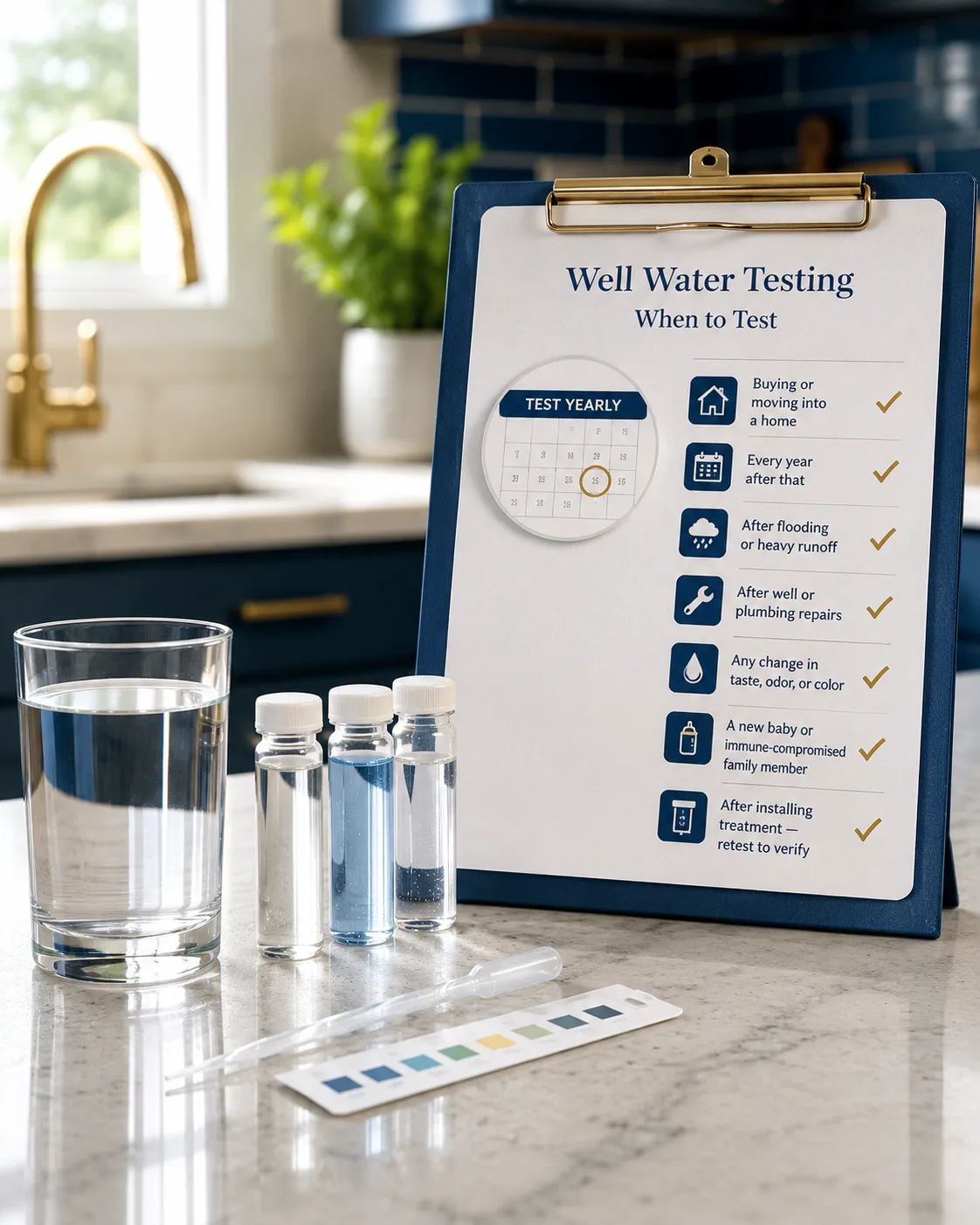
Testing is worth the money when: the home runs on a private well near a known or suspected PFAS source — airport, military site, fire-training area, landfill, or industrial operation; a nearby property or water system has reported PFAS; a government agency has named an investigation area nearby; you want a verified baseline before spending anything on treatment; you are buying a home with a private well near that kind of land use; existing equipment claims PFAS reduction but has never been verified with a treated-water sample; or a prior result found PFAS and follow-up monitoring is due.
Testing is usually wasted money when: it is a drugstore strip or any non-laboratory kit — nothing you can do at home measures parts per trillion; the actual question is hardness, iron, or TDS, which are different tests; the sample plan does not identify the source, the tap, and the treatment stage being sampled; or the lab’s reporting limits are not low enough to compare against the standards that matter.
We coordinate accredited PFAS laboratory testing as part of a full water workup — because PFAS never gets treated in isolation from the rest of your chemistry, and the rest of your chemistry is what decides whether a PFAS system will actually survive your water.
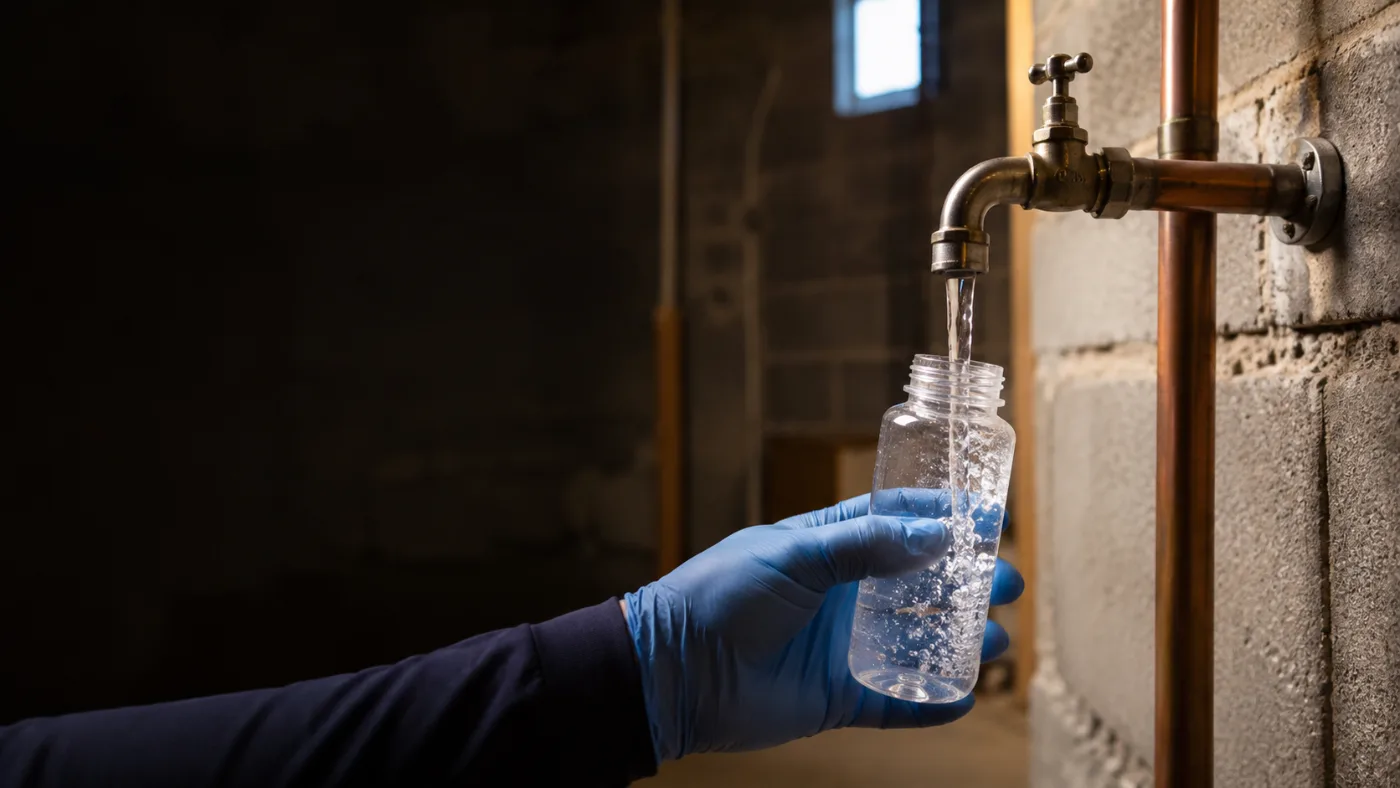
Real PFAS analysis runs on lab instruments using EPA Methods 533 and 537.1, which together measure 29 PFAS compounds. The sequence done right:
1. Define the question. Private well, public water at your tap, or before-and-after around existing treatment — the sample plan follows the question.
2. Choose the lab and panel. Pennsylvania-accredited, a suitable EPA method, reporting limits low enough to interpret, and written sampling instructions.
3. Plan the sample points. Raw well water, water after treatment, the drinking tap — a before/after pair is what proves treatment.
4. Do not contaminate your own sample. PFAS hides in waterproof clothing, cosmetics, and food wrappers. PA DEP publishes a sampling fact sheet on exactly this — follow the lab kit’s instructions to the letter.
5. Read the report properly. Compound by compound: result, units, reporting limit, flags. The next section shows how.
6. Verify treatment — and retest over time. One clean install-day test is a snapshot, not a warranty.
“Non-detect” does not mean zero. It means the laboratory did not measure the compound at or above its stated reporting limit. That distinction sounds picky and matters enormously when the numbers are this small.
| Report wording | What it actually means |
|---|---|
| ND / non-detect | Not measured above the lab’s stated limit — not proof of zero |
| <2 ppt | Below a 2-ppt reporting limit; could be anything from zero to just under 2 |
| Detected | Measured above the reporting threshold — now compare it to the limits above |
| Estimated / J-flag | Detected, with extra analytical uncertainty |
| “Total PFAS” | Only meaningful when the report defines which compounds were summed |
You will never see us claim “0 ppt,” “PFAS-free,” or “all PFAS removed.” The honest versions are “not detected above the laboratory reporting limit” and “results apply to this sample, location, and date.” Any company promising more than that is promising something no laboratory report can back up.

Look for a model-specific PFAS reduction claim — PFOA/PFOS or “Total PFAS” — certified under NSF/ANSI 53 (filtration) or NSF/ANSI 58 (reverse osmosis). The standard number alone is not enough; verify the exact model’s claim in NSF’s or WQA’s public product listings.
Certification currently proves reduction to below 20 ppt (tightened from 70 ppt in 2022) — not to the EPA’s 4 ppt limits. The EPA says so plainly: current certifications “do not yet indicate that a filter will remove PFAS down to the levels EPA has now set.” A certified filter is still meaningfully better than an uncertified one — it just is not a 4 ppt guarantee, and nobody should sell it as one.
The EPA names three technologies that work: granular activated carbon, anion exchange, and high-pressure membranes such as reverse osmosis. Real-world performance depends on the compounds present, water chemistry, flow, contact time, and what competes for the media.
| Treatment | Best role | Strengths | Limits |
|---|---|---|---|
| Point-of-use reverse osmosis | Drinking and cooking water at one tap | Strong barrier across a wide PFAS range | Reject water; needs service and often pretreatment |
| Granular activated carbon | Point-of-use, or whole-home when properly sized | Proven adsorption for long-chain PFAS; improves taste and chlorine too | Depends on bed depth, contact time, flow, and replacement timing |
| Anion exchange | Targeted whole-home treatment | High PFAS capacity, including some shorter-chain compounds | Resin choice and chemistry matter; spent media needs handling |
| Carbon + ion exchange train | Engineered whole-home systems | Complementary media with sample ports between stages | More equipment, more service |
| Whole-home RO | Specialized cases only | Membrane separation across the entire supply | Flow, storage, pressure, and reject water make it the exception |
The design point most sales pitches skip: a PFAS system is sized by tested peak flow, contact time, actual lab results, and pretreatment — not tank size. That is the difference between working in year three and quietly failing in year one. Our reverse osmosis guide covers the drinking-water side.
We could put a glossy customer story here. We are not going to — a PFAS case worth publishing needs certified lab results before and after treatment, and we publish nothing we cannot document. Here is what a legitimate verification looks like; use it to judge anyone’s claims, including ours.
The testing: an accredited laboratory named on the report, the EPA method used, sample dates and locations, each PFAS compound with its result and reporting limit — untreated and treated, from the same sample points.
The context: the supporting water chemistry and household flow the system was designed around — those decide whether the result holds.
The design disclosure: point-of-use or point-of-entry, the technology, which component carries which certified claim, media volume, pretreatment, and sample ports.
The honest fine print: results apply to the samples and dates shown, and maintenance plus periodic retesting are part of the deal. When we complete a documented SW PA PFAS project with lab verification on both ends, it will be published here.
| Product or method | PFAS answer |
|---|---|
| Boiling | No — heat does not touch PFAS |
| Water softener | No — softeners trade hardness ions; Minnesota’s health department says plainly they are not likely to remove PFAS |
| UV disinfection | No — UV helps inactivate microorganisms; it does not remove chemicals |
| Sediment filter | No — PFAS is dissolved, not a particle |
| pH neutralizer | No — corrects acidity, nothing else |
| Aeration | No — PFAS does not off-gas like radon or sulfur |
| TDS meter | Cannot detect or verify PFAS at any level |
| Generic carbon cartridge | Not unless that exact product has verified PFAS performance |
| RO with only a TDS claim | Do not assume a PFAS claim that is not listed |
| Fridge or pitcher filter | Only if the exact cartridge carries a verified PFAS claim and gets replaced on schedule |
Most of this equipment does a different job well — none of it is PFAS treatment. And the EPA adds: even the right filter stops working when it is not replaced on schedule.


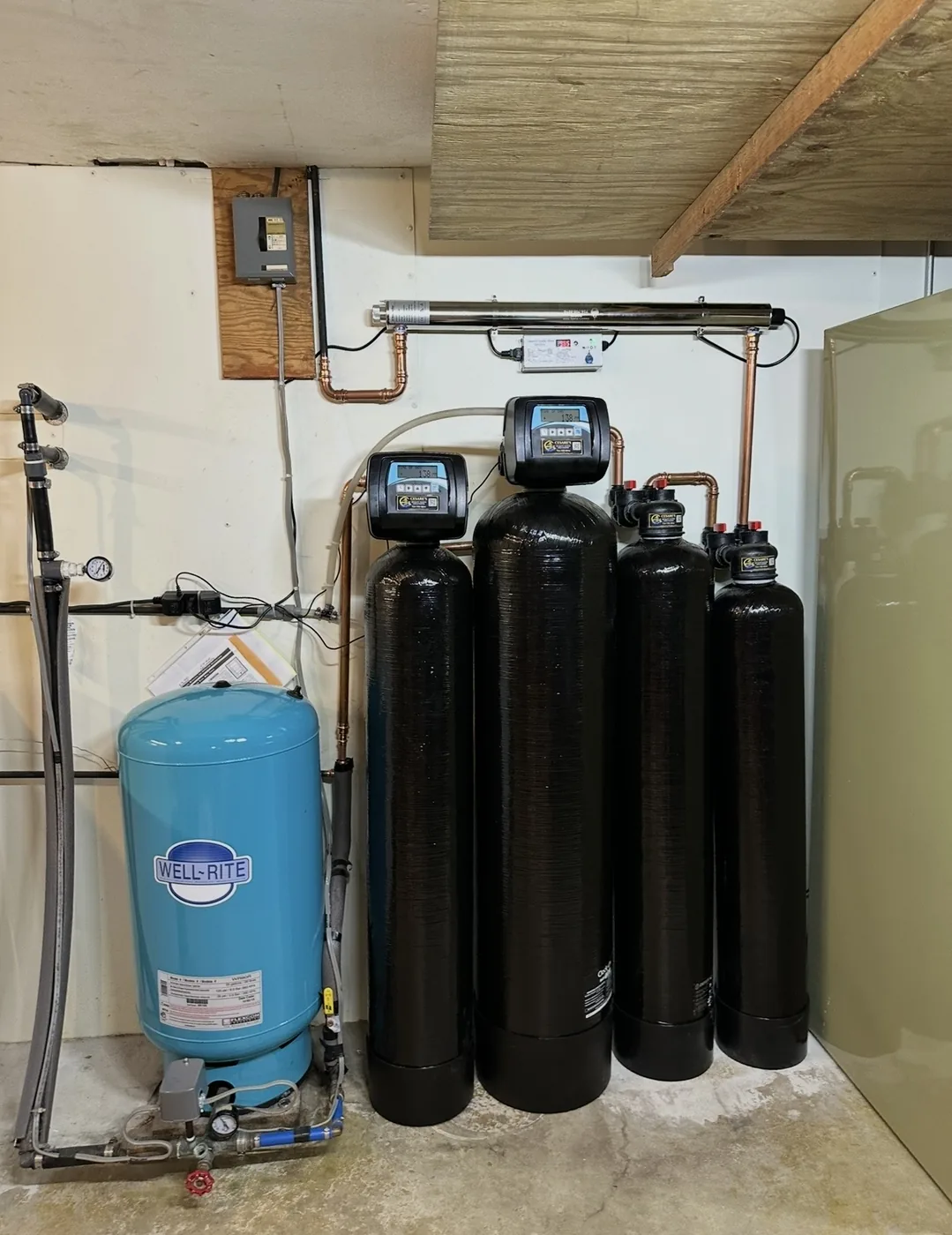
1. Confirm the source. Public system, private well, spring, or a mix. Everything downstream depends on this.
2. Coordinate accredited laboratory testing. No handheld device, strip, or TDS reading is ever presented as a PFAS result — ours or anyone else’s.
3. Work up the complete water chemistry. Chlorine or chloramine, organics, iron, manganese, sediment, hardness, pH, flow, and pressure. This is what decides whether PFAS media will last in your water or die early.
4. Define the protection goal. Drinking and cooking water only, whole-home treatment, or the layered approach — whole-home adsorption plus a point-of-use RO at the kitchen tap.
5. Match the technology to the lab results. The analytes, the concentrations, the flow requirement, and your appetite for maintenance pick the system. There is no one-size PFAS package on our truck.
6. Build in verification. Sample ports before and after treatment stages, so proving performance is a five-minute job instead of a plumbing project.
7. Retest and maintain. A single install-day test is not permanent verification. Media loads up, flow patterns change, and the retest schedule is part of the design, not an afterthought.

A general home inspection does not include PFAS. Neither do most standard well-testing packages — PFAS is a separate laboratory panel that has to be requested. If you are buying a home on a private well near an airport, military site, landfill, fire-training area, or industrial land, that panel is worth considering while you still have negotiating room.
Seller-provided results deserve the same scrutiny as any report: check the date, the sample point, and the laboratory. A three-year-old sample from an outside spigot does not describe today’s kitchen tap.
And the part that matters most: PFAS testing is a laboratory service, not a condition of buying equipment. If the results do not support treatment, that conclusion gets documented too — a clean result that saves you from buying a system you did not need is a good outcome, and we treat it as one.

There is no honest flat price for PFAS work, and we do not publish one. What we can tell you is exactly what moves the number, so any quote you get — ours included — can be read line by line.
Testing costs ride on: how many sample locations, how many compounds in the panel, which laboratory and method, the reporting limits you need, and standard versus rush turnaround.
Treatment costs ride on: point-of-use versus whole-home scope, carbon versus ion exchange versus RO, your peak flow, media volume and staging, what pretreatment your water chemistry demands, plumbing conditions, sample ports and bypasses, post-installation lab verification, and replacement frequency.
What a written PFAS proposal should identify: the test result it is based on, the compounds addressed, which component carries which claim, design flow, treatment sequence, maintenance, replacement criteria, post-install testing — and what is not included. A proposal missing those is not cheaper, just vaguer.
More answers in our Specific Contaminants Knowledge Center.
Every figure on this page traces back to a primary source — regulators, accredited standards bodies, and the utilities themselves.
Regulatory status last reviewed: July 2026. Federal and Pennsylvania PFAS rulemaking is still changing; this page is reviewed whenever it does. Regulations change. Federal and Pennsylvania PFAS regulatory information on this page was last reviewed July 31, 2026 by Lance Cesare, third-generation water treatment specialist. This page describes water treatment, not medical advice.