- Pittsburgh & Southwestern PA • Custom-Engineered Water Treatment
- Fully Licensed & Insured
- 24/7 Emergency Water Service
- 3rd Generation Water Treatment Experts


The most important facts about hard water — testing, symptoms, and treatment — in one quick overview.
Water containing elevated levels of dissolved calcium and magnesium.
Generally, yes. The main concerns are scale, spotting, soap residue, and appliance wear — not health.
In grains per gallon (GPG) or milligrams per liter (mg/L).
1 GPG = 17.1 mg/LA properly sized water softener removes hardness minerals. A salt-free conditioner may help control scale when mineral removal isn’t the goal.
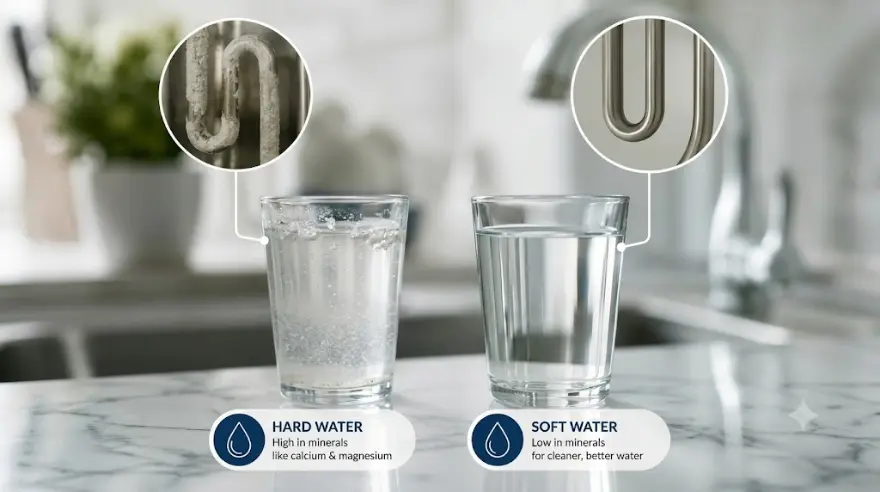
Hard water is water that carries a high concentration of dissolved minerals — mainly calcium and magnesium. Rain is naturally soft, but as it soaks through the limestone, shale, and sandstone under Southwestern Pennsylvania, it dissolves those minerals and carries them into wells and municipal supplies alike.
There are two forms. Temporary hardness comes from calcium and magnesium bicarbonates and can partly drop out as scale when water is heated. Permanent hardness comes from sulfates and chlorides and stays dissolved no matter what — it only comes out with treatment. Either way, the "hardness" is simply how much of those minerals your water is carrying.
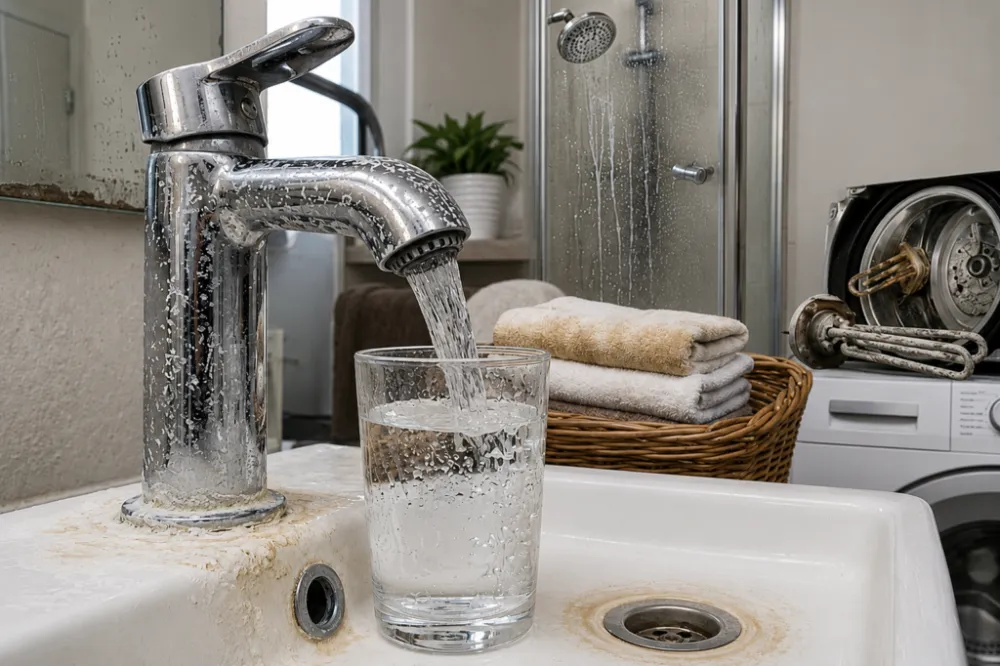
Hard water shows up on your body, your fixtures, and inside your plumbing:
Hardness is measured in grains per gallon (GPG) or milligrams per liter (mg/L, also called ppm). The conversion is simple: 1 GPG = 17.1 ppm. Here is the standard scale:
| Classification | Grains per gallon | ppm (mg/L) | What homeowners typically notice | Common considerations |
|---|---|---|---|---|
| Soft | 0 – 1.0 | 0 – 17 | Nothing — soap lathers easily, no scale | No hardness treatment needed |
| Slightly hard | 1.0 – 3.5 | 17 – 60 | Faint spotting on glassware | Usually a preference decision rather than a plumbing one |
| Moderately hard | 3.5 – 7.0 | 60 – 120 | Visible spotting, more soap and detergent used | Homeowners often weigh appliance life and soap cost |
| Hard | 7.0 – 10.5 | 120 – 180 | Scale on fixtures and in the water heater, film on skin | Property protection becomes the main argument |
| Very hard | 10.5+ | 180+ | Persistent scale, shortened water-heater and fixture life | Most homes at this level treat it; it remains the homeowner’s decision |
Much of Southwestern Pennsylvania — both municipal water and private wells — tests in the hard to very hard range, and many wells across Westmoreland, Washington, and Butler counties run well above 10–15 GPG. A quick test tells you exactly where your home lands on this scale.
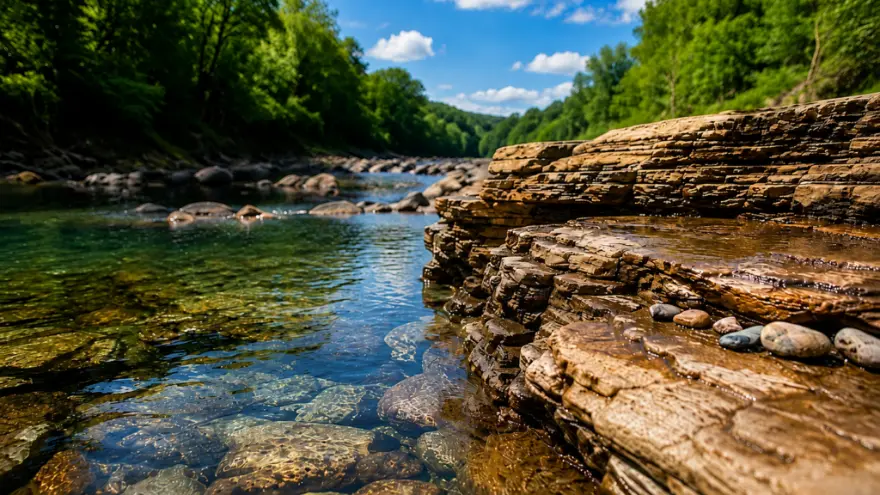
Our region sits on limestone, shale, and sandstone — rock that's rich in exactly the minerals that make water hard. As groundwater moves through these formations, carbon dioxide in the water slowly dissolves calcium and magnesium carbonate out of the rock and carries it along.
That's why hard water shows up on both sides of the meter here: private wells pull it straight from the aquifer, and municipal supplies draw from the same mineral-rich sources. We see hard to very hard water constantly across Allegheny, Westmoreland, Washington, Butler, Beaver, Armstrong, Indiana, and Fayette counties.
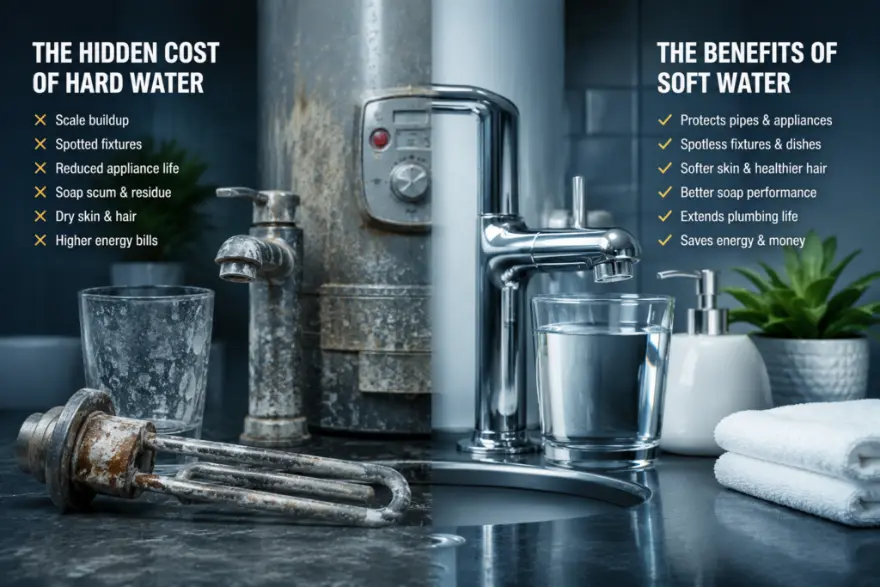
For most people, yes. The calcium and magnesium in hard water aren't a health hazard — the EPA regulates hardness as an aesthetic (secondary) issue, not a health one, and both minerals are things our bodies actually use. If anything, hard water contributes a small amount of dietary calcium and magnesium.
The real cost of hard water is everything it does around your home: scale that shortens the life of water heaters and appliances, spotting and film on dishes and glass, soap scum, dry skin and hair, and slow, scaled-up plumbing. Softening doesn't make your water "safer" to drink — it protects your home, your appliances, and your comfort.
The same tasks get easier — and your home lasts longer — once the minerals are out:
| Hard Water | Soft Water | |
|---|---|---|
| Soap & lather | Won't lather; leaves scum | Rich lather; rinses clean |
| Dishes & glass | Cloudy, spotted | Clear, spot-free |
| Skin & hair | Dry, filmy | Softer, cleaner feel |
| Appliances & water heater | Scale, early failure | Run efficiently, last longer |
| Plumbing | Scale narrows pipes | Stays clear |
| Laundry | Stiff, faded | Softer, brighter |
Not every mark on your fixtures is hard water. Matching the color to the cause tells you what treatment you actually need:
| Hard Water Scale | Iron | Manganese | |
|---|---|---|---|
| Color | White / chalky | Orange, red, rust | Black, dark brown |
| Texture | Crusty mineral scale | Rust film or particles | Slick dark film |
| Cause | Calcium & magnesium | Dissolved iron | Dissolved manganese |
| Treatment | Water softener / conditioner | Iron removal system | Manganese removal system |
Seeing orange instead of white? See our iron removal guide. Black or brown stains? See our manganese removal guide. Many Southwestern PA homes have more than one of these at once — which is exactly why we test before recommending anything.
Ion exchange pulls out the calcium and magnesium behind scale, spotting, and dry skin — here’s what happens inside the tank.
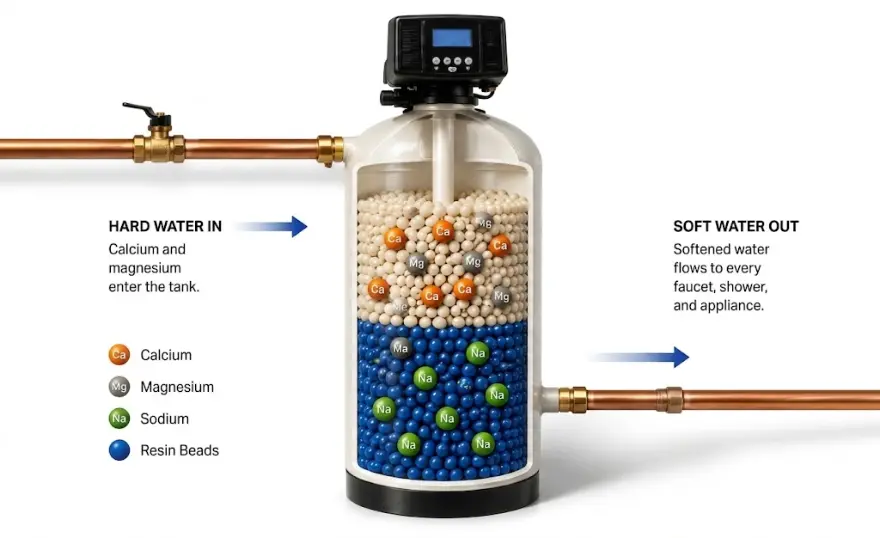
The Ion Exchange Process
Hard water flows down through thousands of resin beads that carry a negative charge. The positively charged calcium and magnesium stick to the beads and are swapped for sodium — so the water leaving the tank is soft. On an automatic cycle, the system flushes the captured hardness away with brine and recharges the resin.
Searching for a “salt-free water softener”? There are really two technologies. A water softener removes the hardness minerals; a salt-free conditioner leaves them in but changes how they behave to cut scale. We recommend whichever fits your water and your goals — not a sales quota.
| Salt-Based Water Softener (Ion Exchange) | Salt-Free Conditioner (TAC) | |
|---|---|---|
| What it does | Removes hardness minerals (calcium & magnesium) from the water | Leaves the minerals in the water and changes how readily they stick to surfaces |
| Removes hardness? | Yes — measured hardness drops | No — measured hardness is unchanged |
| Scale buildup | Removed at the source — the minerals are gone | May reduce how much scale adheres; results vary with water chemistry and temperature |
| Spotting on dishes & glass | Virtually eliminated | Not reliably eliminated — the minerals that cause spotting are still present |
| Soap lather | Full soft-water lather | Unchanged — lather depends on hardness being removed |
| Shower & water feel | Classic soft, silky feel | Feels the same as untreated water; hardness is unchanged |
| Hair & skin | Soft-water feel | Unchanged; the calcium and magnesium remain in the water |
| Maintenance | Add salt periodically | Virtually maintenance-free; no salt |
| Best for | Removing hardness: lather, spotting, scale and appliance protection | Reducing scale adhesion where salt, a drain line or a discharge restriction rules out a softener |
After installing water treatment systems throughout Southwestern Pennsylvania, we’ve found both technologies have their place. A properly sized softener gives the most complete hard-water treatment by removing the minerals entirely. A quality salt-free conditioner can be an excellent choice for many municipal-water homes — customers regularly report less scale, cleaner glassware, better soap performance, more comfortable showers, and no salt to buy or brine tank to maintain. The right call comes down to your water test and what matters most to you.
ProblemVery hard well water with elevated iron and manganese, coliform and E. coli bacteria, and high TDS — scale on fixtures and appliances alongside staining and contamination.
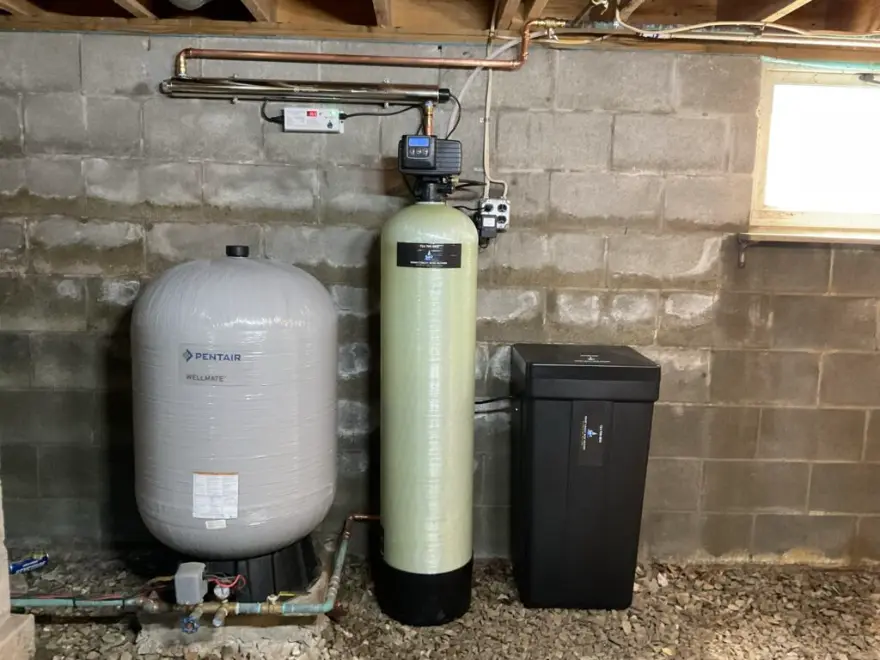
SolutionOne connected system: a properly sized water softener for the hardness, iron and manganese filtration ahead of it, a disinfection stage, and reverse osmosis for drinking water — engineered to the well’s chemistry rather than sold as a package.
ResultsHardness, iron and manganese all below the field method’s reporting limits on the retest; fixtures clear and scale-free. Bacteria clearance is confirmed by the homeowner’s accredited laboratory retest, not by our field testing.
A private well in Southwestern Pennsylvania measured very hard, with elevated iron and manganese and high total dissolved solids on our on-site field analysis, plus a laboratory bacteria result already on file. Rather than dropping in a single softener, we engineered one connected system sized to the well’s actual chemistry. Exact before and after hardness figures for this property are being confirmed with the homeowner before publication.
“After years of hard-water issues, this was a game changer — the difference in our hair, skin, and the taste has been incredible.”
Sean Walker — Monroeville, PA · Google review (a separate customer, not the well above)Every claim on this page traces back to a primary source — regulators, accredited standards bodies and the utilities that publish local water quality.
Reviewed July 2026 by Lance Cesare, third-generation water-treatment specialist. Water testing referenced on this page is on-site field analysis performed by Cesare’s Quality Water Solutions, not certified laboratory analysis. Bacteria, lead, nitrate, PFAS and disinfection by-product results require an accredited laboratory and are not published from field methods.
More answers in our Water Softener Knowledge Center.